Ancient Egypt's Pyramids: How Many There Are and Which to Visit
Egypt has well over a hundred pyramids, not three. A 2026 guide to every major pyramid field, the thousand-year evolution of pyramid building, and which ones reward your time.
Most visitors arrive in Egypt believing there are three pyramids. There are well over a hundred: a chain of royal tombs running for roughly 70 kilometres down the west bank of the Nile, built and refined over a thousand years, of which Giza represents a single spectacular generation near the beginning. Several of the others are more interesting to walk through than Giza, most are almost empty of tourists, and a few are masterpieces that barely feature in guidebooks.
This article takes the national view. If you want the Giza plateau in depth, that’s our complete Pyramids of Giza visitor guide, and for the practical side of getting there and getting in, our Giza Plateau guide. If you want to know which interior to climb into, see Inside the Great Pyramid. What follows is the bigger picture: how many pyramids there really are, how pyramid building evolved and then stopped, what’s at each site, and the practical question of which ones deserve your limited time.
TL;DR
- Egypt has at least 118 pyramids, with counts commonly cited between 118 and 138 and new discoveries still being made. The variation has real causes; it is not sloppiness.
- Sudan has more pyramids than Egypt: roughly 200 to 255 across Meroë, Nuri, El-Kurru and Jebel Barkal. The largest concentration of pyramids on earth is not in Egypt.
- After Giza, the sites that most reward a visit are Dahshur (two enterable pyramids, almost no crowds), Saqqara (the Step Pyramid, the Pyramid Texts, the Serapeum) and Meidum (strange, dramatic, and enterable). Verify current access and pricing before booking anything, because Egyptian site access changes frequently.
How Many Pyramids Are There in Egypt?
The straight answer is “at least 118, and the number keeps moving.” Figures between 118 and 138 are commonly quoted by reputable sources, and you’ll see higher numbers too. This is not because nobody has counted. It’s because the question is harder than it sounds.
Three reasons the count varies:
Definitional problems. What counts as a pyramid? Egypt’s kings built pyramids, but so did queens: dozens of small subsidiary “queens’ pyramids” cluster around the royal ones at Giza, Dahshur and Saqqara. Some lists count them, some don’t. Then there are the satellite or cult pyramids, small ritual structures beside the main tomb, and the tiny provincial step pyramids of the Third Dynasty, scattered across Egypt, which appear to have had no burial function at all.
Ruin. Many pyramids, especially the mudbrick-cored Middle Kingdom ones, have collapsed into low mounds of rubble that are hard to tell from a natural hillock at a glance. Whether an eroded heap “is” a pyramid is a judgement call. Some structures were abandoned part-built and never rose above their foundation platforms.
Ongoing discovery. Pyramids are still being identified. Egyptian and international missions continue to work the necropolises south of Cairo, and satellite and radar survey has flagged candidate structures under the sand. Any number published today is a snapshot.
The practical takeaway for a traveller: forget the exact figure. What matters is that pyramid building was a national, thousand-year programme, not a one-off feat at Giza, and that a dozen or so of the surviving sites are visitable.
The surprise: Sudan has more
Here’s the fact that reliably astonishes people. Sudan, not Egypt, has the most pyramids in the world. Estimates run from around 200 to 255, concentrated in ancient Nubia at Meroë, Nuri, El-Kurru and Jebel Barkal.
They were built by the kings and queens of Kush, who ruled Egypt themselves as the 25th Dynasty (the “Black Pharaohs”) and then, back in their Nubian heartland, continued building pyramids for around a thousand years after Egypt had abandoned the form. Nubian pyramids look different: much smaller, far steeper (sides often around 70 degrees against Egypt’s roughly 51), and built in dense clusters with an offering chapel attached to the east face. The royal cemetery at Meroë is a UNESCO World Heritage Site and one of the most extraordinary and least-visited archaeological landscapes on earth.
They are not remotely accessible from a Cairo day trip, though, and travel advice for Sudan has been severely restricted in recent years. They belong here as context, and as a reason the phrase “Egyptian pyramids” undersells the story.
Other Experiences You Might Enjoy
The pyramid fields are one strand of a visit to northern Egypt. Around them sit the Grand Egyptian Museum and its Tutankhamun galleries, the Great Sphinx at Giza, the ruins of Memphis with its colossus of Ramses II, the bazaars of Khan el-Khalili and the churches of Coptic Cairo, and from the Red Sea coast, day trips to Luxor and the Valley of the Kings.
A Thousand Years of Pyramid Building
The pyramids were not invented; they were developed, through a traceable sequence of experiments, failures and refinements. This is the spine of the story, and knowing it changes a visit to the lesser sites, because you can see the engineering problem being solved in front of you.
Before pyramids: the mastaba
Early Dynastic kings and nobles were buried under mastabas: low, flat-roofed, rectangular mudbrick superstructures over a burial shaft, the name coming from the Arabic for “bench.” They were substantial but earthbound. Everything that follows is an attempt to build upward.
The Step Pyramid of Djoser, Saqqara (c. 2670 BC)
The breakthrough. The Third Dynasty king Djoser and his architect Imhotep (later deified, and one of the very few ancient Egyptian commoners whose name survives) began with a large stone mastaba and then did something nobody had done: they stacked progressively smaller mastabas on top of it, six in all, to roughly 60 metres.
Two innovations matter here. First, the step form itself, a stairway to the sky. Second, and arguably more important, the decision to build in dressed stone instead of mudbrick, at monumental scale, for the first time in human history. The whole enclosure, a walled complex of courtyards, chapels and dummy buildings whose stone columns imitate bundled reeds, is the world’s oldest large-scale stone architecture.
The Step Pyramid reopened to visitors in March 2020 after a fourteen-year restoration following earthquake damage; the substructure and the Southern Tomb have also been opened at various points. Interior access is periodic and subject to conservation closures, so confirm before you rely on it.
The transitional experiments
Djoser’s success prompted imitation and failure in roughly equal measure. Sekhemkhet’s buried step pyramid at Saqqara never rose far above its foundation. The Layer Pyramid at Zawyet el-Aryan was similarly abandoned. A scatter of small provincial step pyramids, at Elephantine, Edfu, Naqada and elsewhere, appear to have been symbolic royal markers, not tombs. This is a period of a form being tested and not yet mastered.
Sneferu and the invention of the true pyramid
The single most inventive reign in the history of pyramid building belongs to Sneferu, founder of the Fourth Dynasty and father of Khufu, who built three pyramids and in the process solved the true-pyramid problem.
Meidum came first: begun as a step pyramid and then, in an attempt at a smooth-sided form, filled in and cased. It failed. Today it stands as a strange, dramatic three-stepped tower rising from a vast skirt of its own collapsed rubble, which is why locals call it el-haram el-kaddab, “the false pyramid.” Whether it collapsed during construction or centuries later is still argued.
The Bent Pyramid at Dahshur is the most visually striking failure-in-progress anywhere in Egypt. It rises at a steep angle of about 54 degrees and then, roughly halfway up, abruptly changes to a shallower 43, almost certainly because the builders detected instability and reduced the load mid-construction. It also uniquely retains much of its original polished limestone casing, so it gives the best surviving impression of how a finished pyramid looked.
The Red Pyramid, also at Dahshur and named for the pinkish tone of its exposed limestone, was built at the safer shallow angle from the ground up, and it worked. It is the world’s first successful true smooth-sided pyramid, and everything at Giza is built on the lessons learned across Sneferu’s three attempts.
The Fourth Dynasty apogee: Giza
Khufu, Khafre and Menkaure took the perfected form and built it at a scale never attempted before or since. That story is told in full in our Pyramids of Giza visitor guide and covered further in Inside the Great Pyramid and the Great Sphinx of Giza.
The outlier deserves a note here: Djedefre’s pyramid at Abu Rawash, the northernmost in Egypt, built by Khufu’s immediate successor on a high hilltop north of Giza. It survives as a ruin, heavily quarried in Roman times, and whether it was ever completed is debated. Its elevated site would have made it the highest pyramid in Egypt in absolute terms even though it was smaller.
The Fifth Dynasty at Abusir: smaller pyramids, better reliefs
Something changes in the Fifth Dynasty. The pyramids at Abusir (Sahure, Neferirkare, Nyuserre and others) are markedly smaller and much more shoddily built, with rubble-and-mortar cores that have slumped badly. Historians read this as a shift in royal power and resources, and a shift in emphasis: these kings poured their effort into solar temples and into the exquisite relief decoration of their mortuary temples, not into sheer mass.
Abusir also gave us the Abusir Papyri, the temple archives from Neferirkare’s complex, which are among our richest sources on how Old Kingdom temple administration, rotas and accounting worked.
Unas and the Pyramid Texts (c. 2350 BC)
The most important thing inside any Egyptian pyramid is not treasure. It is writing.
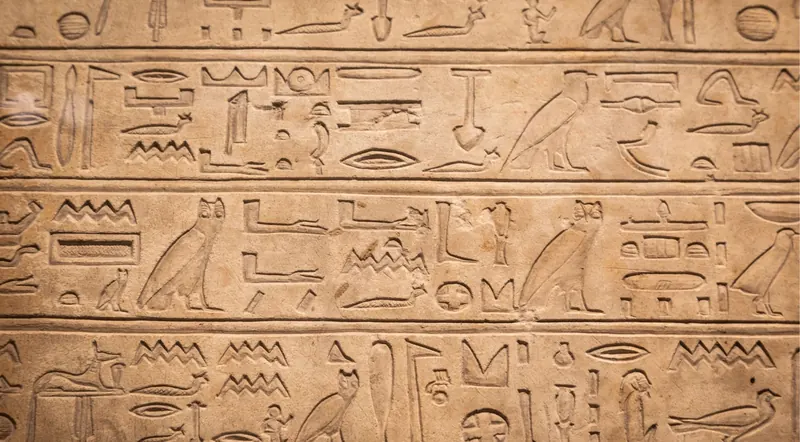
The small, unremarkable-looking pyramid of Unas at Saqqara, last king of the Fifth Dynasty, contains the first appearance of the Pyramid Texts: spells carved in columns of hieroglyphs across the burial chamber walls to guide the king’s soul into the afterlife. They are the oldest known corpus of religious writing in the world, predating the Book of the Dead by centuries and the major world scriptures by far longer. Later Sixth Dynasty kings, Teti, Pepi I and Pepi II, followed suit.
Standing in Unas’s cramped chamber, surrounded by blue-painted hieroglyphs, moves most people more than standing in the bare granite box at the top of the Great Pyramid. It is one of the most underrated experiences in Egypt.
The Middle Kingdom revival, and why it melted
After the collapse of the Old Kingdom, the Twelfth Dynasty revived pyramid building at Lisht (Amenemhat I, Senusret I), Lahun (Senusret II), Hawara (Amenemhat III) and Dahshur (the Black Pyramid). But they built differently: a core of mudbrick with a limestone casing, faster and cheaper than solid stone.
The casing was stripped in later centuries, and without it the mudbrick cores dissolved. This is why the Middle Kingdom pyramids look like slumped brown hills today, the same reason they’re mostly ignored by visitors, and the reason they’d be unrecognisable to their builders. What survives instead is their ingenuity underground: Hawara and Lahun in particular have elaborate anti-robbery designs, blind passages, trapdoor stones and concealed entrances placed on unexpected faces. Amenemhat III’s mortuary complex at Hawara was the vast structure Herodotus called the Labyrinth, which he claimed surpassed even the pyramids; almost nothing of it survives above ground.
Why pyramid building stopped
By the New Kingdom the pyramid had been abandoned for royal burials. The reason is usually and plausibly given as security: a pyramid is an enormous signpost saying “treasure here,” and every single one had been robbed. From Thutmose I onward, kings hid their tombs instead, cut into the rock of the Valley of the Kings at Thebes, beneath a natural pyramid-shaped peak (el-Qurn) that arguably did the symbolic work the built pyramid used to do.
The form didn’t vanish entirely: the workmen of Deir el-Medina capped their own tomb chapels with small mudbrick pyramids, and centuries later the Nubian kings revived pyramid building on a grand scale in what is now Sudan.
Egypt’s Pyramid Fields: A Practical Guide
| Site | Location / distance from Cairo | Key pyramids | Can you go inside? | Worth visiting? |
|---|---|---|---|---|
| Giza | Giza, ~13–20 km | Khufu, Khafre, Menkaure | Yes (separate tickets) | Essential |
| Saqqara | ~30 km south | Step Pyramid (Djoser), Unas, Teti | Yes: Step Pyramid substructure, Unas, Teti (verify) | Essential |
| Dahshur | ~40 km south | Bent, Red, Black | Yes: Bent & Red (Black closed) | Highly recommended |
| Meidum | ~100 km south | Meidum (“false”) Pyramid | Yes | Recommended: dramatic and quiet |
| Abusir | Between Giza & Saqqara | Sahure, Neferirkare, Nyuserre | No | Access uncertain, verify |
| Abu Rawash | ~8 km north of Giza | Djedefre | Ruin only | Specialists only |
| Zawyet el-Aryan | Near Giza | Layer Pyramid, Unfinished Pyramid | No | Not accessible |
| Hawara | Fayoum, ~100 km | Amenemhat III | Partly (flooded) | For enthusiasts |
| Lahun | Fayoum, ~100 km | Senusret II | Yes | For enthusiasts |
| Lisht | ~65 km south | Amenemhat I, Senusret I | No | Drive-by only |
Saqqara
The single richest archaeological site in Egypt after Giza, and the one most visitors give too little time. Beyond the Step Pyramid and its enclosure, Saqqara holds the Pyramid of Unas with its Pyramid Texts, the Pyramid of Teti, the spectacular painted Mastaba of Ti, the Serapeum (the vast rock-cut galleries of the mummified Apis bulls, in colossal granite sarcophagi), and the small, excellent Imhotep Museum. Allow at least half a day. Which tombs and interiors are open rotates constantly: ask your guide on the day, and specifically ask for the Serapeum and Unas, which are often quietly omitted from standard itineraries. The Saqqara, Memphis and Dahshur day trip from Cairo (rated 4.7/5 from more than 350 reviews) covers the Step Pyramid, Memphis and Dahshur’s Red and Bent Pyramids in one guided day with lunch.
Dahshur
Our pick for the best pyramid experience outside Giza. Two enormous pyramids you can walk right up to, both enterable on standard site admission (unlike Giza, where interiors are separately ticketed), and often almost no other tourists. The Red Pyramid’s descent is long, steep and low, opening into tall corbelled chambers; the smell of ammonia from bat colonies is notorious and puts some people off. The Bent Pyramid was reopened to visitors in 2019 and is, for many, the more rewarding of the two. The Black Pyramid (Amenemhat III’s mudbrick Middle Kingdom attempt, which sank into the water table) is a striking dark ruin but closed to entry.
Not suitable for anyone claustrophobic or with knee, back or breathing problems: the passages are long, steep and cramped.
Meidum
Around 100 km south of Cairo, and worth the drive for anyone who likes their archaeology strange. The three-stepped tower rising out of its own collapse debris looks like nothing else in Egypt, and you can go inside: a steep descent to a corbelled chamber. Nearby is the mastaba that produced the extraordinary painted statues of Rahotep and Nofret, now in the Egyptian Museum in Tahrir (see our museum comparison). Crowds are minimal.
Abusir: access is unclear
Be careful with Abusir. Sources published within the last two years directly contradict each other: some state it is open daily, others that it has been closed to tourism with viewing only from a distance, and others that entry requires a permit arranged in advance instead of a gate ticket. It has certainly been closed for long periods since 2012. Do not plan a trip around Abusir without confirming current access through a local operator first. If it is open, the ruins of Sahure’s mortuary temple are the highlight.
Abu Rawash, Zawyet el-Aryan and Lisht
Three for specialists. Abu Rawash (Djedefre) is a hilltop ruin with a fine view and little standing architecture. Zawyet el-Aryan has historically sat within a restricted military area and is generally not accessible. Lisht’s two Twelfth Dynasty pyramids are not open to the public, though they can be seen from the road en route to the Fayoum.
The Fayoum pyramids: Hawara and Lahun
Both are visitable and both are enterable, though Hawara’s underground chambers are flooded by a modern canal, so you can descend only a few steps. Lahun rewards the effort with a granite-lined burial chamber and sarcophagus. Note a practical wrinkle: visitors to the Fayoum Governorate are frequently accompanied by a police escort, which is routine and not a cause for concern but does affect timing and flexibility. Hawara, Lahun and Meidum combine naturally into one long day from Cairo.
Planning to go beyond Giza? The lesser pyramid fields need a private car and a guide who knows which interiors are open on the day; public transport doesn’t realistically serve them. The Saqqara, Memphis and Dahshur day trip handles both for the two sites most people add. Compare Cairo day trips and excursions and Cairo pyramids tours, and always verify current pricing and inclusions before booking.
Which Pyramids Are Worth Visiting?
A ranked list, with our reasons.
- Giza: non-negotiable for a first visit. The scale is the point, and nothing prepares you for it.
- Saqqara: the Step Pyramid, the Pyramid Texts and the Serapeum together make this the most historically rich pyramid site in Egypt.
- Dahshur: the best interior experience, the best sense of what a finished pyramid looked like (the Bent Pyramid’s casing), and blissfully few people.
- Meidum: visually the strangest, enterable, and almost empty.
- Hawara and Lahun: for enthusiasts who want the Middle Kingdom story and don’t mind a long day.
- Abusir: potentially wonderful, but only if access is confirmed.
- Abu Rawash, Zawyet el-Aryan, Lisht: specialists only, or not accessible at all.
Best for first-timers: Giza, then Saqqara. Best for repeat visitors: Dahshur and Meidum. Best interiors: Dahshur (Red and Bent) and Unas at Saqqara for the texts. Best for avoiding crowds: Dahshur, Meidum, the Fayoum pyramids. Best photography: the Bent Pyramid’s casing in low sun; Meidum’s tower; Djoser’s stepped profile. Best for the architecture story: Saqqara → Meidum → Dahshur → Giza, visited in that order, is the evolution of the pyramid told in four sites.
Suggested itineraries
- One day of pyramids: Giza plateau plus the Grand Egyptian Museum. See our one-day Cairo itinerary.
- Two days: Day one Giza and the GEM; day two Saqqara, Memphis and Dahshur, which is exactly the route of the Saqqara, Memphis and Dahshur day trip. If you would sooner fold Giza into the same day, the Giza, Sphinx, Saqqara & Memphis tour from Cairo combines them at a faster pace.
- Three days: Add Meidum, or a Fayoum day taking in Hawara and Lahun.
Pyramid Facts to Know Before You Go
The Seven Wonders, and why only one survives
The “seven wonders of the ancient world” was a Hellenistic Greek travel list, and the Great Pyramid is the only survivor.
| Wonder | Location | Fate |
|---|---|---|
| Great Pyramid of Giza | Egypt | Still standing |
| Hanging Gardens of Babylon | Iraq (existence disputed) | Vanished; may never have existed |
| Statue of Zeus at Olympia | Greece | Destroyed, probably by fire |
| Temple of Artemis at Ephesus | Turkey | Destroyed by arson and raids |
| Mausoleum at Halicarnassus | Turkey | Destroyed by earthquakes |
| Colossus of Rhodes | Greece | Toppled by earthquake, later sold for scrap |
| Lighthouse of Alexandria | Egypt | Destroyed by earthquakes; stone reused in Qaitbay Citadel |
Two were in Egypt, which is why “a seven wonders trip” tends to start here. The Lighthouse’s remains lie in Alexandria harbour and its stone is visible in the Citadel of Qaitbay.
Why a pyramid shape?
The form is solar and cosmological. Egyptian creation myth begins with the primeval mound rising from the waters of chaos, and the benben, a sacred conical or pyramidal stone at Heliopolis, represented both that mound and the sun’s first rays. A pyramid is a mound made permanent and a ramp of sunlight made solid. The polished capstone (pyramidion) at the apex, sometimes gilded, would have caught the first and last light of every day.
A pyramid is not a building; it’s a complex
The single most useful thing to understand before visiting. Every proper pyramid was one element of a funerary complex: a valley temple at the water’s edge where the king’s body arrived by boat, a covered causeway climbing to the desert, a mortuary temple against the pyramid’s east face where the cult of the dead king was maintained, a small satellite pyramid, boat pits, and an enclosure wall. At Giza, Khafre’s valley temple survives magnificently; at most other sites you’re looking at foundations. Once you can read the layout, ruined sites become legible instead of shapeless.
What they originally looked like
Not tan stepped stone but smooth, gleaming white: cased in fine polished Tura limestone, blindingly bright in the desert sun, some with granite lower courses and gilded capstones. The casing was stripped over centuries, much of it after a major earthquake in 1303 loosened it, and reused in Cairo’s mosques and walls. To see the real thing, look at the apex of Khafre’s pyramid at Giza and, better, the lower flanks of the Bent Pyramid at Dahshur.
Further Reading
For readers who want to go deeper, these are the standard works, authoritative and not gift-shop fare:
- Mark Lehner, The Complete Pyramids: the single best one-volume reference, site by site, superbly illustrated. If you buy one book, buy this.
- Miroslav Verner, The Pyramids: the great scholarly survey, by the Czech Egyptologist who excavated Abusir for decades. Denser than Lehner, and excellent on the lesser sites.
- Toby Wilkinson, The Rise and Fall of Ancient Egypt: the best single-volume narrative history for placing the pyramids in their political context.
- Zahi Hawass has written extensively on Giza and the workers’ village from the excavator’s perspective.
- Kara Cooney, The Woman Who Would Be King (on Hatshepsut) and When Women Ruled the World: excellent on Egyptian kingship, though not pyramid-focused.
- John Romer, The Great Pyramid: Ancient Egypt Revisited: a detailed, sometimes contrarian study of Khufu’s construction.
The Hurghada Angle
If you’re based on the Red Sea, geography is limiting. A day trip from Hurghada to Cairo is roughly five to six hours’ drive each way, or a one-hour flight plus transfers; see our Cairo day trip from Hurghada pillar and the Hurghada to Giza guide.
On a single day, that realistically means Giza and the Grand Egyptian Museum only, which is the route of the by-road Cairo & Giza Highlights Day Tour from Hurghada and the fly-in Cairo day trip with pyramids, Sphinx and museum. A fly-in day trip buys enough hours that some operators add Saqqara and Memphis, but it makes for an intense day and you’ll see them at pace.
Everything else in this article (Dahshur, Meidum, the Fayoum pyramids, an unhurried Saqqara) needs you to base yourself in Cairo. A two-day extension unlocks Saqqara and Dahshur; three days adds Meidum or the Fayoum. If the pyramids beyond Giza interest you, that extension is the single best upgrade you can make to an Egypt trip.
Ready to plan? A guided day trip from Hurghada covering the Giza plateau, the Sphinx and the Grand Egyptian Museum is the efficient way to see the headline sights in one day, and if you can add a night in Cairo, Saqqara and Dahshur become possible. Compare options and check recent reviews before booking.
Frequently Asked Questions
How many pyramids are there in Egypt? At least 118, with figures between 118 and 138 commonly cited and new identifications still occurring. The variation comes from disagreements over what counts (queens’ and satellite pyramids, provincial step pyramids), the difficulty of identifying badly ruined structures, and ongoing discovery.
Which country has the most pyramids? Sudan, with roughly 200 to 255, far more than Egypt. They were built by the Kushite kings and queens at Meroë, Nuri, El-Kurru and Jebel Barkal, and are smaller and much steeper than Egyptian pyramids.
What is the oldest pyramid in Egypt? The Step Pyramid of Djoser at Saqqara, built around 2670 BC by the architect Imhotep. It is also the world’s oldest large-scale stone building.
What was the first true (smooth-sided) pyramid? The Red Pyramid at Dahshur, built by Sneferu: his third attempt, after Meidum failed and the Bent Pyramid had to change angle mid-construction.
Which pyramids can you go inside? At Giza: Khufu, Khafre and (usually) Menkaure, each on a separate ticket. At Dahshur: the Red and Bent Pyramids, included in site admission. At Saqqara: the Step Pyramid substructure, Unas and Teti when open. Also Meidum and Lahun. Access rotates, so verify on the day.
Are the Pyramids of Giza the best ones to visit? For scale and impact, yes, and no first-time visitor should skip them. But for the best interior experience, the fewest crowds and the clearest sense of how pyramids evolved, Dahshur and Saqqara are arguably more rewarding.
Which pyramid has writing inside it? The Pyramid of Unas at Saqqara, which contains the earliest Pyramid Texts, the oldest known religious writings in the world, from around 2350 BC. Several Sixth Dynasty pyramids at Saqqara have them too.
Why is the Bent Pyramid bent? Its angle changes from about 54 to 43 degrees roughly halfway up, almost certainly because the builders detected structural instability and reduced the load. It also retains much of its original casing, so it shows better than anything else what a finished pyramid looked like.
Why did the Egyptians stop building pyramids? Primarily security: every pyramid was robbed, and a pyramid advertises its own location. From the New Kingdom, kings hid their tombs in the Valley of the Kings instead, beneath a naturally pyramid-shaped peak.
Why do the Middle Kingdom pyramids look like piles of mud? Because they largely are. Twelfth Dynasty builders used mudbrick cores with limestone casings; once the casing was quarried away, the cores eroded into shapeless mounds.
Is Abusir open to visitors? Unclear. Recent sources contradict each other: some say open, some say closed with distance viewing only, some say permit-only. It has been closed for extended periods. Confirm with a local operator before planning around it.
Can I visit the pyramids beyond Giza on a day trip from Hurghada? Only marginally. A one-day trip realistically covers Giza and the GEM; a fly-in trip can sometimes add Saqqara and Memphis. Dahshur, Meidum and the Fayoum pyramids need you to stay in Cairo.
What’s the best book about the pyramids? Mark Lehner’s The Complete Pyramids is the standard one-volume reference and the best starting point. Miroslav Verner’s The Pyramids is the deeper scholarly survey.
What did the pyramids originally look like? Smooth and gleaming white, cased in polished Tura limestone with granite at the base of some and gilded capstones, not the stepped tan stone you see today. The casing was stripped over centuries and reused in medieval Cairo.
How long do I need to see the main pyramid sites? One day for Giza plus the GEM; two days to add Saqqara and Dahshur; three to include Meidum or the Fayoum.
See the Pyramids of Giza — One Full Day from Hurghada
Join 7,000+ travelers who rated this Cairo day trip 4.6/5. Hotel pickup, air-conditioned transport, an expert Egyptologist guide, and lunch are all included. Free cancellation up to 24 hours before you go.
Check Availability & Book