Cairo Day Trip from Hurghada: Everything You Need to Know
Planning a Cairo day trip from Hurghada? Compare bus vs plane tours, see the Pyramids, Sphinx & the new Grand Egyptian Museum, and learn what to book in 2026.
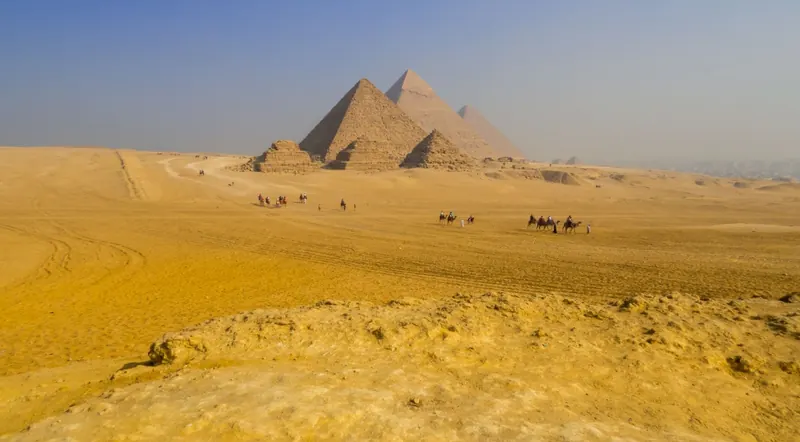
Standing on the Giza plateau in the shadow of the Great Pyramid — then walking the marble halls of the brand-new Grand Egyptian Museum — is entirely possible as a single day out from your Red Sea resort. A Cairo day trip from Hurghada is one of the most rewarding excursions in Egypt, but it is also one of the longest and most logistically demanding, and the way you do it matters enormously. This guide explains every option, what has changed in 2026, and how to choose the trip that suits you.
The single most important thing to know: since the Grand Egyptian Museum (GEM) fully opened, the classic Cairo itinerary has shifted. The world’s largest collection of Tutankhamun’s treasures is now displayed beside the pyramids, and most modern tours have re-routed accordingly. We cover exactly what is open below.
The Two Ways to Reach Cairo: Bus vs Plane
Hurghada sits on the Red Sea coast, roughly 450–460 km by road from Cairo. There is no passenger railway to Hurghada — trains in Egypt serve the Nile Valley (Cairo–Luxor–Aswan), not the Red Sea coast — so a same-day Cairo trip means either a long coach/car journey or a short domestic flight. (A Qena–Hurghada high-speed rail line is under construction but is not yet an operating passenger service.)
By road (coach or private car)
The drive follows the Zafarana coastal road north along the Red Sea, then turns inland through the Eastern Desert towards Cairo via the Suez region. Realistic driving time is roughly 5 to 6 hours each way, before you add hotel pick-ups, security checkpoints and Cairo’s notoriously heavy traffic. In practice the tour operators themselves describe the full road-based day as an 18–20 hour undertaking.
Pick-ups from Hurghada hotels typically begin in the small hours — commonly between around 00:30 and 02:30 — because the coach needs to reach Giza in the morning, complete the sightseeing, and drive all the way back the same day. Expect a shared coach to make several hotel stops at the start, adding time before you even leave town.
Convoys and checkpoints: the old system of compulsory armed police convoys for tourist vehicles has largely been phased out on this route, but you will still pass through multiple security checkpoints, and delays there are common. Coaches do not require a special permit; private tourist cars are logged at checkpoints and drivers carry the necessary paperwork. You must carry your passport (or a copy) for these checks. Night-driving restrictions have historically applied on some desert roads, which is one reason road tours are timed the way they are.
By plane
The fastest option by far. The Hurghada International Airport (HRG) to Cairo International Airport (CAI) hop covers just 401 km (249 miles) and takes roughly 1 hour 5 minutes to 1 hour 20 minutes. The route is exceptionally well served: it is flown nonstop by EgyptAir, Air Cairo, Nile Air and Nesma Airlines, with around 67 flights a week — an average of about ten a day — and departures spread right across the schedule (from just after midnight to late evening). Flying collapses the transit time so dramatically that the whole trip becomes roughly 12–16 hours door to door instead of 18–20, and — crucially — you are not exhausted from ten-plus hours in a coach seat.
Flight-based tours are structured around an early-morning departure and an evening return, giving a comfortable window of sightseeing in Cairo. Because timings depend on the exact flights your operator books, always confirm the specific departure and return times before you commit, and build in a buffer for domestic check-in.
Airports and terminals: EgyptAir uses Cairo’s Terminal 3 for its own flights, while other domestic and regional carriers (including Air Cairo and Nile Air) use Terminal 1; Terminal 2 also handles some domestic services. All three terminals are linked, but if a tour involves any terminal change, allow generous time. Note also that Cairo now has a second airport — Sphinx International Airport (SPX), west of the city and much closer to Giza and the GEM — but the Hurghada day-trip market still runs overwhelmingly through the main Cairo International Airport, so check which airport your flight actually uses.
Ready to compare? Read our dedicated breakdown in Hurghada to Cairo: Plane vs Bus before you book, and browse verified, free-cancellation options on our Cairo & Pyramids tours page.
Other Experiences You Might Enjoy
A Cairo day trip pairs naturally with more of Egypt and the Red Sea — from a Nile felucca sunset sail and the lantern-lit Khan el-Khalili bazaar in Cairo, to snorkeling and diving trips, desert safaris and Luxor excursions back on the Red Sea coast. If you have extra days around Hurghada, it’s worth browsing what else is on offer — we rank the options in our guide to Cairo day trips and excursions.
What a Typical Cairo Day Trip Includes
Whether you fly or drive, the Cairo sightseeing core is broadly the same. A well-run day trip focuses on a realistic handful of sites — trying to cram in everything is the classic mistake.
The standard itinerary
- Pyramids of Giza & the Great Sphinx — the centrepiece. You will see the three main pyramids (Khufu, Khafre and Menkaure), stop at a panoramic viewpoint for the classic photograph, and visit the Sphinx and the Valley Temple. Plan on roughly two to three hours on the plateau.
- The Grand Egyptian Museum (GEM) — the new flagship museum on the Giza plateau, about 2 km from the pyramids. Most current tours now include the GEM (see below). Allow at least three hours to do it any justice; guides typically budget two to three on a day trip.
- Lunch — usually an included buffet or set meal at a local restaurant, sometimes with a pyramid or Nile view.
- Optional Nile boat/felucca ride — frequently offered as a paid add-on rather than being included.
- A papyrus or perfume “workshop” stop — a near-universal feature of coach tours; it is a sales stop, and you are under no obligation to buy.
Some longer or private itineraries substitute or add the Egyptian Museum in Tahrir Square, Khan el-Khalili bazaar, Coptic or Islamic Cairo, or Saqqara and Memphis — but realistically you cannot combine all of these with Giza in one day, especially on a road trip — our one day in Cairo itinerary sets out what genuinely fits. Choose a tour whose stated itinerary matches your priorities rather than one promising an implausibly long list. If you stay a night or two, our list of things to do in Cairo covers the old city in detail.
GEM vs the old Egyptian Museum: what’s actually open in 2026
This is the single biggest recent change, so read carefully.
- The Grand Egyptian Museum held its official inauguration ceremony for world leaders and dignitaries on 1 November 2025, with full public opening on 4 November 2025. It is fully open in 2026, including the long-awaited Tutankhamun Galleries — a 7,500 m² space displaying all 5,398 artefacts from the boy king’s tomb together for the first time since Howard Carter’s 1922 discovery — plus the Khufu (solar) boat.
- Advance, timed-entry online booking is now mandatory for the GEM. Since 1 December 2025, tickets must be bought through the official portal (visit-gem.com / tickets.gem.eg) and on-site sales have ended, partly to manage crowds — the museum drew around 19,000 visitors a day in its first public week, peaking near 27,000 — with a daily visitor cap now in force. This is one reason a tour that bundles your GEM entry is genuinely convenient.
- The Egyptian Museum in Tahrir Square has not closed. It remains open as a historic museum with a vast collection, though its most famous headline pieces — Tutankhamun’s gold mask and treasures — have moved to the GEM, and the royal mummies are now at the National Museum of Egyptian Civilisation (NMEC). Tutankhamun’s mask is therefore at the GEM, not Tahrir.
The practical upshot: tours that once paired the pyramids with the Tahrir museum increasingly pair them with the GEM instead. When booking, check explicitly which museum is included, because both are still marketed and some listings are out of date.
Want the full picture before you go? See our detailed Hurghada to Pyramids of Giza day trip walkthrough, covering exactly what you’ll see at the plateau and the museum. For the museum on its own, see our Grand Egyptian Museum guide.
What’s included vs excluded
Inclusions vary, so scrutinise the listing. Typically included: hotel transfers, transport (coach or flight), an English-speaking Egyptologist guide, main entrance fees and lunch. Typically excluded or optional: entry inside a pyramid (a separate ticket, limited numbers daily), camel or horse rides, the Nile boat ride, drinks with lunch, tips/baksheesh, and occasionally the GEM ticket itself. We give qualitative pricing only in this guide — flight-based trips cost considerably more than coach trips, and private tours cost more than group departures — so always verify current pricing and exactly what is included before booking.
Practicalities You Need to Plan For
Best time of year
October to April is the comfortable window, with November to February the sweet spot for cooler days on the exposed plateau. Summer (May–September) is punishingly hot at Giza — regularly above 35°C by late morning — so any summer trip lives or dies on an early start. The GEM, being fully indoor and air-conditioned, is a genuine refuge in the heat. Our month-by-month best-time guide covers each month, the events and the best hour to reach Giza.
Ramadan and public holidays
Ramadan moves about 11 days earlier each year. In 2026, Egypt’s Dar al-Ifta al-Misriyya confirmed the first day of fasting as Thursday 19 February; Ramadan ended on 19 March, with Eid al-Fitr on Friday 20 March and a public holiday from 19 to 23 March. In 2027 it is expected to begin around 8 February, depending on the moon sighting. During Ramadan, opening hours can contract: museums have been reported opening roughly 9am–3pm and archaeological sites closing earlier than their standard 8am–4pm (the pyramids’ official listing gives no separate Ramadan hours, so check on the day); the GEM’s Ramadan hours are reported at around 9am–4pm. Traffic patterns shift too, with a rush before iftar. Tourism continues as normal, but timings are tighter, so confirm hours if travelling in this window. Egyptian public holidays can also affect traffic and site crowds.
Cairo traffic
Cairo traffic is relentless and unpredictable, and it is the main reason day-trip itineraries slip. This is a strong argument for flying (more buffer for sightseeing) and for keeping your itinerary realistic.
Visas — important for Hurghada visitors
Here is a crucial distinction. Visitors who enter Egypt via Sharm el-Sheikh can sometimes use a free, Sinai-only entry permit — but that permit is not valid for Cairo. Anyone travelling to Cairo needs a full Egyptian tourist visa, and Hurghada arrivals require a full visa anyway. Most nationalities can obtain either an e-Visa online (apply about a week ahead via the official portal, visa2egypt.gov.eg) or a visa on arrival at the airport; both allow a 30-day stay, and your passport must be valid for at least six months. Your visa status does not restrict domestic travel to Cairo once you are legally in the country — but do not attempt a Cairo trip on a Sinai-only permit. Always use the official portal, not third-party resellers.
Safety and travel advisories
The UK Foreign, Commonwealth & Development Office (FCDO) does not advise against travel to Hurghada, Cairo or the Giza pyramids. Its “advise against” zones lie elsewhere: all travel to within 20 km of the Egypt–Libya border (except El Salloum), all travel to the North Sinai Governorate, all-but-essential travel to the northern part of the South Sinai Governorate and to Ismailiyah east of the Suez Canal, and all-but-essential travel to much of the Western Desert — none of which the Hurghada–Cairo route crosses. Travelling against FCDO advice can invalidate your travel insurance, so it is worth checking the current wording before you go. Road accidents are a genuine risk on Egyptian highways, which is another reason to choose a reputable operator with well-maintained vehicles and professional drivers.
Currency, cash and tipping
Egypt’s currency is the Egyptian pound (EGP), which floats and has been volatile. ATMs are the best source of pounds; USD, EUR and GBP are accepted at many tourist-facing businesses and for some site tickets, but small local transactions need pounds. Card acceptance has improved but remains uneven, so carry cash. Crucially for a day trip, bring a supply of small-denomination notes: tipping (baksheesh) is woven into Egyptian service culture, and you will want small notes for washroom attendants, drivers, the guide, and anyone who helps. Bring clean, undamaged foreign notes if exchanging — worn bills are often refused.
Photography rules and fees
At the Giza plateau, personal phone and camera photography is fine and free — nobody should charge you a “photo permit” for personal snaps. Inside the GEM, personal photography is generally permitted in the main galleries (no flash, tripods, selfie sticks or drones), with some restrictions signposted in the Tutankhamun Galleries; a separate paid permit applies to professional/commercial gear. Some monument interiors and the Tahrir museum have their own camera rules and fees, so check on the day.
Scams and hassle at Giza
The Giza plateau is one of the most aggressively touristic environments in Egypt. Common tactics include the “free” gift or headscarf that turns into a demand for cash, the camel or horse ride whose agreed price mysteriously changes (“that was per person / per minute / extra to get down”), and unofficial “guides” who attach themselves to you and then present a bill. The rules of thumb: nothing is free, agree every price in full and in writing beforehand, keep small notes, and be politely firm. This is exactly where an organised tour earns its keep — with a pre-arranged licensed guide, prepaid tickets and hotel transfers, the entrance gauntlet becomes a brief walk-through rather than an ordeal. See our honest guides to camel rides at the pyramids and going inside the Great Pyramid.
Who this trip suits — and who should think twice
Be realistic about the length of the day. A coach trip can mean 20 hours with very early starts and long desert drives; even a flight trip is a full, tiring day.
- Children: doable, and many families do it, but the ultra-early wake-up and long transit are hard on young kids — flying helps a lot.
- Elderly, pregnant travellers, and those with mobility limitations: the combination of very long hours, uneven ground at Giza, and limited rest makes the flight option, or an overnight trip, strongly preferable; a private tour lets you set the pace.
- Motion sickness / long-drive comfort: the desert road is long and can be monotonous; if you are prone to travel sickness, fly, sit near the front, and bring remedies.
Bus vs Private Car vs Plane vs Overnight: How to Choose
Group coach day trip — the budget choice. Cheapest, sociable, but the longest and most tiring, with multiple hotel pick-ups, a fixed itinerary, larger groups and less time at each site. Best for cost-conscious travellers who don’t mind a marathon day.
Private car/minibus day trip — more comfortable and flexible than a coach, with a private guide who can adjust the itinerary, but still a very long road day. Best for families or small groups who want control without paying for flights.
Flight day trip — the best-value use of your time. Considerably more expensive than the coach, but it converts a brutal 20-hour slog into a manageable day and vastly more time on the ground. Best for anyone who values comfort, or is short on holiday days, or is travelling with children or older relatives.
Overnight (two-day) trip — the honest recommendation for many people. Spending a night in Cairo or Giza removes the clock-watching entirely: you can see the pyramids and the GEM without rushing, add Old Cairo, Khan el-Khalili or a Nile dinner cruise, and see the monuments at a civilised hour. If your schedule allows, an overnight is a far less exhausting and more rewarding way to experience Cairo than any single day can be.
A private guide (versus a large group) changes the day considerably: pace, flexibility, no waiting for stragglers, and far less exposure to touts. Most operators run these tours daily, though some flight departures have specific best-availability days — confirm when booking.
Booking Your Cairo Trip: Do It Online, in Advance
In Hurghada you will be offered Cairo trips by hotel reps, street agencies and beach touts, sometimes with heavy pressure and “today only” pricing. There is a better way. Booking online in advance is generally safer and better value: you get transparent pricing and inclusions, verified reviews, licensed operators, and — critically — free cancellation options and no doorstep pressure. If a seller demands immediate cash, refuses a receipt, or is vague about inclusions, walk away.
Before you book, check:
- Is it a flight or a road trip? (This changes the whole day.)
- Are entrance fees included — and specifically the GEM ticket?
- Which museum is included: the GEM at Giza or the Tahrir Egyptian Museum?
- Group size — large coach, small group, or private?
- Pick-up coverage — does it include your location? Reputable operators cover Hurghada, Makadi Bay, Sahl Hasheesh, El Gouna, Soma Bay and Safaga, sometimes with a small transfer supplement for outlying resorts.
- Cancellation policy and what happens if a flight time changes.
Book with confidence. Browse verified, free-cancellation Cairo day trips from Hurghada — by bus or plane — and plan your route with a realistic one-day Cairo itinerary.
Frequently Asked Questions
Is a Cairo day trip from Hurghada worth it? Yes — if seeing the pyramids and the Grand Egyptian Museum matters to you, it is worth the effort, especially by plane. Just go in with realistic expectations: this is a long, tiring day, not a relaxed one. If you can spare a night, an overnight trip is more comfortable.
How long is the trip? By road, expect an 18–20 hour day with pick-ups starting around 00:30–02:30. By plane, roughly 12–16 hours door to door, with a much gentler pace on the ground.
How far is Cairo from Hurghada? About 450–460 km by road (roughly 5–6 hours’ driving each way before checkpoints and Cairo traffic), or about a one-hour flight (401 km).
Is it safe to travel from Hurghada to Cairo? The FCDO does not advise against travel to Hurghada, Cairo or Giza. The main practical risks are road accidents and tourist scams, both mitigated by booking a reputable operator. Carry your passport for checkpoints.
Do I need a visa, and does the Sinai permit work for Cairo? You need a full Egyptian tourist visa (e-Visa or visa on arrival). The free Sinai-only permit issued to some Sharm el-Sheikh arrivals is not valid for Cairo — but Hurghada visitors need a full visa regardless.
Is the Grand Egyptian Museum open, and are the Tutankhamun galleries included? Yes. The GEM is fully open in 2026, including the Tutankhamun Galleries with all 5,398 tomb artefacts. Entry requires an advance, timed online booking — another reason to let a tour handle it.
Which museum will I visit — the GEM or the old Egyptian Museum? It depends on the tour. Most now include the GEM at Giza; the Tahrir Egyptian Museum is still open but no longer holds the Tut treasures. Confirm which one your booking covers.
Can I go inside the pyramids? Yes, but interior entry is a separate, limited ticket that is usually not included and often sells out. If it matters to you, book a tour that includes it or arrive early.
What should I bring and wear? Comfortable closed shoes, sun hat, sunglasses, high-SPF sunscreen, water, and modest clothing that covers shoulders and knees (respectful and practical). Bring your passport and a supply of small notes for tips.
Is the trip suitable for children or elderly travellers? It can be, but the length is demanding. For young children, older travellers, pregnant travellers or anyone with mobility issues, choose the flight or an overnight trip, ideally private.
Can I do it by train? No. There is no passenger rail line to Hurghada; trains serve the Nile Valley only. Your options are coach, private car or plane.
When is the best time to go? October to April, with November to February ideal. Avoid the peak summer heat if you can, and factor in reduced site hours during Ramadan (19 February–19 March in 2026; expected from about 8 February in 2027). Our month-by-month best-time guide has the detail.
See the Pyramids of Giza — One Full Day from Hurghada
Join 7,000+ travelers who rated this Cairo day trip 4.6/5. Hotel pickup, air-conditioned transport, an expert Egyptologist guide, and lunch are all included. Free cancellation up to 24 hours before you go.
Check Availability & Book