Egyptian Museum vs Grand Egyptian Museum: Which to Visit
Cairo now has three great Egyptology museums. A 2026 comparison of the Grand Egyptian Museum, the Egyptian Museum in Tahrir and NMEC, and which one to pick.
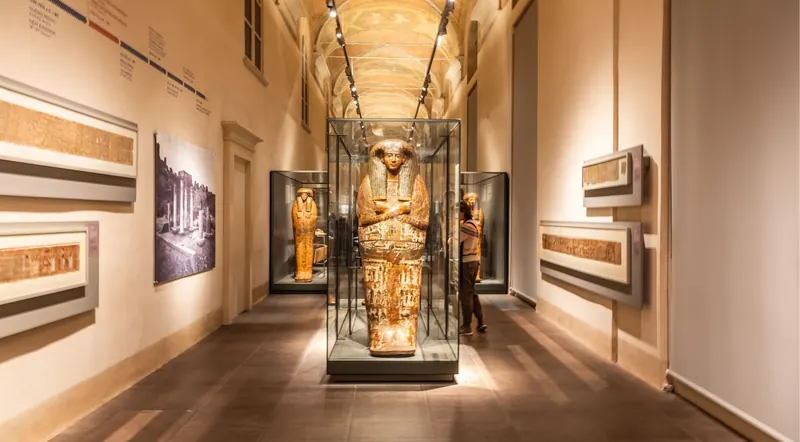
Cairo now has three world-class Egyptology museums instead of one, and the treasures have been redistributed between them, which means the old advice to “do the Egyptian Museum” is out of date. For most visitors with limited time, and especially for anyone day-tripping from Hurghada, the Grand Egyptian Museum is the right choice: it holds Tutankhamun’s complete collection and sits two kilometres from the pyramids. That verdict comes with real caveats, though, and the Egyptian Museum in Tahrir Square is far from the emptied-out husk some travellers now assume it to be.
This article is the decision guide. Because the GEM is covered in depth in our full Grand Egyptian Museum guide, most of the detail here goes to the Egyptian Museum in Tahrir and the National Museum of Egyptian Civilization (NMEC), the two museums travellers now know least about.
TL;DR
- Grand Egyptian Museum (GEM), Giza: the complete Tutankhamun collection including the gold mask, the Ramses II colossus, the Khufu solar boats, modern presentation, and a two-kilometre hop from the pyramids. The default choice.
- Egyptian Museum, Tahrir Square: still open, still extraordinary, and now considerably calmer. It has lost Tutankhamun and the royal mummies but retains the Narmer Palette, Khafre Enthroned, Rahotep and Nofret, the Amarna colossi and roughly 170,000 objects. The connoisseur’s museum.
- NMEC, Fustat: home to the royal mummies, and the only place to see them. Quiet, modern, and Cairo’s most underrated museum.
One day, one museum: GEM. Two days: GEM plus NMEC, or GEM plus Tahrir if you love old-school collections. Always verify current opening hours, ticketing and pricing before you go, because all three museums are in flux following the GEM’s November 2025 opening.
What Moved Where: The 2026 Position
Get this straight and everything else follows.
Tutankhamun’s complete collection, including the solid gold death mask, is now at the GEM. All 5,398 objects from the tomb are displayed together for the first time since Howard Carter’s 1922 discovery. The final 26 pieces still at Tahrir in mid-2025 (the mask, the innermost gold coffin, a gilded coffin, the gold dagger, the royal diadem and pectorals among them) were transferred ahead of the GEM’s grand opening on 1 November 2025, and the Tahrir museum’s Tutankhamun Gallery closed. If you read a source claiming the mask is still in Tahrir, it is out of date.
The royal mummies are at NMEC, moved in the televised “Pharaohs’ Golden Parade” of 3 April 2021. Tahrir no longer has a Royal Mummies Room.
Everything else, and it is a vast everything else, remains at Tahrir. Reporting around the transfer put the Tahrir museum’s remaining holdings at roughly 170,000 objects. Losing Tutankhamun and the mummies removed the two headline draws, but it did not empty the building.
Other Experiences You Might Enjoy
Museums are one part of a Cairo day. The Giza plateau adds the Great Pyramid of Khufu, the Pyramids of Khafre and Menkaure and the Great Sphinx, and elsewhere in the city are the bazaars of Khan el-Khalili, the churches and synagogue of Coptic Cairo and a Nile felucca sail at sunset.
The Egyptian Museum, Tahrir Square
A museum that is itself a historic monument
The institution traces to Auguste Mariette, the French Egyptologist appointed to halt the wholesale export of Egypt’s antiquities, who opened the first national collection at Bulaq in 1858. After flood damage the collection moved to a palace in Giza, and finally into the purpose-built neoclassical museum on Tahrir Square, designed by the French architect Marcel Dourgnon and opened in 1902. Mariette himself is buried in the garden, his sarcophagus watched over by a bust and a semicircle of busts of Egyptologists, a quiet, shaded spot most visitors walk straight past.
The building is part of the appeal. The distinctive salmon-pink facade, the soaring central atrium, the wrought-iron galleries and the wooden vitrines with handwritten cards are the physical fabric of Egyptology’s founding century. The layout is straightforward: the ground floor runs broadly chronologically, clockwise from the Old Kingdom through to the Graeco-Roman period, while the upper floor is arranged thematically by tomb group and subject.
What’s still there, and it’s a lot
This is the question that decides whether Tahrir is worth your time. The short answer: the museum retains an astonishing concentration of the objects that define ancient Egyptian art.
Old Kingdom masterpieces. The Narmer Palette, arguably the single most important artefact in Egyptian history, depicting the unification of Upper and Lower Egypt around 3100 BC, is a Tahrir centrepiece. So is the diorite Khafre Enthroned, with the Horus falcon enfolding the pharaoh’s head, found in the Valley Temple beside the Sphinx. The painted limestone statues of Rahotep and Nofret, with their unnervingly lifelike rock-crystal eyes, remain among the most arresting objects in any museum anywhere. Add the Menkaure triads, the Seated Scribe, the wooden Sheikh el-Balad (Ka-Aper), and the tiny ivory statuette of Khufu, barely three inches tall and the only known likeness of the man who built the Great Pyramid.
The Amarna collection. The colossal, elongated, faintly unsettling statues of Akhenaten from Karnak, along with Amarna-period reliefs and sculpture, form one of the museum’s great strengths. (Nefertiti’s famous painted bust is in Berlin, not Cairo, a longstanding source of Egyptian repatriation claims.)
Middle Kingdom and New Kingdom holdings. The painted wooden tomb models of granaries, boats and workshops; the Meidum Geese panel; the treasures of Yuya and Thuya (Tutankhamun’s likely great-grandparents, whose near-intact burial was the richest find before KV62); and the Tanis treasures, including the silver coffin of Psusennes I, which featured in a renovated wing unveiled in 2023.
Later periods. The Fayum mummy portraits, those startlingly modern-looking encaustic panels from Graeco-Roman Egypt, plus Late Period statuary, animal mummies and coffins.
The picture, then, is not “a museum stripped bare” but “a museum that has lost its two celebrity attractions and retains its scholarly heart.” Curators have also been bringing material out of storage to fill the vacated space, so displays are shifting; check what is currently on show if a specific object matters to you.
The atmosphere: genuinely improved
For decades the Tahrir museum was notorious in equal measure for the quality of its collection and the state of its presentation: overcrowded galleries, dim lighting, faded typewritten labels, no air conditioning, and coach parties funnelling relentlessly toward Tutankhamun. Travellers who loved it called it a “warehouse of treasures” or an explorer’s attic; those who didn’t found it exhausting.
The GEM’s opening has changed the experience meaningfully. With the crowds now migrating to Giza, visitor reports since late 2025 describe a calmer, more contemplative museum where you can stand alone in front of the Narmer Palette. A phased renovation programme has been running for years, including EU-supported work and a refurbished wing unveiled in February 2023, improving infrastructure, lighting, archiving and digitisation. Egyptian officials have signalled the museum will stay open and be reconceived, with reporting variously describing a future as a centre for archaeological research and heritage, a home for temporary and rotating exhibitions, and (a much-discussed idea among museum professionals) a museum partly about the history of Egyptology and collecting itself. These plans are evolving and the details are not settled; further renovation phases are expected later this decade, so check for partial closures before visiting.
Two honest caveats remain. Labelling is still patchy by international standards, and the building is still a 120-year-old structure without comprehensive climate control. A good guide transforms a Tahrir visit far more than it transforms a GEM visit.
Practicalities
The museum sits on the north side of Tahrir Square in central Cairo, a short walk from Sadat metro station (Lines 1 and 2), making it the easiest of the three museums to reach by public transport. Tickets can be bought on site or online through the Ministry of Tourism and Antiquities’ platform, egymonuments.com. There is a separate photography fee for cameras (phone photography rules have loosened over the years but are inconsistently applied, so check on the day), a gift shop, a café, and the garden. Allow two to three hours; enthusiasts easily spend half a day. Opening hours have historically run roughly 9am to 5pm with extended evening hours at some periods and reduced hours during Ramadan. Verify current hours and pricing before you go, as these change.
The comparison table below sets these practicalities side by side with the other two museums.
The National Museum of Egyptian Civilization (NMEC)
Cairo’s most underrated museum
NMEC sits in Fustat, in Old Cairo, a few kilometres south of Tahrir and close to the Coptic quarter. It opened partially in 2017 and fully on 3 April 2021, the same day as the Pharaohs’ Golden Parade. Where the other two museums are devoted to pharaonic antiquity, NMEC tells the story of Egyptian civilisation across its whole span (prehistoric, pharaonic, Graeco-Roman, Coptic, Islamic, modern and contemporary) through a main chronological gallery and thematic halls on subjects such as the Nile, writing, state, society and beliefs.
The Royal Mummies Hall
The reason most visitors come. On 3 April 2021, 22 royal mummies (18 kings and 4 queens) were carried in gilded, nitrogen-filled cases on custom vehicles through Cairo’s streets in a televised procession watched worldwide, travelling from Tahrir to NMEC. They are now displayed in a purpose-built, deliberately sombre subterranean hall designed to evoke the Valley of the Kings: dim, cool, hushed, each mummy individually lit in a climate-controlled case with a panel on the pharaoh’s life and reign.
The roll-call is extraordinary: Ramses II, Thutmose III, Seti I, Hatshepsut, Seqenenre Tao (his skull still showing the axe wounds that killed him), Ramses III, Amenhotep I and more. Note that the number displayed is usually reported as slightly fewer than the 22 transferred, with sources commonly citing 20 on show, so verify the current display count if it matters to you.
Photography is strictly prohibited in the Royal Mummies Hall, and the rule is enforced. Bags are checked. The atmosphere is genuinely reverent, and for many visitors this is the most affecting hour in Cairo.
Practicalities
NMEC is open daily, typically around 9am to 5pm with later Friday and Saturday evening hours (verify current hours), with tickets available online via egymonuments.com or on site; the Royal Mummies Hall usually carries a supplementary ticket on top of general admission. It is around 20–30 minutes by car from Tahrir depending on traffic, and reachable via the Mar Girgis metro area with a short onward hop. Allow 1.5 to 2 hours for the mummies plus the main gallery, 2–3 hours for the whole museum. It pairs naturally with a morning in Coptic and Old Cairo.
Planning a Cairo day from Hurghada? The GEM’s timed-entry booking system and Cairo’s traffic make a guided, transfer-inclusive day trip the low-stress option. Compare Cairo and pyramids tours that bundle museum entry with the Giza plateau, such as the by-road Cairo & Giza Highlights day tour or the fly-in Cairo day trip with pyramids, Sphinx and museum, and always check what is included before booking.
Head to Head: The Comparison
| Grand Egyptian Museum | Egyptian Museum, Tahrir | NMEC, Fustat | |
|---|---|---|---|
| Opened | Fully Nov 2025 | 1902 | Fully Apr 2021 |
| Location | Giza plateau, ~2 km from pyramids | Central Cairo, Tahrir Square | Fustat, Old Cairo |
| Star attraction | Tutankhamun’s complete collection & gold mask | Narmer Palette, Khafre Enthroned, Rahotep & Nofret | Royal Mummies Hall |
| Also holds | Ramses II colossus, Khufu solar boats, Hanging Obelisk | Amarna colossi, Yuya & Thuya, Tanis treasures, Fayum portraits | Whole-civilisation gallery, Coptic & Islamic material |
| Collection scale | 100,000+ held; ~50,000 displayed | ~170,000 objects | Broad but smaller |
| Presentation | Excellent: modern lighting, bilingual labels, interactives | Historic, dense, patchy labelling | Modern, well-lit, clear narrative |
| Atmosphere | Spectacular, monumental, busy | Atmospheric, old-world, now calm | Quiet, contemplative, spacious |
| Crowds | Heaviest in Cairo | Much reduced post-GEM | Lightest |
| Time needed | 3–4 hrs minimum; a full day to do justice | 2–3 hrs | 1.5–3 hrs |
| Booking | Online timed entry, mandatory | On site or online | On site or online |
| Cost tier | Highest | Mid | Mid (mummies hall extra) |
| Air conditioning | Full, excellent | Limited | Full |
| Metro access | No direct station yet | Sadat station, easiest | Near Mar Girgis |
| Best for | First-timers, families, Tutankhamun, pyramid pairing | Enthusiasts, repeat visitors, Old Kingdom art | Mummies, calm, whole-history overview |
| Pairs with | Giza pyramids & Sphinx | Downtown, Khan el-Khalili | Coptic Cairo |
Cost is described in tiers only. Prices change frequently in Egypt, so verify current pricing before booking.
Choose the GEM if…
You have one museum day; you want to see Tutankhamun and the gold mask; you are combining a museum with the pyramids; you are travelling with children or anyone who needs comfort, air conditioning and good facilities; or you simply want the most spectacular museum experience available anywhere in the world right now.
Choose the Egyptian Museum in Tahrir if…
You have already seen the GEM; you care more about Old Kingdom sculpture and the founding objects of Egyptology than about Tutankhamun; you want a calm, atmospheric, old-school museum with the density of a private collection; you are staying in central Cairo and value the easy metro access; or you are pairing a museum with downtown Cairo and Khan el-Khalili.
Choose NMEC if…
The royal mummies are what you came for, since this is the only place to see them; you want the quietest major museum in Cairo; you are interested in Egypt beyond the pharaohs (Coptic, Islamic, modern); or you are already spending a morning in Coptic Cairo.
Visiting more than one
Two museums in a day is possible but punishing, and three is a mistake: museum fatigue is real, and Cairo’s traffic will eat the time you think you are saving. If you have two days:
- Day 1: Giza pyramids and Sphinx in the morning, GEM in the afternoon. Everything is in one zone.
- Day 2: NMEC and Coptic Cairo, or the Tahrir museum and downtown.
If you insist on two museums in one day, pair Tahrir and NMEC, which are both east of the river and relatively close, and don’t try to cross from Giza. Our one-day Cairo itinerary sets out realistic timings and the travel times between zones.
The honest verdict for a first-timer with one day
Go to the GEM, and pair it with the pyramids. It is the best use of a first-time visitor’s limited hours: the Tutankhamun galleries are among the most impressive museum displays in the world, the building is a masterpiece, and its position beside the Giza plateau means you lose no time crossing Cairo. Save Tahrir and NMEC for a return trip, and they genuinely do reward one.
Egypt’s Other Museums Worth Knowing
For “best Egyptian museums” completeness, a brief tour beyond Cairo’s big three:
- Luxor Museum: small, superbly curated, beautifully lit, and considered by many Egyptologists the best-presented museum in Egypt. Includes two royal mummies (Ahmose I and, most likely, Ramses I).
- Nubian Museum, Aswan: an award-winning museum on Nubian history and the salvage of the monuments before Lake Nasser flooded them. Excellent.
- Alexandria National Museum: Graeco-Roman, Coptic and Islamic Alexandria in a converted villa; a good half-day if you are on the coast.
- Coptic Museum, Old Cairo: the world’s finest collection of Coptic Christian art, textiles and manuscripts, next to the Hanging Church.
- Museum of Islamic Art, Cairo: one of the greatest collections of Islamic art anywhere; reopened after bomb damage and restoration.
- Imhotep Museum, Saqqara: a small site museum at the Step Pyramid complex, named for its architect; an easy add-on to a Saqqara visit.
- Sharm el-Sheikh Museum: a modern antiquities museum on the Sinai coast, useful for Red Sea holidaymakers who won’t reach Cairo.
- Hurghada Museum: relevant to this site’s readers, a modern, well-presented museum on the Red Sea coast covering the full sweep of Egyptian history. It is a genuinely worthwhile evening out and, for anyone who decides against the long Cairo day trip, the best antiquities experience available locally.
The Hurghada Day-Tripper Angle
If you are coming from Hurghada, geography settles the argument.
A Cairo day trip from the Red Sea is long: roughly five to six hours’ drive each way, or a one-hour flight plus transfers (see our plane vs bus comparison and the full day trip guide). Every cross-city transfer you add in Cairo is stolen from your sightseeing.
The GEM is about 2 km from the pyramids. The Tahrir museum is in central Cairo, roughly 18 km away across some of the most congested urban traffic in Africa, a transfer that can take anywhere from 30 to 75 minutes each way. On a day where you already have ten-plus hours of travel, that transfer is close to unaffordable. NMEC is further still.
So: on a one-day trip from Hurghada, visit the GEM. It is the museum with the headline treasures, and it is the one that costs you almost nothing in transit.
Two circumstances change the calculation. First, if you are flying and not driving, you gain several hours, and a fly-in trip can realistically stretch to a second stop, though we would still spend those hours on the plateau and the GEM and skip a rushed second museum. Second, if you are doing an overnight or two-day Cairo trip from Hurghada, add NMEC or Tahrir on day two; that is when Cairo’s other museums become genuinely accessible.
One practical point reinforces the recommendation: the GEM now requires advance online timed-entry booking, with on-site sales discontinued. That single fact makes a bundled guided tour, which secures your slot, coordinates it with your pyramid timing and handles transfers, the sensible choice for a day-tripper. Several Hurghada tours let you choose your museum at booking, including Hurghada: Full-Day Trip to Cairo by Plane (Grand Egyptian Museum or Egyptian Museum, one only). If the Tahrir museum is the one you want, Hurghada to Cairo: Pyramids & Museum for First-Time Visitors is a by-road small-group option that visits it by default, with the Grand Egyptian Museum as a possible switch depending on the option and availability. See our Cairo day trips and excursions comparison, and the Cairo day trip from Hurghada pillar for the full picture.
Ready to book? A guided full-day tour from Hurghada covering the Giza pyramids, the Sphinx and the Grand Egyptian Museum, with your timed entry arranged, is the most efficient way to see Egypt’s headline sights in a single day. Compare options, check recent reviews, and verify current pricing and inclusions before booking.
Frequently Asked Questions
What’s the difference between the Egyptian Museum and the Grand Egyptian Museum? They are two separate museums. The Egyptian Museum is the historic 1902 building in Tahrir Square, central Cairo. The Grand Egyptian Museum (GEM) is the vast new museum on the Giza plateau that opened fully in November 2025, holding the complete Tutankhamun collection. Both are open.
Is the old Egyptian Museum still open? Yes. It remains open and is expected to stay open, with renovation work continuing in phases. Only the Tutankhamun Gallery closed, when those objects moved to the GEM.
Is the Egyptian Museum still worth visiting? Yes, genuinely. It retains around 170,000 objects, including the Narmer Palette, Khafre Enthroned, Rahotep and Nofret, the Khufu ivory statuette, the Amarna colossi, the Yuya and Thuya treasures and the Fayum portraits. And it is far calmer now that the crowds have moved to Giza.
Where is Tutankhamun’s mask now? At the Grand Egyptian Museum in Giza, displayed as the climax of the Tutankhamun galleries alongside all 5,398 objects from the tomb. It is no longer in Tahrir Square.
Where are the royal mummies? At the National Museum of Egyptian Civilization (NMEC) in Fustat, moved there in the Pharaohs’ Golden Parade on 3 April 2021. They are not at the GEM or at Tahrir.
Which Cairo museum is best? For most visitors, the GEM, for its scale, Tutankhamun and proximity to the pyramids. For lovers of Old Kingdom art and museum history, Tahrir. For the royal mummies and a quiet visit, NMEC. They are complementary and not competing.
Can you visit the GEM and the Egyptian Museum in one day? Physically yes, sensibly no. They are on opposite sides of Cairo, each deserves several hours, and museum fatigue sets in fast. If you must do two in a day, pair Tahrir with NMEC instead.
How long do you need at each? GEM: three to four hours minimum, ideally a full day. Tahrir: two to three hours. NMEC: 1.5 to three hours depending on whether you explore beyond the mummies.
Do you need to book tickets in advance? For the GEM, yes: advance online timed-entry booking is mandatory and on-site sales have ended. For Tahrir and NMEC you can generally buy on site or online. Verify current arrangements before travelling.
How much do tickets cost? Prices are revised regularly, so we don’t quote figures. Broadly, the GEM sits at the highest tier, Tahrir and NMEC in the middle, with a supplement for NMEC’s Royal Mummies Hall. All three use tiered pricing with lower rates for Egyptians and students. Verify current pricing before booking.
Can you take photos inside? Rules vary and change. At the GEM, personal photography is broadly allowed, with phone-only restrictions in the Tutankhamun galleries. At Tahrir, a separate camera fee has historically applied. At NMEC, photography is strictly banned in the Royal Mummies Hall. Flash and tripods are prohibited everywhere.
Which museum is best for families with children? The GEM, comfortably: modern facilities, air conditioning, interactive displays, a dedicated children’s museum, and the Tutankhamun galleries, which hold most children’s attention effortlessly.
Is the Egyptian Museum closing or being turned into something else? It is not closing. Officials have confirmed it stays open, with phased renovation and a reconceived future role, variously described as a heritage and research centre and a venue for temporary and rotating exhibitions. The details remain unsettled; check for partial closures near your travel date.
Which museum should I visit on a day trip from Hurghada? The GEM. It is two kilometres from the pyramids, so it costs you almost no travel time, whereas Tahrir means an expensive cross-city transfer on a day you can’t spare it.
What about museums outside Cairo? The Luxor Museum is superbly curated and widely considered the best-presented in Egypt; the Nubian Museum in Aswan is outstanding; and for Red Sea visitors, the Hurghada Museum is a genuinely good local option if you skip the Cairo trip.
See the Pyramids of Giza — One Full Day from Hurghada
Join 7,000+ travelers who rated this Cairo day trip 4.6/5. Hotel pickup, air-conditioned transport, an expert Egyptologist guide, and lunch are all included. Free cancellation up to 24 hours before you go.
Check Availability & Book