The Giza Plateau: Where the Pyramids Are and How to Get There from Cairo
Exactly where the Giza Plateau is, every way to get there from Cairo, and how the new Great Gate entrance, tickets and electric shuttle work in 2026.
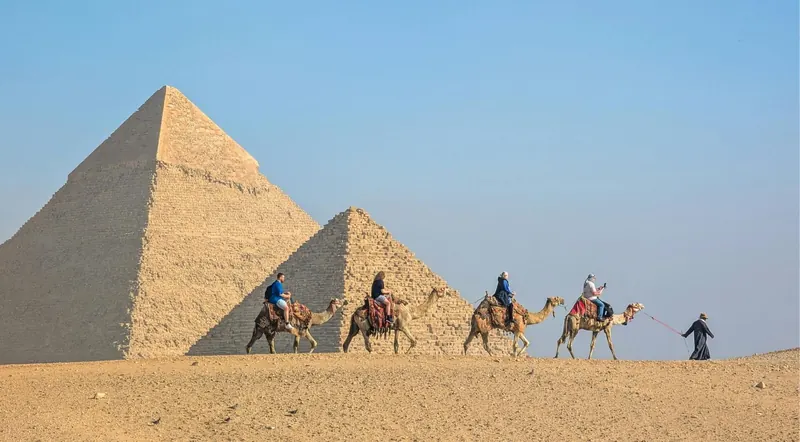
The Giza Plateau sits on the western edge of Greater Cairo, in Giza Governorate on the west bank of the Nile: a limestone desert shelf roughly 13–15 km from downtown Cairo that you can reach in 30–45 minutes by car in normal traffic. That is the short answer. The longer, more useful one covers where exactly Giza is, which of the many ways to get there suits you, and how the rebuilt 2025 entrance and shuttle system works. Read it the night before you go, and you will walk up to the pyramids knowing where to be dropped, which gate to use, what to buy, and which of the day’s dozen small traps to sidestep.
This is the transport-and-access companion to our monument-focused writing. If you want the pyramids as buildings (who built them, what is inside, the necropolis and the history), read our Pyramids of Giza: Complete Visitor Guide and Inside the Great Pyramid; for the pyramid fields beyond Giza, see our guide to Ancient Egypt’s pyramids. If you are coming from the Red Sea coast, our Hurghada to the Pyramids of Giza day trip guide covers that whole journey. This article stays on one job: getting you onto the plateau, and getting you in.
Is Giza the Same as Cairo? Where the Plateau Is
No. Giza is not Cairo, and understanding the distinction saves confusion later. Cairo is the capital, on the east bank of the Nile, in Cairo Governorate. Giza is a separate city and the capital of its own Giza Governorate, sitting on the west bank of the Nile, directly opposite central Cairo. The two are physically continuous (you cross from one to the other over a Nile bridge without noticing), but administratively they are distinct.
Both belong to the sprawling Greater Cairo metropolitan region, which stitches together several governorates and satellite cities into one giant conurbation. Giza is the third-largest city in Egypt, with a population of over 4.4 million (2023 figure), while Giza Governorate as a whole holds around 9.6 million people. So when signs, taxi drivers and your hotel say “Giza,” they mean the west-bank city, and the pyramids sit at its desert edge, not in Cairo proper.
The plateau itself is a shelf of Middle Eocene limestone (the Mokattam Formation), elevated roughly 60 metres above sea level and standing well above the fertile Nile valley floor. This is why the site was chosen more than 4,500 years ago: the ancient builders needed stable bedrock that would not settle under millions of tonnes of stone, Nile access for floating in granite from Aswan and fine white casing limestone from Tura across the river, and a desert edge that did not consume the farmland the kingdom depended on to eat. The west bank also carried religious weight, as the direction of the setting sun and the land of the dead, but the placement was an engineering decision first and a sacred one second.
Where the ancient desert once ran up to the monuments, the modern city now does. The suburb of Nazlet el-Semman presses right up against the eastern foot of the plateau, a dense residential quarter of guesthouses, camel stables and rooftop cafés that ends abruptly where the archaeological zone begins. Running up to it is Haram Street (Pyramids Road / Sharia al-Haram), the long, straight, roughly 7.5 km avenue laid out under Khedive Ismail in the nineteenth century as a grand tree-lined approach so European royalty could ride out to the pyramids for the 1869 Suez Canal celebrations. These days it is a busy, cluttered commercial artery, and it remains one of the two main road approaches to the site.
Distances and Travel Times From Around Cairo
Cairo traffic is the single biggest variable in any journey here. The distances are short; the times are not, once the city clogs up. The figures below are driving estimates; treat the higher end as your peak-hour reality (roughly 07:30–10:00 and 15:00–19:00).
| From | Approx. distance (by road) | Off-peak drive | Peak drive |
|---|---|---|---|
| Downtown Cairo / Tahrir Square | ~13–15 km | 30–40 min | 60–90 min |
| Zamalek | ~10–17 km | 20–30 min | 45–75 min |
| Cairo International Airport (CAI) | ~40–45 km | 45–60 min | 90+ min |
| Sphinx International Airport (SPX) | ~12–20 km | 20–35 min | 30–50 min |
| Maadi | ~12 km | ~20 min | 45–60 min |
| Heliopolis | ~34 km | ~35 min | 75+ min |
| Grand Egyptian Museum (GEM) | ~2 km | 5–10 min | 10–20 min |
| Saqqara | ~15–20 km | 30–40 min | 45–60 min |
A few things to flag. Maadi is surprisingly close, often under 20 minutes off-peak, because it has a fairly direct run to the plateau. Heliopolis and Cairo Airport are on the far north-eastern edge of the metropolis, so they are the longest hauls and the most exposed to traffic. And the Grand Egyptian Museum is now effectively next door: around 2 km away, linked to the plateau by a landscaped pedestrian promenade. According to Major General Atef Moftah, general supervisor of the GEM project, the walkway “stretches approximately 1.27 km from the GEM directly to the Giza Pyramids,” with its width varying between 13.5 and 27.5 metres; it opened in late 2025, so the two work as a single day out. See our Grand Egyptian Museum guide for how to combine them.
Other Experiences You Might Enjoy
The plateau is the start of a Cairo visit, not the whole of it. Within reach are the Tutankhamun galleries of the Grand Egyptian Museum, the Step Pyramid of Saqqara and the ruins of Memphis (both on the Saqqara, Memphis and Dahshur day trip), the bazaars of Khan el-Khalili, the churches of Coptic Cairo, and a sunset felucca sail on the Nile.
Every Way to Get to Giza From Cairo, Compared
There is no single “best” way; it depends on your budget, your appetite for hassle, and where you are staying. Here is the comparison, with no price figures (Egyptian prices move too fast to quote responsibly, so always verify current pricing before booking).
| Method | Journey time | Cost tier | Pros | Cons | Best for |
|---|---|---|---|---|---|
| Uber / Careem / inDrive | 30–45 min | $ | Fixed app price, no haggling, card payment, GPS route | Pickup on the way out can be fiddly; surge at peak; driver can’t drive onto plateau | Independent travellers, couples, anyone wanting simplicity |
| Organised tour with hotel pickup | Door to door | $$–$$$ | Tickets, guide, transfers all handled; no logistics | Less flexible on timing; some include pushy shopping stops | First-timers, families, anyone short on time |
| Private car with driver for the day | Flexible | $$ | Waits for you; multi-stop (Saqqara, GEM); door to door | Driver can’t enter plateau; costs more than a one-way ride | Groups, multi-site days, older travellers |
| White (metered) taxi | 30–45 min | $ | Cheap, everywhere | Meter “broken,” haggling, no English, overcharging | Confident travellers who’ll negotiate first |
| Metro (Line 2) + taxi/microbus | 60–90 min | $ (cheapest) | Beats traffic underground; very cheap | Giza metro station is ~8 km from the plateau; onward leg still needed | Budget travellers, solo adventurers, cooler months |
| Public bus / microbus | 60–90 min+ | $ (cheapest) | Extremely cheap; local experience | Confusing, crowded, drops short of the gate, little English | Backpackers, Arabic speakers |
| Walking (from Nazlet el-Semman) | 5–20 min | Free | No transport at all if you sleep near the gate | Only works if your hotel is at the plateau edge | Those staying in pyramid-view hotels |
| Driving yourself | 30–45 min | $ | Total control | Cairo traffic is brutal; parking; not for the faint-hearted | Long-stay residents only |
Uber, Careem and inDrive: the simplest option
For most independent visitors, a ride-hailing app is the answer. Uber and Careem are both widely used and reliable across Greater Cairo; inDrive (where you name your own fare) also operates. They remove the two biggest frictions of Cairo transport: haggling and not knowing the fare in advance. You can pay by card in-app, though some drivers prefer cash, so carry some just in case.
Two practical warnings. First, since the 2025 redevelopment, private cars cannot drive onto the plateau: your driver drops you at the new visitor centre car park, and you go in on foot and by shuttle. Second, getting picked up on the way out is the weak point: the pickup zones sit behind a police checkpoint, and drivers sometimes cannot get through to you, or cancel. Set your pickup pin at a clear, accessible spot (the visitor centre or just outside the gate), be patient, and expect a bit of back-and-forth by phone. A working local eSIM or SIM makes all of this far easier.
Organised tours and private drivers
If you would rather not think about any of this, a tour with hotel pickup bundles the transfer, entry tickets, a guide and often lunch into one booking, and a good guide is the most effective shield against the touts and scams described below. This is the route we recommend for first-timers and families. From a Cairo or Giza hotel, the private Pyramids & Great Sphinx tour with a camel ride is rated 4.9/5 from more than 7,800 reviews, and the half-day Giza Pyramids and Sphinx tour from Cairo is a shorter shared option rated 4.6/5 from more than 3,800. Browse more in our Cairo Pyramids tours and Pyramids and Sphinx tours roundups.
A private car with driver for the day is the flexible middle ground: the driver waits while you explore, then takes you on to Saqqara, Memphis or the GEM. Note that even a private driver cannot drive onto the plateau; the vehicle ban applies to everyone bar a few pre-arranged exceptions. If you want that multi-stop day with the guide and tickets arranged for you, the Giza, Sphinx, Saqqara & Memphis tour and the Grand Egyptian Museum, Pyramids & Sphinx tour with lunch both collect you from your Cairo or Giza hotel.
Taxis, and the standard scams
Cairo’s white taxis are metered; the classic move is a driver claiming the meter is broken so he can name an inflated price at the end. Agree a fare before you get in if the meter is “off.” The older black-and-white taxis have no meter and no air conditioning and are best avoided by visitors. In the app era there is little reason to use a street taxi to Giza at all: Uber or Careem will be cheaper, cooler and calmer.
Cairo Metro: cheap, but only part of the way
Here is the detail that trips people up: the Metro does not go to the pyramids. Cairo Metro Line 2 runs to Giza station on Haram Street, but that station is still around 8 km from the plateau, so you then need a taxi, Uber or microbus for the final leg up Haram Street. It is the cheapest way across the city and it beats surface traffic, but it is a two-stage journey. Skip it in high summer or with heavy bags.
The much-anticipated Metro Line 4, which will include a dedicated “Pyramids” station, is under construction but not yet open. On 28 April 2026, Tarek Gewaily, chairman of Egypt’s National Authority for Tunnels, confirmed that the 19 km, 17-station first phase, running from 6th of October City past the Grand Egyptian Museum and along Haram Street, is scheduled to open in the first half of 2028, with the Japan International Cooperation Agency (JICA) lending up to ¥100 billion (about US$640 million) toward construction. Until then, there is no direct metro to the plateau, whatever older blog posts imply. Re-check this close to your trip.
Public buses, microbuses and walking
Local buses and microbuses run along Haram Street and are dirt cheap, but they are crowded, confusing, drop you short of the gate, and involve little English: strictly for the adventurous. If your hotel is in Nazlet el-Semman or on Haram Street near the plateau, you may simply be able to walk to the entrance, which is the best “transport” of all.
The horse and camel “transport” on the approach: refuse it
On the roads and paths near the plateau, men on horseback or leading camels will offer to “take you to the pyramids” or tell you the vehicle entrance is far and you need their animal to reach the site. You do not. These are not transport; they are the opening move of the single most common complaint at Giza: a cheap or “free” ride offered up front, followed by a much larger demand once you are out on the sand and cannot easily get down. The 2025 shuttle system means you never need an animal to cross the site. If you want a photo-ride for the experience, that is your call, but agree the full price and the return trip, in writing, before you get on, and be aware of the well-documented animal-welfare concerns. A tour that includes the ride, such as the private Pyramids & Great Sphinx tour with a camel ride, fixes the price when you book.
From Cairo Airport and layover tours
Arriving at Cairo International Airport (CAI) and heading straight to Giza is a 45–60 minute drive off-peak, longer in traffic. If you have a long layover, several operators run layover tours that collect you from the airport, take you to the pyramids and the GEM, and return you in time for your flight, a sensible option given the distance and the single-entry ticket system. If your itinerary lets you choose, Sphinx International Airport (SPX) on the western edge of Greater Cairo is far closer to the plateau (roughly 12–20 km) and a good choice for a Giza-focused trip.
Planning a full day? The most efficient bookings pair the plateau with the Grand Egyptian Museum next door, or add Saqqara. See our Cairo day trips and excursions and one-day Cairo itinerary for ready-made routes; most include transfers, so the logistics above become someone else’s problem.
The Entrance System in 2026: What Changed
If you read one section, read this one. The way you enter the Giza Plateau was completely rebuilt in 2025 by Orascom Pyramids Entertainment (OPE), the private operator (a subsidiary of the Sawiris family’s Orascom group) that has developed the site since 2018 under a cooperation protocol with the Supreme Council of Antiquities. According to OPE chairman Amr Gazarin, the redevelopment is a project worth over EGP 1 billion (around US$51 million). The pilot of the new system launched on 8 April 2025, and most guidebooks and older web pages still describe the old arrangement. Here is the current set-up, with the caveat that details are still in flux and should be re-checked.
The Great Gate: the new main entrance
The main entrance has moved to “The Great Gate” on the Cairo–Fayoum desert road, on the southern/south-western side of the plateau. This is now where the overwhelming majority of visitors enter. It comes with a large visitor centre and a substantial car park: the Supreme Council of Antiquities’ pilot statement cited capacity for around a thousand vehicles, while OPE chairman Amr Gazarin has put it higher, at “over 1,200 private cars and 200 tourist buses.” Either way it is vast. Facilities include self-service ticket machines and ticket offices, restaurants and cafés, souvenir shops, clean toilets, and luggage lockers/cloakrooms. Inside there is a 3D model of the pyramids and a short introductory film narrated by the actor Kevin Costner, confirmed by Giza Plateau Director Ashraf Mohie El-Din, plus a VIP lounge. If you arrive by Uber, taxi, private car or coach, this is the gate you will use.
The old Mena House / Al-Haram gate: closed
The historic entrance up the hill near the Marriott Mena House hotel, the de facto way in since the late nineteenth century, was permanently closed when the new system launched in April 2025. Plenty of older guides, and even some tour descriptions, still send people there. Do not rely on it.
The Sphinx Gate: east side, exit and online-ticket entry
The Sphinx Gate on the eastern (Nazlet el-Semman) side of the plateau, near Khafre’s Valley Temple, remains in use. It is the closest entrance if your hotel is in the Sphinx area, and it is the natural place to start if you want to see the Sphinx first. Two important limits: it has no ticket office, so you can only enter here with a ticket already bought online; and travellers have reported glitches with the online system (payments going through without a usable ticket), so build in a margin. The Sphinx Gate also functions as an exit, which leads to the single most avoidable mistake on the plateau (see below). Note too that add-on interior tickets (to go inside a pyramid) may only be buyable at the main Great Gate or online, not at the Sphinx Gate.
Which gate will you arrive at?
- Uber / taxi / private car / coach / tour: the Great Gate on the Fayoum road.
- Staying in Nazlet el-Semman / Sphinx-area hotel, with an online ticket: the Sphinx Gate is closer and quicker.
- Walking from a pyramid-view hotel: whichever gate you are nearest, but check it is an entry gate, not exit-only, that day.
The single-entry trap
Your admission ticket is single-entry. Leave the plateau and you must buy a new ticket to get back in. The classic error: riding the shuttle to the Sphinx, stepping off at a stop that is the exit, and finding yourself outside the gate with a spent ticket. Stay on until the stop that puts you at the Sphinx viewing area, not the exit, and do not step out until you are finished.
Security, bags and what’s allowed
Expect airport-style security screening at the gate. Large professional cameras and tripods are generally not permitted (phone photography is fine and free); drones are banned. Large bags may need to go in the lockers at the visitor centre. Modest clothing and proper walking shoes are sensible: the terrain is a mix of paved paths, sandy tracks and uneven limestone.
The electric shuttle system
Since 2025, private cars and tour buses can no longer drive onto the plateau. Instead you move around on a fleet of electric shuttle buses, and this is one of the biggest improvements to the Giza experience in decades, because it removes the old need to negotiate with a camel handler just to cross the site.
Key facts, with the caveats:
- It is included free with your admission ticket: there is no separate shuttle fare, and no ticket checks once you are inside. Every source agrees on this.
- It runs as a hop-on, hop-off service. The official launch, as reported by Daily News Egypt, described a single main visitation loop with seven stops for seven main monuments, “starting with the Visitors’ Centre, the Panorama One, then Menkawre, Khufu, and Khafre pyramids, the Sphinx and then Panorama 4, before returning back again to the visitor centre.” By 2026, several travel guides instead describe four routes built around that loop plus branch services. The practical picture is one main loop plus secondary services.
- Colour-coding is not officially confirmed. One widely read guide marks its main route “red” on its own custom map, but there is no documented official red/green/blue system, so don’t rely on colours to navigate.
- The stops that matter are the visitor centre, the Panorama viewpoint (the classic all-three-pyramids photo), Khufu (Great Pyramid), Khafre, Menkaure, and the Sphinx. The 9 Pyramids Lounge sits off the main loop and is served by a separate, less frequent bus, so check before boarding.
- Frequency: in a statement reported by Egyptian Streets on 11 April 2025, Orascom said “over 45 electric buses had been deployed on the site, and the buses were scheduled to run with a five-minute interval between each to ensure continuous operation.” Treat this as the operator’s own figure, issued in response to complaints; nobody has verified the count independently. In practice, 2026 guides report “short waits.”
- A useful quirk: the shuttle does not always return to the Sphinx Gate. If you entered there and want to leave the same way, it may be quicker to walk the ~15 minutes back east from the Sphinx than to wait for a bus to retrace the route.
- Timing catch: although the site opens earlier, the shuttle typically doesn’t start running until around 8am, so a true sunrise walk-in is no longer possible.
- Guides ride with you. The system explicitly provides electric transport for “visitors and their guides,” so a licensed Egyptologist can accompany your group on the shuttle.
VIP golf carts and the vehicle ban
For those who would rather not share the shuttle, private electric golf carts can be booked in advance at a premium, typically bundled into a private guided tour (hotel pickup, VIP lounge, skip-the-line, private cart with an Egyptologist). These are sold by tour operators, not by Orascom directly, and must be pre-arranged; you cannot reliably find one at the gate.
The vehicle ban has a few exceptions, all of which must be arranged ahead of time; asking on arrival rarely works:
- Large coaches for groups of roughly 25 or more may be permitted onto the site.
- Wheelchair users and travellers with limited mobility can be accommodated with private vehicle access to the interior road; the shuttle buses themselves are also wheelchair-accessible.
- Pre-booked golf carts.
The criticism, and the 2025 adjustment
The rollout was rocky. On the first days of the April 2025 pilot, horse and camel operators protested their relocation to parking zones they said were too far from the entrance to earn a living, at one point blocking tour buses. Separately, visitors and guides complained on social media of an “insufficient number of electric vehicles” and of waiting or walking in the heat. In response, the Ministry of Tourism and Antiquities approved the immediate deployment of additional diesel buses to ease transport while sticking to the long-term electric plan, and directed operators to increase capacity. By early 2026, seasoned visitors were describing the system as transformed and “well-managed,” a real improvement, but the socio-economic friction with the plateau’s traditional workers has not fully gone away, and fine details of routes and frequency are still settling. Re-check before you go.
Hours, Tickets and the Best Time to Arrive
Opening hours
Sources vary slightly, which is itself a reason to verify close to your visit, but the official Giza Plateau schedule currently lists:
- Summer and winter: open from 07:00, with last entry at 16:00. (Some sources quote a 17:00 summer close and an 08:00 winter open; the safest plan is to arrive by early afternoon at the latest and confirm on egymonuments.com.)
- Ramadan: shorter hours, typically opening 08:00 with last entry around 15:30.
- Interiors (inside a pyramid) can open slightly later and close earlier than the plateau, and the interior of the Great Pyramid has a daily visitor cap, commonly reported as a small morning and afternoon allocation, so interior tickets frequently sell out by mid-morning in peak season.
Ramadan moves about eleven days earlier each year. In 2027 it is expected to begin around 8 February and end around 9 March, depending on the moon sighting, and nearby cafés and restaurants may be closed during daylight hours, so plan your food and water accordingly.
Tickets and how to pay
There is no single ticket; there are layers:
- General admission gets you onto the plateau and around all three pyramids, the Sphinx and Valley Temple.
- Interior tickets are separate add-ons: the Great Pyramid of Khufu is the priciest, Khafre cheaper and much quieter, Menkaure cheaper again.
- Other add-ons where available include certain tombs and the Workers’ Cemetery. Note the old Solar Boat Museum on the plateau has closed: Khufu’s restored boat is now at the Grand Egyptian Museum, so don’t plan your Giza visit around it.
You can buy through the official portal, egymonuments.com, at the ticket machines/office at the Great Gate, and interior add-ons online. Crucially, Egypt’s major monuments are now effectively card-only at the gates, so bring a working Visa or Mastercard, not just cash. Booking the general and interior tickets online in advance is the safest approach in high season (October–April), when interior slots vanish early. As always with Egyptian pricing, verify current ticket costs before booking on the official portal. For deeper history and monument detail, cross-refer to our complete visitor guide and the Great Sphinx article.
The best, and worst, time to go
Go at opening. Early morning means cooler air, softer light on the stone, and, critically, you beat the mid-morning wave when cruise and coach groups funnel through the same gates and onto the same shuttles within a tight window. Once that wave hits, the Panorama viewpoint, the Sphinx and the interior queues fill within minutes. Because the shuttle starts around 8am, “early” now means being ready to move the moment buses run, which is after first light.
Best months: October to April, when the desert heat is manageable; midday in July and August on the exposed plateau is punishing. Best days: midweek (Tuesday/Wednesday) is quietest; weekends and Egyptian public and school holidays are busiest. Budget two to three hours for a comfortable circuit of the highlights, or half a day if you are going inside a pyramid and lingering, and a full day if you are pairing it with the GEM. Our best time to visit guide has the month-by-month picture.
“Cairo Pyramids View”: Where You Can See Them
A common question: can you see the pyramids from central Cairo? Usually not. Between the 13–15 km distance, the dense skyline and Cairo’s frequent haze and smog, the pyramids are not a reliable sight from the city centre, Tahrir or the Nile-side hotels. On an exceptionally clear day you might catch them from a high floor or rooftop in west-facing areas like Maadi, but treat that as a bonus, not a plan.
Where you can see them without buying a plateau ticket:
- The KFC / Pizza Hut terrace opposite the Sphinx: the famously incongruous fast-food building at Abu al-Hol Square in Nazlet el-Semman, whose rooftop has a superb, near-free view of the Sphinx and pyramids. It went viral for good reason.
- Rooftop cafés and hotels along Haram Street and in Nazlet el-Semman: dozens of guesthouses market “pyramid-view” rooftops; many are excellent at sunset and during the evening Sound and Light show.
- The desert approach roads to the west and south, and the ring roads, give sweeping open views.
- From the plane: flights landing at Cairo (and especially Sphinx) airports often pass with the pyramids visible below on a clear day.
- Inside the site, the Panorama point is the classic spot to frame all three pyramids together.
For the angles and the best light inside the site, the viewpoints section of our Pyramids of Giza visitor guide covers them.
Your First Ten Minutes On Arrival
- Head straight for the visitor centre / ticket machines at the Great Gate (or scan your pre-booked ticket). Buy your interior add-on now if you want one; the Khufu quota goes early.
- Use the toilets and fill your water bottle before you go through; facilities on the plateau are thinner and pricier.
- Ignore anyone outside the gate telling you the site is “closed,” that it’s a “holiday,” or that you “need a guide” to enter. These are opening lines. The site is open; general admission needs no guide; official tickets come only from the machines, the office or egymonuments.com.
- Note your shuttle stop and the exit so you don’t accidentally leave on a single-entry ticket.
- Agree nothing with camel or horse handlers unless you have decided, in advance, that you want a ride, and then fix the full price and return first.
- Fix your pickup plan. Decide now where your Uber or driver will collect you (the visitor centre is simplest), remembering the police checkpoint can complicate app pickups.
Food, water and meeting your driver afterwards
There are cafés and a few sit-down restaurants on and around the plateau (9 Pyramids Lounge, Khufu’s and others), plus kiosks at shuttle stops; quality is variable and prices are tourist-grade, so carry water and a hat regardless. When you are done, the cleanest exit-and-pickup is usually back at the Great Gate visitor centre; if you entered at the Sphinx Gate, remember the shuttle may not loop back there, so allow time to walk. Set your ride-hailing pin somewhere the driver can reach, and be ready for a short wait.
Ready to make it easy? Skip the ticket queues, the touts and the pickup guesswork with a guided pyramids experience that includes transfers and a licensed Egyptologist. Browse Cairo Pyramids tours and Pyramids & Sphinx tours, and if you’re on the Red Sea, see how a Cairo day trip from Hurghada works, from the by-road Cairo & Giza Highlights Day Tour to the plane vs bus comparison.
Frequently Asked Questions
How do I get from Cairo to the pyramids? The simplest independent option is an Uber or Careem to the Great Gate on the Cairo–Fayoum road, around 30–45 minutes from central Cairo in normal traffic. Alternatively, take an organised tour with hotel pickup (best for first-timers), hire a private car with driver, or, on a budget, take Metro Line 2 to Giza station and a taxi for the final ~8 km.
Can you take the metro to the pyramids? Not all the way. Metro Line 2 reaches Giza station on Haram Street, but that is still about 8 km from the plateau, so you then need a taxi, Uber or microbus. A dedicated Metro “Pyramids” station is being built on Line 4 but is not expected to open until the first half of 2028.
Is Giza the same as Cairo? No. Giza is a separate city and governorate on the west bank of the Nile, opposite Cairo. Both are part of the Greater Cairo metropolitan area and run into each other seamlessly, but they are administratively distinct. The pyramids are in Giza, not Cairo proper.
Where exactly is the Giza Plateau? On the western desert edge of Greater Cairo, in Giza Governorate, about 13–15 km from downtown Cairo. It is a raised limestone shelf standing above the Nile valley, with the suburb of Nazlet el-Semman at its eastern foot and the Grand Egyptian Museum about 2 km away.
What time do the pyramids open? Generally from 07:00, with last entry around 16:00 (hours can vary by season, and some sources cite a 17:00 summer close). During Ramadan the site opens around 08:00 with last entry near 15:30. Interiors may open later and close earlier. Always verify close to your visit.
Which entrance should I use? The Great Gate on the Cairo–Fayoum road is the main entrance and where cars, taxis and tours drop off; it has the visitor centre, ticket machines and full facilities. The Sphinx Gate on the east side is handy if you’re staying nearby, but it has no ticket office, so you must have an online ticket. The old Mena House gate is permanently closed.
Do I need to buy tickets in advance? In high season (October–April), yes, especially for going inside the Great Pyramid, which has a small daily cap and sells out early. Buy via egymonuments.com or at the Great Gate machines. Note that gates are largely card-only now, and the Sphinx Gate requires a pre-bought online ticket.
Is there a shuttle inside, and is it free? Yes. Private cars and coaches can no longer drive onto the plateau; instead a fleet of electric hop-on, hop-off shuttle buses links the visitor centre, Panorama viewpoint, the three pyramids and the Sphinx. It is included free with your admission ticket.
Can I still take a camel or horse to get around? You no longer need to, because the shuttle covers all the distances. Camel and horse rides still exist as an optional experience, relocated to designated zones, but they’re the most common source of complaints. If you want one, agree the full price and the return before you get on, or book a tour that includes the ride.
How far are the pyramids from Cairo airport? Cairo International Airport (CAI) is about 40–45 km away, roughly 45–60 minutes’ drive off-peak and considerably more in traffic. Sphinx International Airport (SPX), on the western side of the city, is far closer, around 12–20 km. Long-layover tours from CAI are a popular way to see the pyramids between flights.
Can you see the pyramids from Cairo? Rarely from the city centre: distance, buildings and haze usually block the view. You can sometimes glimpse them from high floors in west-facing areas like Maadi on a clear day, and reliably from Nazlet el-Semman rooftops, Haram Street cafés, the KFC/Pizza Hut terrace by the Sphinx, and from planes landing at Cairo.
How long should I spend at the Giza Plateau? Two to three hours for a comfortable circuit of the highlights; around half a day if you’re going inside a pyramid and taking your time. Pair it with the Grand Egyptian Museum next door for a full, well-balanced day.
Can I visit the pyramids and the Grand Egyptian Museum on the same day? Yes, and it’s the smartest plan. They sit about 2 km apart and are linked by a 1.27 km pedestrian walkway that opened in late 2025. Do the pyramids in the cool morning and the air-conditioned galleries in the afternoon.
Is it better to visit independently or on a tour? Both work under the new system, which is far more independent-friendly than before. A tour removes all the logistics and the tout pressure and is ideal for first-timers; going independently by Uber gives you flexibility and costs less. Either way, the entrance and shuttle changes of 2025 make a modern Giza visit calmer than its reputation suggests.
See the Pyramids of Giza — One Full Day from Hurghada
Join 7,000+ travelers who rated this Cairo day trip 4.6/5. Hotel pickup, air-conditioned transport, an expert Egyptologist guide, and lunch are all included. Free cancellation up to 24 hours before you go.
Check Availability & Book