Grand Egyptian Museum: The Full Visitor Guide
Opening dates, the complete Tutankhamun galleries, how to book timed tickets, hours, photo rules and how to fit the Grand Egyptian Museum into a day trip from Hurghada.
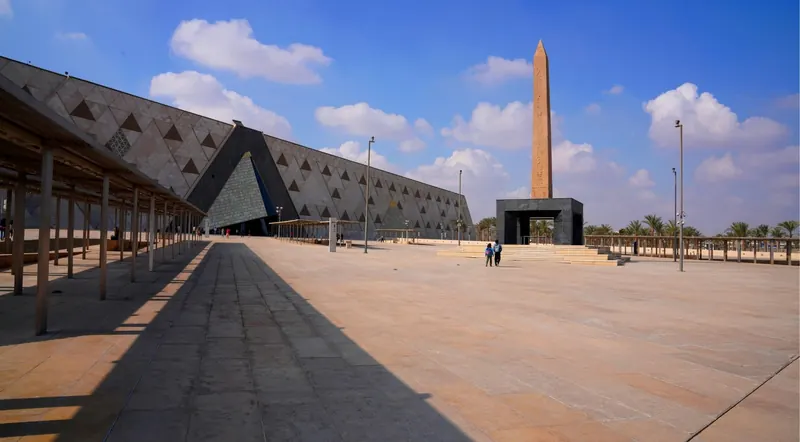
The Grand Egyptian Museum (GEM) is the largest museum in the world dedicated to a single civilisation. It opened fully to the public on 4 November 2025 on the Giza plateau, roughly two kilometres from the Pyramids, and it is now one of the most important cultural attractions in Egypt. For anyone staying in Hurghada and weighing up a Cairo day trip, the GEM is hard to leave out: it holds the complete treasures of Tutankhamun, displayed together for the first time in over a century, alongside the colossal statue of Ramses II, the world’s only hanging obelisk, and a six-storey Grand Staircase that ends in a framed view of the pyramids themselves.
This guide covers what you need to plan a visit: what is inside, how to book, how long it takes, and how to fit it into a compressed day trip from the Red Sea. Hours, ticket rules and prices at the GEM have changed several times since it opened, so verify the current details before you build a day around them.
TL;DR
- The GEM is open. After more than two decades of construction and repeated delays, it was officially inaugurated on 1 November 2025 and opened to the public on 4 November 2025. All twelve main galleries, the Grand Staircase, the complete Tutankhamun galleries and the Khufu Solar Boat hall are now accessible.
- You must book tickets online in advance. On-site sales ended in December 2025 and entry is by timed slot through the official portal. That is the single biggest practical reason Hurghada day-trippers should book a tour that bundles GEM entry instead of risking a turn-up without a ticket.
- Budget three to four hours minimum, ideally a full day. The GEM is vast; day-trippers from Hurghada will only scratch the surface, so prioritise the Tutankhamun galleries, the Grand Staircase and the Ramses II atrium.
Key Findings
- The GEM cost more than US$1 billion, roughly three-quarters of it financed through Japanese (JICA) concessional loans, and occupies a 500,000-square-metre site with around 81,000 square metres of museum floor space.
- It was designed by the Dublin firm Heneghan Peng Architects, who won a 2002–03 international competition, one of the largest in history, with 1,557 entries from 82 countries.
- The Tutankhamun galleries display all 5,398 catalogued objects from the boy king’s tomb together for the first time since Howard Carter’s 1922 discovery, including the solid-gold death mask.
- Sources conflict on headline numbers: the collection is variously described as “over 100,000 artefacts” and “over 50,000 on display”; the site as 500,000 (or 480,000 or 484,000) square metres; and the cost as US$1 billion to US$1.2 billion. We flag these throughout.
- Early operations were rocky, with overcrowding, a controversial Egyptian-versus-foreigner ticket quota and ticketing chaos, but the museum has since moved to online-only timed entry and capped daily attendance at 15,000.
Other Experiences You Might Enjoy
A Cairo day is bigger than one museum. The same stretch of Giza holds the Great Pyramid of Khufu, the Pyramids of Khafre and Menkaure and the Great Sphinx, and within reach of the plateau are the bazaars of Khan el-Khalili, the churches of Coptic Cairo and a Nile felucca sail. Many travellers from Hurghada pair the GEM with the plateau on the same day.
The Museum Itself: Facts and History
A project more than 30 years in the making
The idea for a new grand museum was first announced in 1992 under President Hosni Mubarak, to relieve the overcrowded, dimly lit and traffic-shaken Egyptian Museum in Tahrir Square and to place Egypt’s treasures within sight of the pyramids they came from. On 5 January 2002 Mubarak laid the foundation stone at the chosen site on the edge of the Giza plateau, and an international design competition was launched days later.
That competition was one of the largest in architectural history: 1,557 entries from 82 countries. On 2 June 2003 the jury selected the design by Heneghan Peng Architects, a then little-known Dublin studio led by Irish architect Róisín Heneghan and Taiwanese-American Shih-Fu Peng. Construction began in 2005, but the project was repeatedly derailed: by the 2008 financial crisis, by the 2011 Arab Spring and Mubarak’s fall (which halted work for around three years), and later by the COVID-19 pandemic. The colossal statue of Ramses II was installed on site as early as 2006; the conservation centre opened in 2010; the first private tours ran from 2022.
The museum’s twelve main galleries and Grand Staircase opened in a phased trial from October 2024. The full, official inauguration took place on 1 November 2025 with a lavish ceremony attended by delegations from more than 70 countries, followed by full public opening on 4 November 2025, a date chosen to fall almost exactly 103 years after Carter opened Tutankhamun’s tomb.
The architecture
Heneghan Peng’s building is generated almost entirely by the view to the pyramids. It sits on the 50-metre level difference between the Nile valley and the desert plateau, forming a new “edge” to the plateau and never rising above it. In plan it is a chamfered triangle whose north and south walls align directly with the Great Pyramid of Khufu and the Pyramid of Menkaure, so the monuments remain visible on axis throughout.
The most striking feature is the facade: an 800-metre-long translucent membrane of alabaster, Egyptian limestone and glass, patterned as a Sierpinski triangle, an equilateral triangle repeatedly subdivided into smaller triangles so the same figure recurs at ever-smaller scales, a fractal running from the whole wall down to hand-sized panels. The wall is lit from within after dark. The building is largely concrete to buffer temperature swings and reduce air-conditioning needs, and it has earned green-building certification (EDGE Advance), billed as the first green museum in the region. The engineering was led by Arup and Buro Happold, landscape by West 8, and the exhibition and museology design by Atelier Brückner.
Not everyone is uncritical of the design. Some architecture critics have argued the built facade reduces the elegant competition concept to a “field of cladding triangles.” The consensus among visitors, though, is that the building is genuinely breathtaking.
Size, cost and collection: where sources conflict
- Site area: most sources say approximately 500,000 square metres (about 50 hectares or 124 acres); some give 480,000 or 484,000.
- Museum floor area: around 81,000 square metres, with permanent exhibition space variously cited as 24,000 square metres.
- Cost: “more than US$1 billion” is the most common figure; Wikipedia and some outlets cite US$1.2 billion.
- Collection size: the museum is designed to hold “more than 100,000 artefacts,” though many reports (and some officials) describe “over 50,000” on display. The distinction appears to be between total holdings and storage capacity on one side and what is actually exhibited on the other. Treat “100,000+” as the headline holdings figure and “50,000+” as roughly what is on show.
Funding
Roughly 75% of the cost was covered by Japanese official development assistance. According to JICA’s official account, the agency provided two ODA soft loans in 2008 and 2016 totalling 84.2 billion yen (around US$800 million), repayable over 25 years at 1.4% interest with a seven-year grace period, covering construction, exhibition build-out, ICT infrastructure and consulting services. Japan also provided technical cooperation: conservation training at the GEM Conservation Centre, museum-operations support, and the excavation of Khufu’s second solar boat. The Egyptian government funded the remainder, with additional international contributions and donations.
What’s Inside: The Collection and Galleries
The Grand Hall and the colossus of Ramses II
You enter through the Grand Hall (Great Atrium), dominated by the 83-tonne, roughly 11-metre red granite colossus of Ramses II. The 3,200-year-old statue originally stood at the Temple of Ptah in ancient Memphis, spent decades from 1955 in Cairo’s Ramses Square (a traffic-choked roundabout by the main railway station), was moved to Giza in 2006 to protect it from pollution and vibration, and was installed in the atrium in 2018.
The Hanging Obelisk
In the sloping forecourt outside the entrance stands the Hanging Obelisk of Ramses II, described as the only one of its kind in the world. The roughly 3,200-year-old, 16-metre granite obelisk from Tanis (San el-Hagar) was found broken in two pieces, rejoined, and raised on a steel structure supported by four pillars carved with the word “Egypt” in many languages. Visitors can walk beneath it and look up to see the pharaoh’s cartouche inscribed on the base, an inscription originally meant to be hidden between the obelisk and its pedestal, and unseen for more than 3,000 years.
The Grand Staircase
Beyond the atrium, the Grand Staircase climbs six storeys (about 108 steps, with travelators alongside) to the main galleries. It is lined with colossal royal statues, sarcophagi, columns and stelae, reported as more than 60 pieces and by some accounts up to 87, arranged as a vertical narrative that moves from the “Royal Image” through the king’s relationship with the gods to the funerary realm. At the top, a full-height glass wall frames the pyramids: the museum’s signature reveal.
The 12 main galleries
The twelve main galleries occupy the top floor and are organised as a grid: chronologically into four groups of three, and thematically within each period around Society, Kingship and Beliefs. This lets you either follow the timeline or compare one theme across eras.
- Galleries 1–3: Prehistoric and Predynastic periods, Early Dynastic, Old Kingdom and First Intermediate Period.
- Galleries 4–6: Middle Kingdom and Second Intermediate Period.
- Galleries 7–9: New Kingdom (the age of Tutankhamun, Ramses II and Hatshepsut).
- Galleries 10–12: Third Intermediate Period, Late Period and Graeco-Roman Period.
Tucked between some galleries are smaller “caves” with focused displays (for example on the priestesses of Hathor, the Valley of the Kings, and the workers’ village of Deir el-Medina). Highlights include the jewellery of Queen Hetepheres I, mother of Khufu. The galleries use modern lighting, bilingual labelling and some interactive and AR displays.
The Tutankhamun Galleries
The centrepiece, and the reason the world waited for the November 2025 opening, is the pair of Tutankhamun Galleries, occupying roughly 7,000–7,500 square metres and designed by Atelier Brückner. For the first time since Carter’s discovery, all 5,398 catalogued objects from the tomb are displayed together (the old Tahrir museum only ever showed perhaps 1,700–2,000 at once). The layout tells two stories depending on the direction you walk: one path follows Tutankhamun’s life and afterlife, the other follows Carter’s 1922 discovery, and both end at a full-scale reconstruction of the tomb.
Yes, the gold mask is here. The solid-gold death mask (around 10–11 kg of gold, inlaid with lapis lazuli, carnelian, obsidian and turquoise glass) is displayed as the grand finale of the galleries, behind heavy security glass. Other star objects include the four nested gilded shrines, the nested coffins (one solid gold), the golden throne, two reassembled chariots, the celestial-iron dagger, over 130 items of jewellery, and everyday items such as sandals, linen, furniture and board games. An adjacent room displays the two mummified foetuses, Tutankhamun’s stillborn daughters, on public view for the first time. Note: the mummy of Tutankhamun himself is not here. It remains in his tomb (KV62) in the Valley of the Kings at Luxor.
The Khufu Solar Boat hall
The Khufu Boats hall displays the first solar boat, a roughly 4,600-year-old cedar vessel found dismantled in a sealed pit beside the Great Pyramid in 1954, reassembled in the 1960s using original techniques without metal nails, and moved to the GEM in 2021. The second boat (around 1,650 wooden components, roughly 42 metres long, extracted from its pit by 2021) began a live, public reassembly at the GEM on 23 December 2025. The process is expected to take up to four years and is carried out in front of visitors as an open-conservation display, through Egyptian–Japanese cooperation.
Other facilities
The complex also includes a Children’s Museum (aimed at ages 6–12, with a separate ticket), the vast Conservation Centre, temporary-exhibition halls, a cinema, a conference centre, an Egyptian–French research library, landscaped gardens, restaurants and cafés (some with pyramid views), and a large retail and gift-shop area featuring Egyptian brands, books, jewellery and replicas.
Temporary exhibitions in 2026
The GEM has dedicated temporary-exhibition halls, and guided-tour operators note that temporary exhibitions and the Children’s Museum are ticketed separately from general admission. Programming continues to evolve; check the official site for current temporary shows before you travel.
Visiting Practicalities: Critical and Time-Sensitive
Booking a Hurghada–Cairo day tour that includes GEM entry? Because on-site ticket sales have ended and entry is by timed slot, the simplest way to make sure you actually get in is to book a guided tour that handles your GEM ticket, transfers and timing in one go. Browse Cairo & GEM day tours →
Opening hours
Reported hours (verify before travelling):
- GEM complex (grounds, shops, cafés): 8:30 AM – 7:00 PM
- Galleries: 9:00 AM – 6:00 PM
- Extended evenings: on Wednesdays and Saturdays, galleries stay open until 9:00 PM (complex to 10:00 PM).
- Last entry: about one hour before gallery closing (last ticket around 5:00 PM, or around 8:00 PM on extended days).
- Ramadan: shortened hours (reported around 9:00 AM – 4:00 PM). Hours may also shift on public holidays and for VIP events.
The official published hours do not list a weekly closing day, but sources vary slightly on the exact split, so reconfirm on the official site.
Advance online booking is mandatory
This is the most important practical point. Since 1 December 2025, on-site ticket sales have ended: all visitors must pre-book a timed-entry slot online. The official channels are the museum’s own ticketing platform (tickets.gem.eg, reached via visit-gem.com). Beware of unofficial reseller sites impersonating the museum; in April 2026 the GEM launched an upgraded official booking platform partly in response to counterfeit-ticket sites.
Entry is by two-hour time slots (the slot governs when you enter, not how long you stay). Book several days to a few weeks ahead in peak season (October to April), when the Tutankhamun galleries in particular can reach capacity.
Daily cap and the ticket-quota controversy
At the November 2025 opening the daily cap was 20,000, but on one chaotic Friday more than 27,000 tickets were sold, leaving thousands stranded outside and prompting the switch to online-only booking; as The National reported (18 November 2025), that was “far exceeding the daily limit of 20,000 that museum chief executive Ahmed Ghoneim said it could safely accommodate.” The museum has since capped daily attendance at 15,000. Speaking on the TV programme Al-Hekaya (reported by Ahram Online in July 2026), Ghoneim said “the museum currently receives between 7,000 and 10,000 visitors per day, down from a peak of around 24,000, after the museum capped daily attendance at 15,000 to preserve the quality of the visitor experience.” Ghoneim also confirmed the GEM “received more than three million visitors in the seven months ending in June, with foreigners accounting for 60 percent of visits and Egyptians 40 percent,” an average of roughly 14,000 a day over that period, with the summer 2026 dip attributed to seasonal heat.
A separate controversy concerned a ticket-allocation quota splitting slots between Egyptians and foreign tourists. Rumours of an 80/20 split favouring foreigners circulated; Ghoneim called the 80/20 figure a rumour and said the ratio would “never exceed 60-40” in either direction. An Egyptian MP (Freddy Elbaiady) formally requested the quota be abolished as discriminatory and unconstitutional. As of mid-2026 there is no reported official decision abolishing it, and the 60/40 foreigner-to-Egyptian split in the museum’s own visitor figures suggests the separate-allocation system remains in place, though this is inference and not a documented ruling. For foreign day-trippers the practical upshot is simple: book early.
Ticket structure (qualitative)
Tickets use a three-tier pricing structure: Egyptian nationals pay the least, foreign residents of Egypt an intermediate rate, and international tourists the most; foreign students (with valid ID) and children (roughly ages 6–12) get reduced rates, and young children enter free. General admission covers the main galleries, the Grand Staircase, the Tutankhamun galleries and the Solar Boat hall; the Children’s Museum, guided tours and temporary exhibitions are ticketed separately. Foreign-visitor tickets require ID (bring your passport). We are deliberately not quoting prices here: rates are set by the Ministry of Tourism and Antiquities and change, and a price rise was announced to take effect from 1 November 2026, so always verify current pricing before booking.
How long to spend
A realistic minimum is three to four hours for the highlights (atrium, Grand Staircase, Tutankhamun galleries, Solar Boat). Committed enthusiasts easily spend a full day; one early visitor spent seven hours and estimated seeing only 60–70% of the museum. Reflecting the scale, News On Japan (7 November 2025) reported that the museum “houses over 50,000 artifacts from ancient Egypt, with an estimated five hours needed just to walk through the entire exhibition.”
Getting there
The GEM is on the edge of the Giza plateau, on the Cairo–Alexandria Desert Road near El Remaya Square, about 2 km from the Pyramids and roughly 15 km from downtown Cairo. From central Cairo it is a 20–45-minute taxi or ride-hailing trip depending on traffic. A dedicated Cairo Metro station is planned but not yet open, so most visitors arrive by car, tour bus or organised tour. A pedestrian promenade and bridge link to the pyramids allows movement between the two on foot or by electric shuttle. From Hurghada it is roughly 450–500 km, about 5–6 hours each way by road, or around a one-hour flight to Cairo plus transfers.
Facilities and accessibility
Facilities include free lockers, cloakroom storage, clean accessible restrooms, dedicated prayer rooms, first-aid and medical assistance, an information desk, device charging, paid parking, landscaped gardens, restaurants, cafés and shops.
Accessibility is a genuine strength by Egyptian standards: the museum is designed to be wheelchair-accessible throughout, with ramps, lifts, wide pathways and golf-cart assistance; complimentary wheelchairs are available; there are tactile replica artefacts with Braille labels for visually impaired visitors; and admission is reported to be free for visitors with disabilities. An audio guide is available in Arabic, English and Japanese, with over 100 stops.
Photography rules
Personal photography and video (including with cameras and phones) is permitted in most of the museum, but in the Tutankhamun Galleries only mobile-phone photography is allowed (no standalone or DSLR cameras). This policy tightened in late 2025 and early 2026 after an earlier period when cameras were allowed. Flash, tripods, monopods, selfie sticks, drones, external lighting and live-streaming are prohibited everywhere. Commercial and professional photography needs an advance permit and fee.
Bags and what you can bring
Large bags, backpacks, luggage, parcels and umbrellas exceeding about 40 × 40 cm must be left in storage; there is airport-style security screening at the entrance. Weapons and sharp objects are banned. Food and drink are not allowed in the galleries, except small water bottles.
Guided tours vs audio guide vs self-guided
The GEM is well laid out with comprehensive English labelling, so self-guided visits work well, unlike the old Tahrir museum, which really needed a guide. That said, an official or private Egyptologist-led tour adds context and efficient navigation of a very large space, and the museum offers guided tours in English and Arabic (about 90 minutes). The multilingual audio guide is a good middle option.
Busiest times and how to avoid crowds
Arrive right at 9:00 AM opening, or book a Wednesday or Saturday evening slot. Both are markedly quieter, with better light and fewer coach groups (tour buses peak from mid-morning to early afternoon). Peak season is October to April; December and January are busiest. Allow extra travel time for Cairo’s notorious morning traffic if you take an early slot.
The GEM vs the Old Egyptian Museum vs NMEC
Cairo now has three major Egyptology museums, and it is easy to get confused about what is where:
- Grand Egyptian Museum (GEM), Giza: the complete Tutankhamun collection, the colossal Ramses II, the Khufu boats, and the vast chronological collection. The newest and most spectacular; pair it with the pyramids.
- National Museum of Egyptian Civilization (NMEC), Fustat: home to the royal mummies (22 pharaohs and queens moved here in the 2021 “Pharaohs’ Golden Parade”), plus a chronological sweep of Egyptian civilisation to the modern era. The royal mummies are not at the GEM.
- Egyptian Museum, Tahrir Square: the historic 1902 museum. Still open and still full of treasures, though many headline pieces (Tut, and previously the mummies) have moved to the GEM and NMEC. Beloved for its old-world, “explorer’s attic” atmosphere.
If you have one museum day, choose the GEM (with the pyramids). Add NMEC for the mummies. We compare all three in detail in our dedicated guide: see Egyptian Museum vs the GEM.
Visitor Reaction and Criticism
The overwhelming verdict is positive: the building, the scale and the Tutankhamun galleries draw superlatives, and “once in a lifetime” recurs in reviews. But early operations had real problems that deserve a mention:
- Overcrowding and ticketing chaos in the first weeks (the over-sold Friday, hours-long desert queues, visitors turned away), now mitigated by online-only timed entry and the lower daily cap.
- The Egyptian-versus-foreigner quota drew sharp domestic criticism as discriminatory.
- Scale can overwhelm. The commonest visitor regret is underestimating how much time is needed; rushed guided tours are the most cited disappointment, not the museum itself.
- Wayfinding. Some find signage and entry logistics confusing, and the “caves” between galleries are easy to miss.
- Food and shopping are pricey, and the walk from the entrance across open tiles can be hot and uncovered.
- Gallery lighting. Some photographers note reflections on display cases make small objects hard to shoot.
- Notable absences. The Rosetta Stone (British Museum), the Nefertiti bust (Berlin) and the Dendera Zodiac (Louvre) remain abroad, and the GEM’s opening has reignited repatriation calls.
Practical tips from early visitors: go straight for what you most want to see (usually the Tutankhamun galleries) before wandering; arrive at opening or take an evening slot; wear comfortable shoes; bring a small water bottle; and set realistic time expectations.
The Hurghada Day-Tripper Angle
For Red Sea holidaymakers, the GEM transforms the classic Cairo day trip, but it also demands planning. On a one-day trip from Hurghada you are already committing to roughly 5–6 hours’ drive each way (or a flight plus transfers), so the day is compressed. See our Hurghada to Pyramids of Giza day trip guide and the plane vs bus comparison for the trade-offs.
Realistically, a day trip that combines the pyramids, the Sphinx and the GEM will only allow two to three hours inside the museum, enough for the highlights and not the whole collection. The GEM deserves a half or full day of its own, so if you are an Egyptology enthusiast consider a two-day Cairo trip, or prioritise the GEM over other stops.
The advance-booking requirement is the decisive reason to book an organised tour: with on-site sales gone and timed entry enforced, a reputable operator secures your GEM slot, coordinates it with your pyramids timing, and handles hotel pickup and transfers, removing the single biggest risk of a self-arranged day trip going wrong. Flying instead of driving buys you several extra hours at the monuments and is far less exhausting.
Ready to see it for yourself? A guided full-day tour from Hurghada that bundles the Giza Pyramids, the Sphinx and Grand Egyptian Museum entry is the low-stress way to tick off Egypt’s greatest hits in one day. Browse the fly-in Cairo day trip with pyramids, Sphinx and museum or the by-road Cairo & Giza Highlights day tour, and check that the option you pick includes the GEM rather than the old Tahrir museum. Compare recent reviews, and see our full Cairo day trip from Hurghada guide for the overview.
Key Museum Facts
| Fact | Detail |
|---|---|
| Official opening | Inaugurated 1 Nov 2025; public opening 4 Nov 2025 (galleries trial-opened Oct 2024) |
| Location | Giza plateau, Cairo–Alexandria Desert Road, ~2 km from the Pyramids |
| Architect | Heneghan Peng Architects (Dublin); competition won 2003 |
| Site area | ~500,000 m² (some sources 480,000–484,000) |
| Museum floor area | ~81,000 m² |
| Collection size | 100,000+ artefacts held; ~50,000+ on display (sources vary) |
| Tutankhamun collection | All 5,398 tomb objects, displayed together for the first time |
| Cost | US$1 billion+ (some sources US$1.2 billion) |
| Main funder | Japan (JICA), ~75% via soft loans |
| Booking method | Online only, timed entry (on-site sales ended Dec 2025) |
| Daily cap | 15,000 (down from 20,000 at opening) |
| Typical visit | 3–4 hours minimum; a full day to do it justice |
| Opening hours | Galleries ~9:00–18:00; Wed & Sat to 21:00 (verify) |
| Photography | Allowed; Tutankhamun galleries phone-only; no flash or tripods |
Frequently Asked Questions
Is the Grand Egyptian Museum open? Yes. It was officially inaugurated on 1 November 2025 and opened to the public on 4 November 2025. All twelve main galleries, the Grand Staircase, the Tutankhamun galleries and the Khufu Solar Boat hall are open. Ignore any source describing it as “under construction” or “partially open”; that is outdated.
Do you need to book tickets in advance? Yes, and it is now mandatory. Since December 2025 on-site sales have ended and all visitors must pre-book a timed-entry slot online through the official platform (tickets.gem.eg or visit-gem.com). Book several days to weeks ahead in peak season.
How much do tickets cost? Pricing uses a three-tier structure (Egyptian nationals, foreign residents, international tourists), with reduced rates for foreign students and children and free entry for young children. Rates are set by the Ministry and change (a rise was announced from 1 November 2026), so we don’t quote figures. Always verify current pricing before booking.
How long do you need at the Grand Egyptian Museum? Three to four hours is the realistic minimum for the highlights; enthusiasts can happily spend a full day. On a compressed Hurghada day trip you will likely have only two to three hours inside.
Is Tutankhamun’s mask at the GEM? Yes. The solid-gold death mask is displayed as the finale of the Tutankhamun galleries, behind security glass. His mummy, however, remains in his tomb (KV62) in Luxor’s Valley of the Kings.
Are all of Tutankhamun’s treasures really there? Yes. All 5,398 catalogued objects from the tomb are displayed together for the first time since Carter’s 1922 discovery, including the shrines, coffins, throne, chariots, jewellery and daily-life objects.
Can you take photos inside? Personal photography is allowed in most of the museum. In the Tutankhamun galleries only mobile-phone photography is permitted (no standalone cameras). Flash, tripods, selfie sticks and drones are banned everywhere.
How far is the GEM from the pyramids? About 2 km. A pedestrian promenade and shuttle link the two, so many tours combine them in one visit.
Where are the royal mummies, and are they at the GEM? No. The 22 royal mummies are at the National Museum of Egyptian Civilization (NMEC) in Fustat, moved there in the 2021 Pharaohs’ Golden Parade. The GEM has selected mummified remains in thematic displays but not the royal mummies hall.
Is the old Egyptian Museum in Tahrir still worth visiting? Yes, if you have time. It retains a huge collection and a unique old-world atmosphere, though its headline pieces (Tut, the mummies) have moved to the GEM and NMEC. For one museum day, choose the GEM.
Can I visit the GEM on a day trip from Hurghada? Yes. Hurghada is about 450–500 km away, roughly 5–6 hours by road or a one-hour flight to Cairo plus transfers. Organised day trips handle hotel pickup, transfers and your pre-booked GEM ticket in one booking.
Is the GEM wheelchair accessible? Yes, notably so: ramps, lifts, wide pathways, complimentary wheelchairs, golf-cart assistance, accessible restrooms, Braille and tactile displays, and (reportedly) free admission for visitors with disabilities.
When is the GEM least crowded? Right at 9:00 AM opening, or the Wednesday and Saturday evening slots. Coach groups peak mid-morning to early afternoon; October to April is peak season.
What’s the difference between the GEM and the “Giza Museum” or “Pyramids Museum”? They are the same place. The Grand Egyptian Museum is often informally called the Giza Museum, the Great Egyptian Museum, the GEM, or the “pyramids museum” because of its location beside the Giza plateau.
Is there a second Khufu solar boat? Yes. The second boat began a live, public reassembly at the GEM in December 2025, expected to take up to four years, and you can watch conservators at work.
Recommendations
- Book a tour that includes GEM entry, and don’t wing it. With on-site sales gone and timed entry enforced, the advance-booking requirement is the single biggest failure point for independent day-trippers. A guided Hurghada–Cairo tour that bundles your GEM slot with the pyramids removes that risk. Compare tours →
- If you are choosing between flying and driving, fly if the budget allows. A one-hour flight buys you several extra hours at the monuments against 10–12 hours in a coach, which matters when the GEM alone deserves half a day. Options like Hurghada: Full-Day Trip to Cairo by Plane let you choose the GEM as your museum. See plane vs bus.
- Prioritise ruthlessly on a day trip. Head straight for the Tutankhamun galleries, the Grand Staircase and the Ramses II atrium; treat the twelve main galleries as a bonus if time allows.
- Choose an early-morning or evening slot (Wednesday or Saturday) to dodge the coach-group crush.
- Consider a two-day Cairo trip if you are an enthusiast. Pair the GEM (day one, with the pyramids) with NMEC and the mummies (day two). If you are already staying in Cairo or Giza, Cairo: Grand Egyptian Museum, Pyramids, Sphinx Tour & Lunch starts from your hotel there. See one day in Cairo and Cairo day trips compared.
- Always verify the time-sensitive details before you travel. Hours, the daily cap, the quota situation and (especially) prices are all still changing. Confirm on the official site.
Benchmarks that would change this advice: if the museum reinstates reliable on-site ticket sales, independent visits become lower-risk; if a dedicated Metro station opens, self-transport from Cairo becomes practical; and if the daily cap is raised or lowered materially, the “book weeks ahead” urgency shifts accordingly.
Caveats
- This is the most fast-changing attraction in Egypt. The GEM only fully opened in November 2025; hours, ticketing rules, the daily cap, the quota, prices and even photography policy have all changed since. Verify everything current before travelling.
- Sources conflict on cost (US$1bn vs US$1.2bn), site area (480,000–500,000 m²), and collection size (50,000 vs 100,000+ artefacts). We’ve flagged these and not picked one.
- Pricing is deliberately omitted and must be checked live; a price increase was announced for 1 November 2026.
- The Egyptian-versus-foreigner quota’s formal status is unresolved in reporting. We infer it persists from 2026 visitor ratios, but no official abolition or confirmation has been published.
- Reseller and unofficial ticket sites are widespread; book only through the official platform or a reputable tour operator.
Related reading: Pyramids of Giza visitor guide · The Great Sphinx of Giza · Pyramids & Sphinx combined tours · Egyptian Museum vs the GEM
See the Pyramids of Giza — One Full Day from Hurghada
Join 7,000+ travelers who rated this Cairo day trip 4.6/5. Hotel pickup, air-conditioned transport, an expert Egyptologist guide, and lunch are all included. Free cancellation up to 24 hours before you go.
Check Availability & Book