The Great Sphinx of Giza: What to Know Before You Go
What the Great Sphinx really was, why Egyptians worshipped it, how the Greek and Egyptian sphinxes differ, and how to visit from Hurghada in 2026.
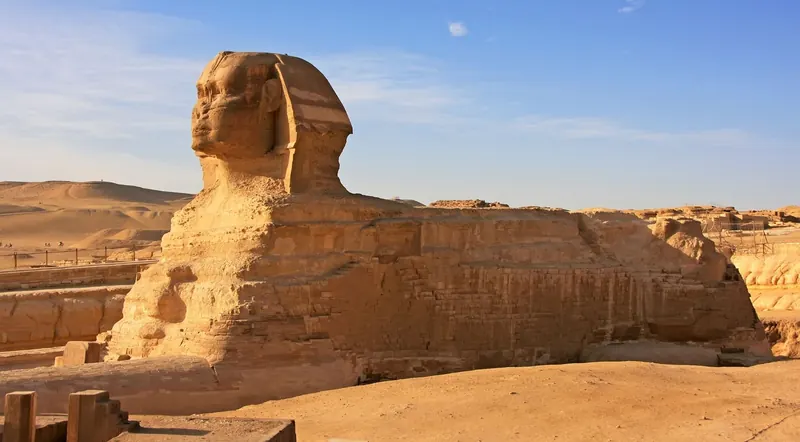
The Great Sphinx of Giza is the oldest known monumental sculpture in the world — a 73-metre lion carved from living bedrock some 4,500 years ago, staring due east at the sunrise it was built to greet. Most visitors arrive knowing only the silhouette. What surprises them is everything the silhouette conceals: a statue that outlived its own name, became a god a thousand years after it was carved, lent its shape to Greek monsters and Las Vegas casinos, and still guards the same patch of desert while a brand-new visitor plateau reshapes itself around it.
This guide is not about how the Sphinx was built or who its face belongs to — those debates, along with its dimensions, geology and famous missing nose, are covered in depth in our companion piece on Pyramids and Sphinx combined tours. This is about what the Sphinx meant, what it still means, and exactly what it feels like to stand in front of it — especially if you are coming across the desert from Hurghada for a single, precious day.
Ticketing, opening hours and the show schedule below change fairly often — verify current details before you build a day around them.
What a Sphinx Actually Was
Before it was a wonder, the Sphinx was an idea. In ancient Egyptian thought, a sphinx was a royal hybrid — the body of a lion, the most potent symbol of raw power and solar energy, fused with the head of a king wearing the nemes headcloth, the uraeus cobra at the brow and the ceremonial false beard. The lion supplied ferocity and guardianship; the human head supplied intelligence and divine kingship. Together they said one thing: here is a ruler with the strength of a lion and the mind of a god, watching over this sacred ground.
Egyptian sphinxes were overwhelmingly male, wingless, and benevolent. They were guardians, not monsters. They crouched at the approaches to temples and tombs, radiating protection outward. The Greeks would later give the concept a completely different personality — but in Egypt, from the Old Kingdom onward, the sphinx was the pharaoh as protector, the human face of the sun’s power on earth.
The name it lost, and the names it gained
Here is one of the strangest facts about the most famous statue on Earth: we do not know what its makers called it. The Old Kingdom Egyptians who carved it around 2500 BC left no inscription naming the monument, and the surrounding temple was apparently never finished. The original name is simply lost.
Every name we do have came later. In the New Kingdom, more than a thousand years after it was carved, Egyptians called it Hor-em-akhet — “Horus of the Horizon,” Hellenised by the Greeks as Harmachis. They also knew it as Shesep-ankh, “living image,” a phrase that may be the true ancestor of our word sphinx. The Greeks applied their own word σφίγξ (sphínx) — from the verb sphíngein, “to squeeze” or “to strangle,” a reference to the way lions kill and to their own riddling monster. Medieval and modern Arabic gave it the name it still carries locally: أبو الهول, Abu al-Hol — usually translated “Father of Terror” or “Father of Dread” — a name that captures the awe the half-buried colossus inspired in later travellers, though scholars suspect it may be a corruption of an older Egyptian phrase rather than a literal description.
Why Egyptians Worshipped a Statue
The most remarkable chapter of the Sphinx’s story is that it became a god — but not when it was built. For centuries after the Old Kingdom, the monument was neglected and swallowed by drifting sand. Then, in the New Kingdom (from around 1550 BC), something changed. The pharaohs of the 18th Dynasty looked at the mysterious lion emerging from the dunes, its human head crowned like a king, facing the rising sun, and saw a god.
The identification made poetic sense. Approached from the east-southeast, the Sphinx’s head appears to rise on the horizon between the pyramids of Khafre and Khufu — exactly like the sun disc between two mountains in the hieroglyph akhet, “horizon.” The Sphinx became Hor-em-akhet, the sun god manifest at the threshold of the sky, guardian of the cosmic gateway through which the sun was reborn each dawn. By this period the statue was worshipped simultaneously as three solar forms: Harmachis, Khepri (the morning sun) and Atum (the evening sun).
A cult with its own temple and priesthood
This was no vague reverence. It became an organised cult with royal patronage. Pharaoh Amenhotep II (reigned c. 1427–1400 BC) built a mud-brick temple dedicated to Hor-em-akhet just northeast of the Sphinx — a temple sometimes called the Temple of Hauron-Haremakhet, excavated in the 1930s by Selim Hassan. Amenhotep, who prized his own image as an athletic warrior-king, seems to have used the ancient monument to legitimise his reign by linking himself to the primordial god-king towering above the plateau.
His son took it further. Thutmose IV erected the famous Dream Stele between the paws — a granite slab recording that the Sphinx appeared to him in a dream as Hor-em-akhet, promising him the throne if he cleared the sand from its body. (The full story of that stele is told in our combined pyramids and Sphinx guide.) He built a great mud-brick enclosure wall around the Sphinx and set devotional stelae into it — seventeen of them showing Thutmose making offerings, sometimes accompanied by his wife.
Ordinary pilgrims came too. Over the New Kingdom, royal and non-royal Egyptians alike left votive stelae around the Sphinx as acts of devotion — a pilgrimage site had grown up around a statue whose origins even the Egyptians had half-forgotten. By the Graeco-Roman period Giza had become a full tourist destination: Roman emperors visited, and around the first century AD the Sphinx was cleared of sand again in honour of Nero, with a monumental stairway more than 12 metres wide leading up to a viewing platform before the paws. People have been coming to gawp at the Sphinx, in other words, for two thousand years. You are joining a very long queue.
The Greek Sphinx vs the Egyptian Sphinx
This is the single most important thing to understand before you go, because almost everything Western culture “knows” about sphinxes is Greek, not Egyptian — and the two could hardly be more different.
The Egyptian sphinx is male (an androsphinx), wingless, recumbent, and benevolent. It is a guardian — silent, protective, a portrait of royal and divine power. It asks nothing of you.
The Greek sphinx is the opposite in almost every respect. She is female, winged, often with a serpent’s tail, and she is a monster. In the myth of Oedipus, the goddess Hera (or another deity) sends her to torment the city of Thebes. She perches outside the city and poses a riddle to every traveller — most famously, “What walks on four legs in the morning, two at noon, and three in the evening?” Those who fail she strangles and devours. Only Oedipus answers correctly — man, who crawls as an infant, walks upright in his prime, and leans on a staff in old age — whereupon the humiliated Sphinx hurls herself to her death.
The contrast is total. The Egyptian Sphinx is a silent guardian; the Greek Sphinx does nothing but ask questions. One protects; the other preys. The Greek form probably reached Greece not directly from Egypt but through Levantine and Phoenician art, which is where the wings and the female form come from. The Greeks then attached their own riddling mythology to the borrowed shape.
Why does this matter to a visitor? Because the “riddle of the Sphinx,” the air of enigma and menace, the idea of a mysterious question-poser — all of that is Greek baggage that Western travellers unconsciously carry to Giza. The actual monument in the sand was never a riddler. It was a king-god, keeping watch. Knowing this changes what you see.
Other Experiences You Might Enjoy
A Cairo day is bigger than the Sphinx alone. The same plateau holds the three great pyramids, the Grand Egyptian Museum with the complete Tutankhamun collection, and — within reach of Giza — the bazaars of Old Cairo, the churches of Coptic Cairo, and a Nile felucca sail. Many travellers pair the Sphinx with the wider plateau and a museum stop on the same day.
The Sphinx in the World’s Imagination
Few images have travelled as far. The word sphinx entered English by the early 15th century and by around 1600 had already taken on its figurative meaning — an inscrutable, enigmatic person. To this day a mysterious public figure gets called a “sphinx”; the enigmatic Czech billionaire Daniel Křetínský is routinely dubbed “the Czech Sphinx” in the British press.
Napoleon and the birth of Egyptomania. When Bonaparte invaded Egypt in 1798 he brought a scientific commission of 167 scholars, engineers and artists — the Commission des Sciences et des Arts — alongside a military force of more than 34,000 men. Their monumental Description de l’Égypte, published from 1809, and Champollion’s decipherment of hieroglyphs in 1822, triggered a wave of Egyptomania across Europe. Engravings of the sand-choked Sphinx — including a famous plate of academicians measuring it — fed a craze for Egyptian motifs in furniture, architecture and fashion that lasted a century. (The persistent legend that Napoleon’s troops shot off the Sphinx’s nose with a cannon is false: the nose was already gone, as documented in drawings made by the Danish traveller Frederic Louis Norden in 1737.)
Art and literature. The great Orientalist painter Jean-Léon Gérôme returned repeatedly to the theme, most famously in Bonaparte Before the Sphinx (painted c. 1867–68 and exhibited at the Paris Salon of 1886 as Œdipe), which cemented the image of the little general dwarfed by the great head. Poets made the Sphinx a symbol of cosmic mystery: Ralph Waldo Emerson’s “The Sphinx” (1841) opens “The Sphinx is drowsy, / The wings are furled” and turns the creature into a riddle of universal identity; Oscar Wilde’s long Decadent poem “The Sphinx” (1894) addresses a “beautiful and silent Sphinx” watching him “through the shifting gloom.” Shelley, though “Ozymandias” (1818) describes a ruined Ramesses colossus rather than a sphinx, gave Romantic readers the archetype of the broken Egyptian monument and the transience of power.
Film and casinos. Hollywood keeps returning to Giza — The Mummy Returns (2001) and Transformers: Revenge of the Fallen (2009) both stage climaxes around the pyramids and Sphinx, and Ridley Scott’s Napoleon (2023) revived the cannon-fire myth as cinematic shorthand. And the shape has been endlessly copied: the Luxor hotel in Las Vegas, opened in October 1993, guards its glass pyramid with a replica Sphinx some 34 metres (110 ft) tall — taller than the original, with blue eyes and a nose it never lost. Not every copy has been welcome: a full-size replica built in Hebei, China, in 2014 so angered Egypt’s antiquities ministry that it complained to UNESCO, and the structure was dismantled — only to reappear, head reattached, in 2018, reigniting the row.
Standing in Front of It: The Real Visitor Experience
Here is what actually happens when you go.
The approach and the surprise of scale. After the Grand Egyptian Museum-era redevelopment, most visitors reach the Sphinx aboard an electric shuttle after entering the plateau. The Sphinx sits below the level of the pyramids, at the end of Khafre’s causeway, in its own excavated hollow — so you often come upon it from above and behind before circling to the front. The first surprise for many is that it is smaller in height than they imagined (about 20 metres) but far longer than they expected — 73 metres of lion stretched out in the sand. The second surprise is the setting: the modern city of Giza presses right up to the plateau’s edge, so the classic “lonely in the desert” photograph requires choosing your angle carefully.
How close can you get? This is the number-one cause of disappointment, so make peace with it now: you cannot walk up to the Sphinx, touch it, or stand between its paws. The monument is fenced, and the public views it from a raised viewing terrace near the eastern (Sphinx Gate) side, looking down and across at it. At the closest you will be perhaps 30–40 metres back. The terrace runs along the Sphinx’s northern flank and around toward the front, giving you the celebrated head-on view with the paws and the Dream Stele visible between them, and — if you position yourself well — the pyramid of Khafre rising directly behind. (A handful of specialist operators can arrange rare paid permits to enter the enclosure between the paws; these require special permission from the Ministry of Tourism and Antiquities and are the exception, not the norm.)
How long people spend. Most visitors spend 20–40 minutes at the Sphinx itself. It is almost always visited after the three pyramids, as the natural climax and final stop of a Giza circuit — the causeway leads your eye down to it, and guides use the moment to tie the whole plateau together. Because it is compact and the walking is easy, it is not physically demanding even at the end of a long, hot day.
Sensory texture and crowds. Early morning, just after the plateau opens, gives the softest light, the smallest crowds and the coolest air — the Sphinx faces east, so the rising sun lights its face directly. By late morning the terrace fills with tour groups and the sun climbs behind you. Late afternoon delivers golden light on the eastern face again and thinner crowds. Whatever the hour, expect vendors, would-be “guides” and photo-hustlers around the approaches; a polite, firm “la, shukran” (no, thank you) and a refusal to hand over your phone or camera will see you through.
Ready to see it for yourself? Most Hurghada travellers reach the Sphinx on a long day trip to Cairo. Browse the fly-in Cairo day trip with pyramids, Sphinx and museum or the by-road Cairo & Giza Highlights day tour, compare inclusions, and see our full Hurghada-to-Giza day trip guide for how the day is structured. Always verify current pricing and exactly what’s included before booking.
The Sphinx After Dark
The Sphinx has a starring role in the Giza Sound and Light Show, staged most evenings on the plateau. The show is narrated — famously — by the Sphinx itself, which “tells” the story of the pyramids, their builders, and figures like Thutmose IV, Akhenaten, Nefertiti and Tutankhamun, while floodlights and projections play across the monuments. The Sphinx and the pyramids lit against the night sky are genuinely atmospheric, and the narration is offered via headsets in a wide range of languages, typically including English, French, German, Spanish, Italian, Russian, Japanese, Arabic and Polish.
Be realistic about the production values. Long-standing visitor reviews describe the show as dated — “an 80s narrated story,” heavy on single-colour illumination rather than the lasers some expect — and performances are occasionally cancelled for renovation work, so confirm the schedule and that the show is running before you build an evening around it, and verify current pricing. For a day-tripper from Hurghada the show is rarely practical (it means a very late return across the desert), but it is a lovely add-on for anyone overnighting in Cairo or Giza. Outside the show, there is no general night-time access to the Sphinx enclosure.
Egypt Is Full of Sphinxes — Here’s Where to Find Them
The Great Sphinx is unique in scale, but it is far from Egypt’s only sphinx. Seeking out the others adds real depth to an Egypt trip — and helps you understand the Giza colossus as one member of a very large family. There is, incidentally, no agreed scholarly census of how many ancient Egyptian sphinxes survive; they range from the 73-metre Giza giant down to small temple pieces, and even the great avenues are counted only approximately.
| Sphinx | Description | Where to see it |
|---|---|---|
| Great Sphinx of Giza | The original: ~73 m limestone androsphinx, Old Kingdom, c. 2500 BC | Giza plateau, on any pyramids tour |
| Alabaster Sphinx of Memphis | ~8 m calcite/alabaster sphinx, New Kingdom (18th Dynasty), uninscribed; possibly Amenhotep II or Hatshepsut; unearthed 1912 by Flinders Petrie | Mit Rahina open-air museum, near Saqqara |
| Avenue of Sphinxes (“Rams Road”) | 2.7 km processional avenue lined with human-headed and ram-headed sphinxes; ceremonially reopened 25 November 2021 | Between Karnak and Luxor Temples, Luxor |
| Karnak ram-headed sphinxes (criosphinxes) | Rows of lion-bodied, ram-headed sphinxes sacred to Amun, guarding the temple approach | First court / forecourt, Karnak Temple, Luxor |
| Sphinxes of Hatshepsut | Colossal red-granite sphinxes of the female pharaoh from her mortuary temple; smashed by Thutmose III, reassembled | Egyptian Museum, Cairo & the Metropolitan Museum, New York |
| Great Sphinx of Tanis | Large pink-granite royal sphinx, inscribed by several pharaohs, acquired by the Louvre in 1826 | Louvre, Paris (Sully Wing, Room 338 — the “Crypt of the Sphinx”) |
| Sphinx of Taharqo | Small granite Kushite sphinx (25th Dynasty, c. 680 BC) from Kawa in Sudan, blending Egyptian form with African royal features | British Museum, London |
| Luxor Las Vegas replica | Modern ~34 m replica guarding a glass pyramid hotel; taller than the original | Las Vegas Strip, USA |
The Alabaster Sphinx at Memphis, carved from a single luminous block of calcite and displayed beside a colossal fallen Ramesses II, is an easy and rewarding addition to a Saqqara–Memphis day. The Avenue of Sphinxes at Luxor is the most spectacular — over a kilometre and a half of guardian statues reopened on 25 November 2021 with a globally televised recreation of the ancient Opet Festival, attended by President Abdel Fattah el-Sisi. And if your travels take you to Paris or London, the Great Sphinx of Tanis presides over the Louvre’s Egyptian galleries while the exquisite Sphinx of Taharqo — a masterpiece of Kushite art the size of a large dog — sits in the British Museum.
Conservation: Can the Sphinx Survive the Next Century?
The Sphinx has survived 4,500 years, but the modern era has been harder on it than the ancient one. The core problem is salt weathering driven by moisture. The limestone of the Sphinx’s body contains natural salts. When moisture — from groundwater, from humid air, or from nightly dew — seeps into the porous stone and then evaporates, the salts crystallise inside the rock’s pores, cracking it from within and causing the surface to flake away. It is a slow, relentless chemical decay.
Several modern forces have accelerated it. The Aswan High Dam and intensive irrigation raised the water table across the Nile valley; the uncontrolled growth of the neighbouring Nazlet El-Semman district — which for decades let wastewater soak into the ground before a sewer system was finally installed in 1992 — pushed near-surface groundwater to within half a metre of the surface behind the Sphinx. Cairo’s explosive growth from around 2.5 million people in the 1950s to well over 15 million today has wrapped the monument in air pollution and vibration. And well-intentioned but disastrous 20th-century restorations made things worse: a 1980s campaign shot the chest with chemicals that flaked off and tore away the mother rock, and packed the base with cement mortar that trapped moisture and activated yet more salt. As Zahi Hawass, then head of Egypt’s Supreme Council of Antiquities, put it: “When you put cement on its body, it stops the breathing of the limestone.” Later 1990s work corrected course, using compatible lime mortar rather than cement.
Today conservation relies on groundwater management (dewatering wells drilled to lower the water table beneath the plateau), careful repair with compatible limestone, 3D laser scanning and photogrammetry to track deterioration millimetre by millimetre, and environmental monitoring. Researchers have even proposed sheltering the monument from dew and wind at night. Looking further ahead, heritage bodies warn that climate change — rising groundwater, extreme weather and, for coastal Egypt, rising seas — poses a long-term threat to the country’s monuments; the World Monuments Fund and Egyptian officials have repeatedly flagged the Sphinx and pyramids among sites at risk by the end of the century.
The Sphinx and the New Giza Plateau (2025–2026)
If you have older guidebooks, ignore what they say about reaching the Sphinx. The Giza plateau is midway through the biggest overhaul in its modern history, managed under a long-term contract by Orascom Pyramids Entertainment, and the way you approach the monument has fundamentally changed:
- The historic entrance near the Mena House hotel has closed. The main entrance moved to a new visitor centre off the Fayoum Highway on the south/west side of the plateau, with self-service ticketing, parking, cafés and shops.
- Private cars and tour buses are no longer allowed onto the plateau itself. Visitors ride air-conditioned electric shuttle buses on a hop-on, hop-off loop that stops at the main points — Khufu, Khafre, Menkaure, the panorama viewpoint and the Sphinx.
- The Sphinx Gate on the east side is still in use but has no ticket office — you can only enter there with a ticket bought online in advance. This matters if you specifically want to approach the Sphinx first.
- Horse and camel vendors have been moved to a designated area away from the monuments, and a fine-dining restaurant and lounge now overlook the plateau.
Because these arrangements are new and still being adjusted, confirm the current entrance, ticketing and shuttle setup with your tour operator before you travel — the details have changed more than once during the rollout.
One more thing to have straight before you go: you will almost certainly see breathless online claims about a “second Sphinx,” hidden chambers, or an underground city beneath Giza, based on radar surveys publicised in 2025 and 2026. These are fringe claims. In March 2026, radar engineer Filippo Biondi claimed on the Matt Beall Limitless podcast to be “about 80 percent” confident of a buried structure “roughly 108 feet tall” — a supposed second Sphinx. A Newsweek fact-check (27 March 2026) rated the claim false, noting there is “no confirmed archaeological evidence,” that “no excavation has taken place, no peer-reviewed study has validated the findings,” and that ground-penetrating radar cannot resolve massive structures buried tens of metres down. Mainstream Egyptologists, including Zahi Hawass, have dismissed these and the related 2025 “underground city” claims outright. We debunk them in detail in our combined tours guide.
Making the Most of a Short Visit from Hurghada
A Cairo day trip from Hurghada is long — typically a very early start and a full day on the road each way, or a short domestic flight. That makes efficiency at Giza essential. A few principles:
- See the Sphinx last, and give it your full attention. After the scale of the pyramids, the Sphinx is where the human story lands. Don’t rush it for the sake of a few more minutes at the base of Khufu’s pyramid.
- Position for the classic shot. The head-on view from the terrace, with Khafre’s pyramid behind the head, is the photograph you came for.
- Go with a guide. The Sphinx rewards context enormously — the difference between “a big statue” and “the god Hor-em-akhet, watching the sunrise for 4,500 years” is entirely down to knowing the story.
- Build in buffer time. The new shuttle system and the sheer distance from the Red Sea coast mean delays happen. A well-run tour with a fixed itinerary protects your day.
Plan your day. If you’re weighing up the journey, start with our Cairo day trip from Hurghada overview and our one-day Cairo itinerary for how to fit the Sphinx, the pyramids and the Grand Egyptian Museum into a single trip. When you’re ready, book a guided Giza pyramids and Sphinx day trip with a reputable operator — and always verify current pricing and inclusions before you book.
Frequently Asked Questions
What is the Great Sphinx of Giza? It is a colossal statue with the body of a lion and the head of a king, carved from a single outcrop of limestone bedrock on the Giza plateau around 2500 BC. At roughly 73 metres long and 20 metres high, it is the largest monolithic statue and the oldest known monumental sculpture in the world.
What did the Sphinx mean to the ancient Egyptians? Originally it represented the pharaoh as a lion-bodied guardian of the sacred plateau. Over a thousand years later, in the New Kingdom, it was worshipped as a sun god, Hor-em-akhet (“Horus of the Horizon”), with its own temple, priesthood and stream of pilgrims leaving votive stelae.
What’s the difference between the Egyptian and Greek sphinx? The Egyptian sphinx is male, wingless, and a benevolent guardian. The Greek sphinx is female, winged, often serpent-tailed, and a deadly monster who poses a riddle and kills those who fail — as in the myth of Oedipus. The riddle and the menace are entirely Greek; the Egyptian original never asked questions.
What does the name “Sphinx” mean? It comes from the Greek sphínx, linked to the verb sphíngein, “to squeeze” or “to strangle.” The Egyptians themselves may have called it shesep-ankh, “living image.” In Arabic it is Abu al-Hol, “Father of Terror.”
Who does the Sphinx’s face represent? Most Egyptologists associate it with the Fourth Dynasty pharaoh Khafre, builder of the second pyramid, though the attribution is debated. We cover the dating and identity debate fully in our combined pyramids and Sphinx guide.
Can you go inside the Sphinx or stand between its paws? No. The Sphinx is solid carved bedrock with no public interior, and the enclosure is fenced. You view it from a raised terrace, at the closest around 30–40 metres away. A very small number of operators can arrange special paid permits to enter the enclosure, but this is rare and requires official permission.
How close can you actually get? From the viewing terrace on the eastern side, roughly 30–40 metres at the nearest point. It’s more than close enough for excellent photographs, including the classic head-on shot with a pyramid behind.
How long should I spend at the Sphinx? Most visitors spend 20–40 minutes. It’s usually the final stop on a Giza circuit, visited after the pyramids.
Is the Sphinx included in the Giza ticket? Yes — access to the Sphinx viewing terrace is included in the general Giza plateau entry ticket; there is no separate Sphinx-only fee. Ticketing has moved largely online under the new system, so verify current pricing and how to buy before you go.
Can I see the Sphinx at night? Yes, as part of the Giza Sound and Light Show, in which the Sphinx narrates the story of the pyramids while the monuments are floodlit. There is no other general night-time access. Confirm the show is running and check pricing before planning an evening around it.
Is it true a “second Sphinx” was discovered? No. Radar-based claims of a second Sphinx or hidden chambers under Giza, publicised in 2025–2026, are fringe theories that have been rejected by mainstream Egyptologists and are not backed by any authorised excavation or peer-reviewed study. A Newsweek fact-check in March 2026 rated the “second Sphinx” claim false.
Are there other sphinxes to see in Egypt? Many. The Alabaster Sphinx at Memphis, the ram-headed sphinxes and the reopened Avenue of Sphinxes at Karnak/Luxor, and Hatshepsut’s granite sphinxes in the Egyptian Museum are the highlights. Others, like the Great Sphinx of Tanis (Louvre) and the Sphinx of Taharqo (British Museum), sit in museums abroad.
Can I visit the Sphinx on a day trip from Hurghada? Yes. The Sphinx sits right beside the Giza pyramids, so it’s included on essentially every Cairo-and-pyramids day trip from Hurghada. Expect a long day and consider whether a flight or a road trip suits you better. See our Hurghada-to-Giza day trip guide.
See the Pyramids of Giza — One Full Day from Hurghada
Join 7,000+ travelers who rated this Cairo day trip 4.6/5. Hotel pickup, air-conditioned transport, an expert Egyptologist guide, and lunch are all included. Free cancellation up to 24 hours before you go.
Check Availability & Book