Inside the Great Pyramid: Is the Extra Ticket Worth It?
An honest 2026 guide to going inside the Great Pyramid of Khufu: what you really see, the climb, ticket caps, and why Khafre is often the smarter buy.
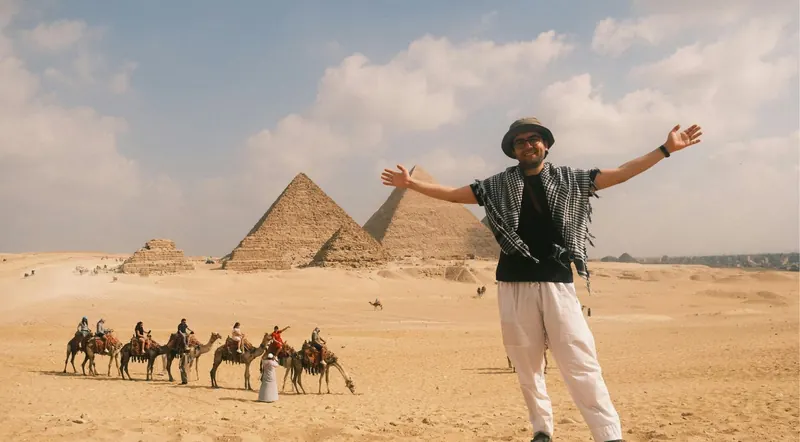
Going inside the Great Pyramid of Khufu is a genuine once-in-a-lifetime experience for the fit and curious — but it is a hot, cramped, crouching scramble into a bare granite room with no treasure, no hieroglyphs and no mummy, and for many travellers on a long day trip from Hurghada, the cheaper, quieter interior of the Pyramid of Khafre is the smarter choice. This guide tells you exactly what you get for that separate interior ticket, who should not attempt it, and how to decide before you spend a single Egyptian pound.
If you have arrived here after reading our Hurghada to the Pyramids of Giza day-trip guide, think of this article as the deep dive on the one decision that guide only skims: whether to buy the separate ticket that gets you inside. Prices and interior access change often, so check live availability and the current option list before you commit.
TL;DR
- Yes, you can go inside — the Great Pyramid interior is open on a separate, capped ticket that costs significantly more than general plateau admission. What you see is architecture, not artefacts: the crouch-up Ascending Passage, the soaring Grand Gallery, and the King’s Chamber with its empty, lidless granite sarcophagus. No decoration, no gold, no mummy.
- It is physically demanding and not for everyone. Expect a sustained crouch, steep wooden ramps, two-way traffic in a passage barely a metre high, poor ventilation, heat and stuffy air. Skip it if you have claustrophobia, serious back/knee/hip problems, heart or respiratory conditions, or are heavily pregnant. There is no wheelchair access whatsoever.
- For many Hurghada day-trippers, Khafre is the better buy. Its interior ticket is considerably cheaper, the crowds are far thinner, the descending-passage-and-chamber experience is arguably more atmospheric, and you still stand in a 4,500-year-old burial chamber — this one with the famous Belzoni graffiti. Always verify which pyramids are open and confirm current pricing before booking.
Other Experiences You Might Enjoy
Before the ticketing detail, a quick step back: the interior is one small decision inside a much bigger day. Around it sit the Great Sphinx and Khafre’s Valley Temple at the eastern edge of the plateau, the Grand Egyptian Museum a mile away with the complete Tutankhamun collection, Old Cairo and the Khan el-Khalili bazaar, felucca sails on the Nile, and — back on the Red Sea coast — Hurghada’s snorkelling, diving and desert safari trips. Worth a browse if you have a day either side of your Cairo run.
Key Findings
- The interior ticket is separate from general admission and is a significant add-on. It is capped daily and sells out in peak season (October–April). Buy it online in advance via the official Ministry portal, egymonuments.com, or at the main gate the moment you arrive — not after photographing the Sphinx.
- The daily cap is small. The Great Pyramid interior is widely reported to admit around 300 visitors per day, split into a morning and an afternoon session (commonly cited as 150 at 8am and 150 at 1pm). Sources genuinely conflict — some 2026 guides state a hard 300 total, while others cite as few as 150 per day — so treat the number as indicative and verify on the day. The session system still operates in 2026.
- What’s inside surprises people. The chambers are undecorated. The King’s Chamber is a bare red-granite box containing an empty, lidless, unfinished sarcophagus. The wonder is the engineering and the sheer age, not any treasure — that was looted in antiquity.
- The alternatives are real and often better value. Khafre’s interior is cheaper and quieter. Menkaure and the Queens’ pyramids are sometimes open. The Red and Bent Pyramids at Dahshur and the reopened Step Pyramid substructure at Saqqara offer superb, crowd-free interiors — but are not realistic on a single Hurghada day trip.
- The Giza interiors rotate for conservation. Historically one pyramid at a time closes for cleaning; the Great Pyramid is generally kept open, while Khafre and Menkaure tend to alternate. Which of the two is open changes, so this is the single most important thing to verify before you count on any particular interior.
The Great Pyramid of Khufu: A Quick Grounding
Before you decide whether to go in, it helps to know exactly what you are standing beneath.
The Great Pyramid was built for the Fourth-Dynasty pharaoh Khufu (Cheops to the Greeks), around 2560 BCE. It originally rose about 146.6 metres and today stands roughly 138.5 metres after the loss of its polished white limestone casing and gilded capstone. Each side of the base measures around 230 metres, and the monument is estimated to contain some 2.3 million blocks. It was the tallest human-made structure on Earth for roughly 3,800 years, and it is the only survivor of the Seven Wonders of the Ancient World.
Modern archaeology has quietly demolished a couple of myths you may have grown up with. The builders were not slaves: excavation of the workers’ village south of the plateau, led by Mark Lehner and Zahi Hawass since the 1990s, revealed a skilled, well-fed, organised labour force living in barracks and eating beef — most of them rotating conscripts serving short tours of duty.
Two genuinely important recent discoveries are worth knowing before you go:
- The lost Nile branch. In May 2024, a team led by Eman Ghoneim of the University of North Carolina Wilmington published evidence in Communications Earth & Environment (16 May 2024) of a now-buried Nile branch, the Ahramat Branch, traced for about 64 km (40 miles) from Lisht to Giza and flowing past 31 pyramids. Detected by radar satellite imagery and confirmed with geophysical surveys and sediment cores, the branch was “about 0.5 kilometers wide… with a depth of at least 25 meters,” and helps explain how the builders moved millions of tonnes of stone: by water, right up to causeways that ended at valley temples acting as river harbours.
- The Merer papyri. Discovered in 2013 by a French mission under Pierre Tallet (Paris-Sorbonne) and Gregory Marouard at the Red Sea port of Wadi al-Jarf, the logbook of the inspector (sḥḏ) Merer — the oldest inscribed papyri ever found in Egypt — records his crew ferrying Tura limestone to “Akhet-Khufu,” the Great Pyramid, in the 26th year of Khufu’s reign (Papyrus Jarf A and B; Tallet 2017). It is the closest thing we have to an eyewitness account of the pyramid’s construction.
You may also have read about the ScanPyramids project. Using cosmic-ray muon tomography, the team announced a large cavity above the Grand Gallery — the “Big Void” (SP-BV) — in the peer-reviewed Nature paper (Morishima et al., 2 Nov 2017, doi:10.1038/nature24647), which reported “the discovery of a large void (with a cross-section similar to that of the Grand Gallery and a minimum length of 30 metres) situated above the Grand Gallery.” A second anomaly behind the chevron stones on the north face, the North Face Corridor (SP-NFC), was confirmed and inspected in 2023 when a 6mm endoscope was slid through a joint between blocks, revealing a roughly 9-metre corridor with a gabled ceiling — completely empty. A 2025 multi-modal study published in Scientific Reports further confirmed the corridor. Crucially for you as a visitor: none of these voids are accessible to the public. You will not see them.
What’s Actually Inside — And What Isn’t
Here is the honest picture, because the gap between expectation and reality is where most disappointment comes from.
The route you’ll actually walk
You enter not by the original entrance but through the Robbers’ Tunnel — the forced passage hacked out on the orders of Caliph al-Ma’mun in the 9th century, and the route all visitors use today. Within seconds of ducking in, you are bent double.
The hardest stretch is the Ascending Passage: roughly a metre square (about 1.05m high and wide), climbing at a 26-degree angle for around 40 metres. You cannot stand. You shuffle up in a half-crouch, gripping wooden cleats underfoot and rails on the walls. If a group is coming down while you climb, there is an awkward, near-dark squeeze past one another.
The passage opens dramatically into the Grand Gallery — and this is the payoff. It runs about 47 metres long and 8.6 metres high, ascending at the same 26 degrees, its corbelled limestone walls stepping inward in seven tiers to a ceiling barely over a metre wide. Standing in a space engineered with this precision 4,500 years ago is, for many visitors, the single most powerful moment of their entire Egypt trip.
At the top, the Great Step leads to a low antechamber passage — another crouch — into the King’s Chamber. This is a room of red Aswan granite, roughly 10.5m by 5.2m and 5.8m high, roofed with enormous granite beams and topped by five “relieving chambers” you cannot see, designed to distribute the crushing weight above. In it sits the granite sarcophagus: lidless, empty, unfinished, with visible saw and drill marks. It is slightly too large to have passed through the entrance passage, so it was almost certainly placed during construction.
Off the system are the Queen’s Chamber (reached via a horizontal passage from the bottom of the Grand Gallery), the mysterious narrow “air shafts,” and, far below, the unfinished Subterranean Chamber cut into the bedrock. In practice, the visitor route in 2026 is the Ascending Passage, Grand Gallery and King’s Chamber; the Subterranean Chamber is normally closed, and access to the Queen’s Chamber varies. Verify on arrival.
What there ISN’T
Set your expectations now: no hieroglyphs, no wall paintings, no carvings, no treasure, no gold, and no mummy. The painted tombs you’re picturing are in the Valley of the Kings at Luxor, not here — and from the Red Sea coast that is a separate day trip in its own right, such as Hurghada: Luxor, Valley of the Kings & Tutankhamun Tomb (from $78, rated 5.0★ by 1,953 travellers). Khufu’s body has never been found and the interior was stripped in antiquity. The chambers are stark, bare stone. If you go in expecting a museum, you will feel short-changed. If you go in to stand inside the engineering, you won’t.
The physical experience, unvarnished
Visitors consistently describe the same things: the sustained crouch that makes your thighs burn; the wooden ramps with slats; two-way human traffic where you brush against people going the opposite way; stuffy, humid, still air with a faint smell of old limestone dust and the breath of everyone who has passed through; and heat that becomes genuinely oppressive in summer. During conservation work the interior humidity was measured at around 85 percent. One Tripadvisor reviewer described a young woman in tears having a panic attack metres from the chamber; another compared the King’s Chamber to “hot yoga on steroids, minus the ability to step outside for a quick breather.”
The whole interior visit is short: most people are in and out in around 20 minutes, and guides suggest allowing 45–60 minutes including the queue and buying tickets. It is not technically difficult. It is physically taxing.
Ticketing and Access: The Practicalities
The interior ticket is separate from general plateau admission, and it is the most expensive of the interior tickets by a wide margin — a significant add-on to what you already pay to enter the site. Always verify current pricing before booking; ticket prices in Egypt change frequently and rose in recent years.
How to buy it:
- Online, in advance, via the official Ministry of Tourism and Antiquities portal, egymonuments.com. This is the safest route in peak season (October–April), when interior slots vanish, and it lets you choose a session time.
- On-site, at the main entrance ticket office (Fayoum Road, west side) — note that interior add-on tickets are generally only sold at the main office or online, not at the smaller Sphinx-side gate, and not always at the pyramid door itself. Gate machines sometimes run out of the interior add-on.
The daily cap. The interior is capped at a small number — commonly reported as around 300 per day, split into a morning session and an afternoon session (frequently cited as 150 at 8am and 150 at 1pm). Note that sources genuinely disagree: some 2026 guides state a hard 300 total, while others cite as few as 150 per day. Either way, it is a tiny allocation for a site that draws thousands daily, so the interior supplement sells out early in high season, sometimes by mid-morning. Verify the exact current cap and session times before you rely on them.
If you’re winging it: arrive right at opening, go straight to the interior ticket window, and buy before the morning quota is gone — don’t wander off to the Sphinx first. Interior entry to individual monuments generally begins at 8am, slightly after the plateau itself opens.
Can tour operators pre-book it? A well-run tour that explicitly includes or pre-arranges interior access is the single best way to guarantee you get in without the dawn scramble — this is exactly the kind of product to look for, and we cover how to vet operators in our guide to choosing the right Cairo pyramids tour. Many cheaper day trips quote the interior only as an optional on-the-day extra, which is a real gamble in peak season.
On the Hurghada day trips we track, the interior appears as a paid option you select at checkout, not as a standard inclusion — which is why it is worth choosing the option deliberately rather than hoping to sort it at the gate:
From Hurghada: Cairo & Giza Highlights Day Tour — the by-road flagship, from $76, rated 4.6★ by 7,243 travellers. Its booking flow makes you choose explicitly between general admission and entry inside the Great Pyramid, so the decision is made before you travel. Full breakdown on our tour page.
Hurghada to Cairo: Pyramids & Museum for First-Time Visitors — from $86, rated 4.8★ by 1,510 travellers, small-group, and lists “entry inside the Great Pyramid (if option selected)” in its inclusions. See our tour page.
Hurghada: Full-Day Trip to Cairo by Plane — from $265, rated 4.8★ by 458 travellers. The flight gets you onto the plateau far earlier, which is exactly when the interior quota is still available; interior entry is again an option you select. See our tour page.
Hurghada to Cairo: Inside Khufu Pyramid, Old Cairo & Bazaar — rated 4.9★ by 290 travellers, and the only Hurghada departure that puts the interior in its title rather than buried in an options list. Entry inside Khufu is still “if option selected”, so choose it at checkout; the day also takes in Old Cairo and the Khan el-Khalili bazaar.
And an honest counter-example that proves the point about reading the fine print: Hurghada: Cairo Day Trip by Flight, Pyramids, Sphinx & Museum (from $273, rated 4.9★ by 4,048 travellers) is an excellent, popular tour — but its “what’s not included” list names “entry into the burial chamber of Cheops or the burial chamber of Chefren” outright. That is a well-run operator being transparent, not a red flag; it simply means the interior is not on the menu for that particular product. Verify current prices, ratings and inclusions on the listing before you book.
Rotating closures. Under a conservation programme running since the mid-1990s, the Giza pyramids close on a rotating basis for cleaning — historically one at a time. The Great Pyramid is generally kept open; Khafre and Menkaure tend to alternate, and which of the two is open changes over time. This is the single most important thing to check before your visit.
Photography. The policy has tightened and is inconsistently enforced. Historically cameras were banned inside entirely; more recently smartphone photography has generally been tolerated, but not video, and not professional cameras or flash. Some guardians will insist you leave a proper camera outside, and some will “offer” to take your photo and then expect a tip — as will anyone who hands you your own phone back. Assume the safest position: phone only, no flash, no video, and be ready to comply instantly if told to stop. Verify the current policy on the day.
Bags, water and what to bring. Wear closed-toe shoes with grip (avoid sandals if you plan to go inside), bring water for the plateau, and note that Egypt’s monument gates are now largely card-only — bring a working Visa or Mastercard, not just cash. Tall visitors should wear a cap to protect their head on the low ceilings.
Hours and Ramadan. The official Giza Plateau page (checked 11 October 2026) lists 8am to 4pm every day, with no separate seasonal schedule; closing times have been reported earlier during Ramadan. Ramadan moves about 11 days earlier each year: in 2026 it ran from 19 February to 19 March, and in 2027 it is expected to begin around 8 February. Interior entry begins at 8am. Confirm hours close to your travel date, and check the current entry fees on the official portal before you travel.
The Alternatives: Often the Smarter Choice
This is the section most guides skip, and it’s the one that could save your day trip. You are not limited to Khufu.
Pyramid of Khafre — the connoisseur’s pick
Khafre’s pyramid (the second, which appears taller because it stands on higher ground and still keeps some casing at its apex) offers a markedly different and, for many, more satisfying interior. Instead of Khufu’s complex ascending system, you take a long descending passage down into a burial chamber carved into the bedrock, roofed with massive gabled limestone slabs. In it sits Khafre’s black granite sarcophagus, partly sunk into the floor.
Its trump cards for the Hurghada day-tripper: the interior ticket is considerably cheaper than Khufu’s, and it is far less crowded — often you can have the chamber almost to yourself, which makes it more atmospheric. And there’s a genuine historical thrill: on the south wall you can still read the graffiti left by the Italian strongman-explorer Giovanni Belzoni, the first person in modern times to enter, on 2 March 1818: “Scoperta da G. Belzoni. 2. mar. 1818.”
When Khafre is open, it is the interior we’d recommend to most people on a tight, tiring schedule. The catch: Khafre is subject to the rotating conservation closures and has spent extended periods shut in recent years (dated visitor and news reports indicate it was closed for much of 2024–2025), so its status must be verified before you count on it.
Pyramid of Menkaure
The smallest of the three has a more elaborate interior plan than its modest exterior suggests, with a descending passage and burial chamber. It too is cheaper than Khufu and much quieter. Its interior access is periodic and subject to restoration — at various points in 2025–2026 either Menkaure or Khafre has been the one closed, so confirm which of the two is open on the day.
The Queens’ Pyramids
The small subsidiary “Queens’ pyramids” beside Khufu and Menkaure are sometimes open, cheap and quiet — a low-key extra for the curious if you have time and energy to spare.
Dahshur: the Red and Bent Pyramids (for context)
Serious pyramid enthusiasts often name the Red Pyramid at Dahshur as the best interior experience in Egypt: a long, steep descent of over 60 metres into soaring corbelled chambers, usually with almost no one else around. Its notorious calling card is the powerful ammonia smell — the legacy of centuries of bat guano — which many visitors find genuinely off-putting. The neighbouring Bent Pyramid is also enterable and, by some accounts, doesn’t smell as strongly. Important for you: Dahshur is around 40km south of Cairo and is not realistic on a standard Hurghada day trip focused on Giza — mention it as a reason to come back, not a same-day option.
Saqqara: the Step Pyramid of Djoser
The world’s oldest monumental stone building, the Step Pyramid, reopened on 5 March 2020 after a 14-year, roughly 103-million-EGP (~$6.6M) restoration; it had been closed after a 1992 5.8-magnitude earthquake left it near collapse (per then-Antiquities Minister Khaled el-Anany). Its southern tomb and substructure passages have also been opened to visitors. Access to the interior/substructure is periodic and subject to restoration closures, so confirm before counting on it. Like Dahshur, Saqqara is a separate excursion from Giza and generally beyond a single Giza-focused Hurghada day trip.
Which interior for which visitor?
| Pyramid | What’s inside | Difficulty | Crowds | Best for | Booking it |
|---|---|---|---|---|---|
| Great Pyramid (Khufu), Giza | Ascending Passage, Grand Gallery, King’s Chamber, empty granite sarcophagus | Hard — sustained crouch, steep, hot | Heavy; capped & sells out | Fit, curious first-timers who want the one; bragging rights | From Hurghada, inside Khufu (4.9★) · From Cairo, ticket included (4.4★) |
| Khafre, Giza | Long descending passage, bedrock burial chamber, Belzoni graffiti | Moderate — steep ramp, less crouching | Light | Most day-trippers wanting atmosphere, value and calm | Gate ticket only — no tour sells this interior |
| Menkaure, Giza | Descending passage, burial chamber | Moderate — narrow, low | Light | Those wanting the “inside a pyramid” experience cheaply and quickly | Gate ticket only |
| Queens’ Pyramids, Giza | Small passage and chamber | Easy–moderate | Very light | Completists with spare time | Gate ticket only |
| Red Pyramid, Dahshur | 60m+ descent to tall corbelled chambers | Hard — long descent; strong ammonia smell | Very light | Enthusiasts on a dedicated Dahshur trip (not a Giza day trip) | Saqqara, Memphis & Dahshur day trip (4.7★) |
| Step Pyramid, Saqqara | Restored substructure/southern tomb | Moderate | Light–moderate | Those on a Saqqara excursion; origin-of-pyramids fans | Saqqara, Memphis & Dahshur day trip (4.7★) · Giza, Sphinx, Saqqara & Memphis (4.7★) |
On that last column. Only Khufu’s interior is packaged by tour operators — everywhere else you buy the interior ticket at the gate on the day, so the “tour” you want is simply one that gets you to the site with time to spare. We looked for a product selling the Khafre or Menkaure interior specifically and found none: one listing’s URL even promises Khafre and then sells Khufu entry in its inclusions. Dahshur’s Red and Bent Pyramid interiors need no ticket beyond site entry, which the Dahshur day trip above includes. Ratings were checked on 26 August 2026; prices are on each listing and move constantly.
Who Should — and Shouldn’t — Go Inside
Be honest with yourself here. Turning back mid-passage is difficult: there is essentially one narrow route in and out, often with a stream of people behind you, and if you get into difficulty it is your own responsibility to extricate yourself. That reality should drive the decision.
Think hard about skipping it if you have:
- Claustrophobia — even mild. The Ascending Passage, the low ceilings, the darkness and the press of other bodies trigger it hard. This is not the place to test whether you’ll be fine.
- Back, knee, hip or neck problems — the sustained crouch and the steep ramps are punishing on joints.
- Heart conditions, asthma, COPD or respiratory sensitivity — the air is close, warm, humid and dusty, and the climb is a real cardiovascular effort.
- Pregnancy — the exertion, heat, poor air and awkward posture make it inadvisable, particularly later in pregnancy.
Children: generally not recommended for under-10s — the tunnels, climb and stuffy air can overwhelm younger kids, and many are more thrilled by the camels and the sheer scale outside than by a bare chamber. Older children who are keen and not anxious can enjoy it.
Elderly visitors: it’s genuinely case-by-case. Fit, mobile older travellers manage it (one reviewer’s elderly mother did it, slowly); those with the conditions above should not.
Accessibility: there is no wheelchair access at all. The interior is completely inaccessible to anyone who cannot manage steep, narrow, low passages unaided. If mobility is a concern, Khufu’s interior is a firm no — and even Khafre and Menkaure are demanding.
The day-trip reality check. A Cairo day trip from Hurghada is long and exhausting — by road it can mean a pickup around 2am and a day stretching to 18–22 hours; even by plane it’s a full, early, tiring day (see our plane vs bus comparison). You will already be hot, footsore and short on time. Adding a physically strenuous 45–60 minutes inside Khufu — often in a queue — is a big ask. For many, the wiser move is either the easier, quieter Khafre interior, or simply banking the energy for the Sphinx, the plateau and the Grand Egyptian Museum.
Planning a Hurghada-to-Cairo day trip and want to be certain you get inside? Book a tour that explicitly includes or pre-arranges interior access rather than leaving it as an on-the-day gamble. Read our companion guide to Giza pyramids and Sphinx tours for what a combined plateau day really delivers — and choose an option that states interior entry up front. It’s the single best way to avoid the sold-out heartbreak at the gate.
Is It Worth It? The Verdict
Visitor opinion genuinely splits, and both camps are right — for themselves.
The transcendent camp stands in the Grand Gallery, looks up at a 4,500-year-old corbelled vault built to mathematical precision, puts a hand on Khufu’s granite sarcophagus, and calls it one of the most moving moments of their lives. For the historically minded, the discomfort is a fair price. As one enthusiast put it, the reward is “immense.”
The underwhelmed camp pays a premium ticket to crouch, sweat and shuffle up a dark tunnel into an empty room with nothing to look at, emerges exhausted, and wonders what the fuss was about — “an overpriced climb into an empty room.”
The deciding variables are consistent:
It IS worth it if you are: reasonably fit; not remotely claustrophobic; genuinely interested in the architecture and engineering (not expecting treasure); visiting outside the worst summer heat; and you’ve secured a ticket so you’re not stressed about caps.
It ISN’T worth it if you are: claustrophobic or anxious in tight spaces; carrying back/knee/hip/heart/respiratory issues; pregnant; travelling with young children; short on time and energy at the tail end of a gruelling day trip; or hoping to see decorated chambers (go to Luxor for those).
Our framework for the Hurghada day-tripper, in order:
- If Khufu’s interior is a bucket-list must and you’re fit — pre-book it, do it early, accept it for what it is.
- If you want the “inside a pyramid” experience without the crowds, cost and crush — go inside Khafre (when open). Best value-to-atmosphere ratio on the plateau.
- If you have any of the risk factors, or you’re flagging — skip the interior entirely. The exterior, the Sphinx and the museum are the real headline acts, and you lose nothing essential by admiring Khufu from outside.
Virtual Tours: A Real Substitute or Just Prep?
If you can’t or won’t go inside — or you want to prepare — there is one genuinely excellent, official-quality option.
Harvard University’s Giza Project / Digital Giza runs the largest online archive on the plateau and, through its Giza 3D / Mused platform, offers a free, guided virtual walkthrough titled “Inside the Great Pyramid.” It reconstructs the interior in 3D and lets you move through the Ascending Passage, Grand Gallery and King’s and Queen’s Chambers — spaces you often can’t linger in or photograph properly in real life — with narration, available in several languages. There are also 3D tours of the Khufu, Khafre and Menkaure complexes, the Sphinx, and several tombs.
Is it a substitute? For the information and the layout, yes — arguably better, because you can pause, read, and see angles impossible in the cramped reality. For the physical sensation — the crouch, the heat, the age pressing in around you — no. A screen can’t reproduce standing beneath 4,500-year-old granite. Treat the virtual tour as (a) a superb preparation tool so you know what you’re looking at, and (b) a dignified alternative for anyone whose health, mobility or claustrophobia rules out the real thing. We’ve named it accurately here rather than linking a URL that may change; search “Digital Giza” or “Giza Project Inside the Great Pyramid” to find the current official page.
Should You Go Inside? A Decision Checklist
Tick these honestly. If you can’t tick the first four, seriously consider Khafre or skipping the interior.
- I am reasonably fit and can sustain a deep crouch on a steep incline for several minutes.
- I am not claustrophobic and am comfortable in tight, dark, crowded spaces.
- I have no significant back, knee, hip, heart or respiratory condition, and I’m not heavily pregnant.
- I understand there are no hieroglyphs, no treasure and no mummy — I’m going for the architecture and the experience.
- I have (or can secure) an interior ticket, ideally pre-booked, and I’ve verified the current cap and session times.
- I’ve checked which Giza pyramid interiors are actually open on my date.
- I have the time and energy to spare on a long day trip — or I’d rather spend both on Khafre, the Sphinx or the museum.
Frequently Asked Questions
Can you go inside the Great Pyramid of Giza?
Yes. With a separate interior ticket (distinct from general plateau admission), you can enter via the Robbers’ Tunnel, climb the Ascending Passage and Grand Gallery, and stand in the King’s Chamber. Access is capped daily and can sell out.
Is it worth going inside the pyramids?
It depends entirely on you. Fit, non-claustrophobic history lovers often call it a highlight; others find it an expensive, sweaty climb into an empty room. If in doubt, the cheaper, quieter Khafre interior is a lower-risk way to experience “inside a pyramid.”
What’s inside the Great Pyramid?
The Ascending Passage, the Grand Gallery, the King’s Chamber with an empty granite sarcophagus, plus the Queen’s Chamber and (normally closed) Subterranean Chamber. There is no decoration, no treasure and no mummy — all long gone.
Is it claustrophobic inside the Great Pyramid?
For many people, very. The Ascending Passage is barely a metre high and wide, the air is stuffy, it’s often dark and crowded, and you sometimes squeeze past people coming the other way. If you have any claustrophobia, this is not the place to test it.
How long does the interior visit take?
The visit itself is short — most people are in and out in around 20 minutes. Allow 45–60 minutes overall including queueing and tickets.
Can you take photos inside the Great Pyramid?
The policy has tightened and is inconsistently enforced. Smartphone photos are generally tolerated; video, flash and professional cameras generally are not, and guardians may make you leave a proper camera outside. Verify on the day and comply if told to stop.
Do interior tickets sell out?
Yes, regularly — the daily cap is small (widely reported as around 300, split morning/afternoon, though some sources cite fewer), and interior tickets can be gone by mid-morning in peak season (October–April). Pre-book via egymonuments.com or through a tour that includes interior access.
Which pyramid is best to go inside?
For sheer prestige and the Grand Gallery, Khufu. For value, calm and atmosphere, Khafre (when open) — cheaper, far less crowded, with Belzoni’s 1818 graffiti. Menkaure is a quiet, cheap third option when open.
Is there anywhere better than Giza to go inside a pyramid?
Enthusiasts rate the Red Pyramid at Dahshur very highly (long descent, tall corbelled chambers, few crowds — but a strong ammonia smell), and the reopened Step Pyramid substructure at Saqqara is fascinating. Neither is realistic on a standard Hurghada-to-Giza day trip.
Is the Great Pyramid interior wheelchair accessible?
No — there is no accessibility whatsoever. The passages are steep, narrow and low, with wooden ramps and no accommodations for wheelchairs, walkers or limited mobility.
Can children go inside?
They’re allowed, but it’s generally not recommended for under-10s — the tunnels, climb and stuffy air can be overwhelming, and many kids far prefer the camels and scale outside.
Is there a virtual tour of the Great Pyramid?
Yes — Harvard’s Digital Giza / Giza Project offers a free, high-quality 3D guided tour called “Inside the Great Pyramid,” a great prep tool and a genuine alternative for those who can’t go in person.
Recommendations
Before you book your Hurghada day trip:
- Decide now whether the interior matters to you, and if so, choose a tour that includes or pre-arranges interior access rather than one that lists it as an on-the-day optional extra. Vet operators using our Cairo pyramids tours guide.
- If Khufu’s interior is non-negotiable, pre-book the interior ticket via egymonuments.com and target the morning session.
On the day:
- Arrive at opening. If buying on-site, go straight to the interior ticket window before anything else.
- Check which pyramids’ interiors are open that day; if Khafre is open and you’re short on energy, strongly consider it over Khufu.
- Phone-only for photos; no flash, no video; card for payments; water and grippy closed shoes; a cap if you’re tall.
Thresholds that should change your plan:
- You feel even mild claustrophobia at the entrance → don’t go in; nobody can easily get you out mid-passage.
- It’s July–August or midday → the interior heat and humidity turn unpleasant fast; do it at 8am or skip it.
- Interior tickets are sold out → default to Khafre or Menkaure (whichever is open), or bank the time for the Sphinx and the Grand Egyptian Museum.
- You’re already exhausted after the journey → skip the interior guilt-free; the plateau and museum are the main event.
For the wider trip, pair this with our Giza Plateau guide for the entrance and shuttle, our Cairo day trip from Hurghada pillar guide, the Hurghada to the Pyramids of Giza day-trip guide, our buyer’s guide to choosing a pyramids tour, the companion pyramids and Sphinx tours guide, and our best time to visit notes for the season you’re travelling in. For the full history and construction story behind the monument you’re standing inside, see our complete Pyramids of Giza visitor guide, and for the other pyramids you can enter across Egypt, our guide to Ancient Egypt’s pyramids; for the Sphinx that awaits you afterwards, see our Great Sphinx of Giza guide.
Caveats
- Prices are deliberately omitted and change often. Egypt’s monument tickets have risen repeatedly in recent years. Always verify current pricing before booking.
- Which interiors are open changes. The Giza pyramids rotate for conservation, and Khafre in particular has closed for extended periods recently. Confirm the live status on egymonuments.com or on-site before relying on any specific interior.
- The daily cap and session times are widely reported but should be verified. The commonly cited figure is around 300 per day split into morning and afternoon sessions; some reputable guides cite as few as 150, and no official published figure could be confirmed.
- Photography rules are inconsistently enforced and can change without notice.
- The ScanPyramids voids are real but not visitable. Reports about “hidden chambers” describe scientific findings, not new tourist attractions.
- Some figures vary between reputable sources (e.g. exact dimensions of the King’s Chamber and Grand Gallery, and the precise original height); we’ve used the most commonly cited scholarly values and flagged ranges where they matter.
- Tour prices, ratings and review counts move. The figures quoted above were checked on 25 August 2026; confirm them on the listing before you book.
See the Pyramids of Giza — One Full Day from Hurghada
Join 7,000+ travelers who rated this Cairo day trip 4.6/5. Hotel pickup, air-conditioned transport, an expert Egyptologist guide, and lunch are all included. Free cancellation up to 24 hours before you go.
Check Availability & Book