Pyramids of Giza: Complete Visitor Guide
The definitive guide to the Pyramids of Giza — history, construction, each pyramid, the necropolis, plus current tickets, hours, shuttle system and viewpoints.
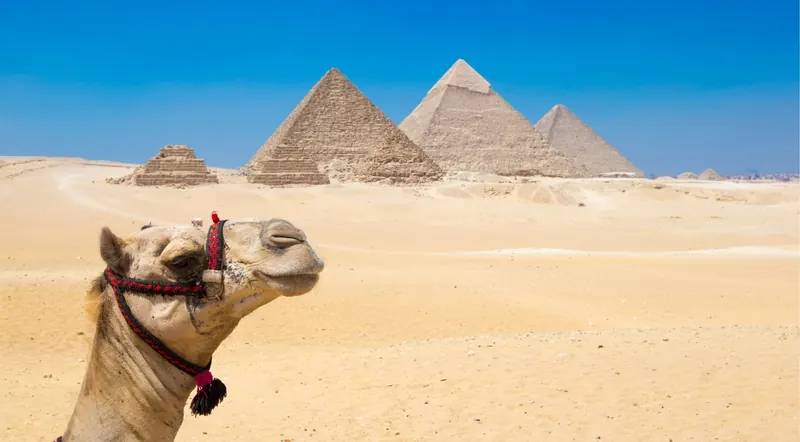
The Pyramids of Giza are the last surviving Wonder of the Ancient World — three colossal royal tombs raised for the pharaohs Khufu, Khafre and Menkaure during Egypt’s Fourth Dynasty (c. 2600–2500 BC), standing on a desert plateau on the western edge of Greater Cairo. This guide is the definitive resource on what they are, why they matter, and everything you need to know to visit them well. If you are staying on the Red Sea coast and planning the journey, pair this with our dedicated Hurghada to the Pyramids of Giza day trip guide and our broader Cairo day trip planner.
Prices, hours and the shuttle system are revised often — always verify current details on egymonuments.com close to your travel date.
TL;DR
- The Pyramids of Giza are three Old Kingdom royal tombs — the Great Pyramid of Khufu (originally 146.6 m, the tallest structure on Earth for nearly 3,800 years), the Pyramid of Khafre (which only looks tallest because it sits on higher bedrock and keeps casing at its apex), and the smaller Pyramid of Menkaure — set within a vast necropolis of queens’ pyramids, mastaba cemeteries, temples, boat pits and the Great Sphinx.
- They are in Giza, not central Cairo — on the west bank of the Nile, roughly 13–20 km from downtown, on the edge of the Western (Libyan) Desert. Since 2025 the plateau has a new main gate on the Fayoum Road, an electric shuttle system and an online ticketing platform; verify current pricing and hours before booking.
- They were built by paid, well-fed Egyptian labourers, not slaves — a fact proven by Mark Lehner and Zahi Hawass’s excavation of the workers’ village and cemetery. Go early, buy interior tickets in advance, cross-link your logistics to our transport articles, and give yourself at least half a day.
Key Findings
- The Great Pyramid contains an estimated 2.3 million blocks and was completed to a base so precise that, per Smarthistory, “the greatest difference in length among the four sides of the pyramid is a mere 4.4 cm (1¾ inches) and the base is level within 2.1 cm.”
- The plateau is a UNESCO World Heritage Site, inscribed in 1979 (reference 86, criteria i, iii, vi) as part of “Memphis and its Necropolis – the Pyramid Fields from Giza to Dahshur.”
- A May 2024 satellite study led by Eman Ghoneim identified the Ahramat Branch, a ~64-km buried arm of the Nile that once flowed past 31 pyramids, helping explain how stone was transported.
- The controversial 2024 plan to re-clad the Pyramid of Menkaure in granite was halted after an international outcry; the pyramid remains as it was.
- The Tomb of Queen Meresankh III, one of the most beautiful painted tombs on the plateau, is accessible to visitors and is the highlight most people miss.
- Current interiors, shuttle arrangements, opening hours and ticket prices change frequently — always confirm on the official platform (egymonuments.com) close to your travel date.
What and Where: Orientation
Giza is a city in its own right
One of the most persistent misunderstandings is that the pyramids are “in Cairo.” They are not. They stand in Giza (al-Jiza), a separate city and the capital of Giza Governorate, on the west bank of the Nile. Cairo proper sits on the east bank. Both are part of the sprawling Greater Cairo metropolitan area, which is why the two names are used almost interchangeably in casual speech — but administratively and geographically they are distinct. The plateau lies roughly 13–20 km from central Cairo depending on your starting point, close enough that the modern suburb of Nazlet el-Semman laps right up against the archaeological fence. The famous contrast — ancient monuments abutting a modern metropolis — is real and often startling to first-time visitors.
The plateau itself sits on the edge of the Western Desert, part of the great Libyan Desert and, beyond it, the Sahara. The ancient Egyptians deliberately built their tombs on the west bank, the land of the setting sun and the realm of the dead. Step a few hundred metres beyond the pyramids and the city vanishes; you are on the lip of a limestone plateau that rolls away into open sand.
The Giza Necropolis and its World Heritage status
The three great pyramids are only the headline act. The Giza Necropolis is a complete funerary landscape: subsidiary queens’ pyramids, satellite pyramids, vast mastaba cemeteries for nobles and officials, mortuary and valley temples, causeways, boat pits and the Great Sphinx.
The whole area was inscribed on the UNESCO World Heritage List in 1979 under the title “Memphis and its Necropolis – the Pyramid Fields from Giza to Dahshur” (reference 86), meeting cultural criteria (i), (iii) and (vi). The inscription covers a serial property stretching from Giza in the north through Abusir, Saqqara and Dahshur — the cemeteries of the ancient capital of Memphis.
Getting there from central Cairo (brief)
From central Cairo you have several options: Cairo Metro Line 2 to Giza station followed by a taxi or microbus; a metered taxi or ride-hail (Uber/Careem) direct to the gate; or an organised tour. For the full journey from the Red Sea coast — including the plane-versus-bus decision — see our Hurghada–Cairo transport comparison and the day-trip mechanics guide. Most Hurghada visitors arrive as part of a tour, which removes the navigation problem entirely.
The Three Main Pyramids
Comparison at a glance
| Pyramid | Builder / dynasty | Date (approx.) | Original height | Current height | Base length | Can you enter? | Notes |
|---|---|---|---|---|---|---|---|
| Great Pyramid | Khufu (Cheops), 4th Dynasty | c. 2600 BC | 146.6 m | ~138.5 m | ~230.3 m | Yes (separate ticket, limited daily slots) | Only surviving Ancient Wonder; tallest structure on Earth for ~3,800 years |
| Khafre | Khafre (Chephren), 4th Dynasty | c. 2550 BC | 143.5 m | ~136.4 m | ~215.3 m | Yes (separate ticket) | Retains casing at apex; looks tallest due to higher bedrock |
| Menkaure | Menkaure (Mycerinus), 4th Dynasty | c. 2510 BC | 65.5 m | ~61 m | ~102–108.5 m | Yes (often, but check) | Smallest; granite-clad lower courses; gash on north face |
The Great Pyramid of Khufu
The Great Pyramid — known to the Egyptians as Akhet Khufu, “The Horizon of Khufu” — is the oldest and largest of the three, and the reason the site is world-famous. Built around 2600 BC for the Fourth-Dynasty pharaoh Khufu (whom the Greeks called Cheops), it originally rose to 146.6 metres (481 feet) and remained the tallest human-made structure on Earth for more than 3,800 years — until it was surpassed in 1311 by the 160-metre central tower of Lincoln Cathedral in England. Stripped of most of its outer casing, it now stands at about 138.5 metres.
The scale is difficult to overstate: an estimated 2.3 million blocks, a total mass often estimated at around 5.75 million tonnes, and a base whose four sides differ in length by only about 4.4 cm — a precision Flinders Petrie famously compared to “opticians’ work… but on a scale of acres.” The base is level to within about 2.1 cm across its entire footprint.
Inside are three principal chambers: an unfinished Subterranean Chamber cut into the bedrock; the misnamed Queen’s Chamber; and the granite-lined King’s Chamber, which houses a lidless granite sarcophagus and is reached via the corbelled Grand Gallery. Above the King’s Chamber sit five relieving chambers, in which 19th-century explorers found painted “gang” graffiti bearing Khufu’s name — crucial evidence for dating the monument. The pyramid’s presumed architect was Khufu’s vizier, Hemiunu. For a full account of climbing inside — the steep passages, the ticketing, whether it is worth it — see our dedicated guide, Inside the Great Pyramid.
The Pyramid of Khafre
The second pyramid, built for Khufu’s son Khafre (Chephren) around 2550 BC, plays a famous optical trick: it appears taller than the Great Pyramid even though it is not. Its original height was about 143.5 m (against Khufu’s 146.6 m), but it sits on bedrock some 10 m higher, and — crucially — it retains a cap of smooth Tura-limestone casing at its apex, the single most photographed detail on the plateau. That surviving casing gives visitors the clearest surviving impression of how all three pyramids once looked: gleaming, smooth-sided and blinding white in the sun.
Khafre’s complex is the best preserved of the three. A long causeway (nearly 500 m) runs down from the mortuary temple on the pyramid’s east side to the superbly preserved Valley Temple, built from megalithic limestone core blocks sheathed in red Aswan granite, with a T-shaped hall of monolithic granite pillars and an alabaster floor. It was here that a diorite statue of Khafre with the Horus falcon enfolding his head was recovered — now a treasure of the Egyptian collections. Five boat pits were found around the complex. The Great Sphinx stands beside Khafre’s causeway and is generally attributed to his reign — we cover it in depth in Pyramids and Sphinx combined tours and our Great Sphinx of Giza guide.
The Pyramid of Menkaure
The third and smallest of the great pyramids belongs to Menkaure (Mycerinus), Khafre’s son or successor, built around 2510 BC. Its base area is less than a quarter of its neighbours’, and it originally rose only about 65.5 m. It is distinctive for its casing: whereas Khufu and Khafre used limestone, Menkaure’s lower courses were clad in red Aswan granite, shipped over 800 km down the Nile. Construction of the granite casing was halted — probably at the king’s death — after only 16 to 18 courses had been laid, of which about seven survive; much of the granite was left “in the rough,” never dressed. Incomplete work like this is a gift to archaeologists, revealing the sequence of finishing that a completed pyramid would hide.
The most conspicuous scar is the large vertical gash on the north face. This dates to around AD 1196, when al-Malek al-Aziz Uthman, a son of Saladin, ordered the Giza pyramids demolished. His workmen began with Menkaure’s, but after some eight months of labour — removing only one or two blocks a day — the task proved so ruinously expensive and slow that it was abandoned. The gash is all they achieved.
In January 2024, an Egyptian-Japanese mission announced a project to study and eventually re-install fallen granite casing blocks around the base — a scheme the then head of the Supreme Council of Antiquities, Mostafa Waziri, called “the project of the century.” It provoked an immediate international outcry, with Egyptologists comparing it to “straightening the Tower of Pisa” and warning it violated international restoration principles. On 16 February 2024, the Menkaure Pyramid Review Committee, chaired by Zahi Hawass, stated it “has unanimously objected to the reinstallation of the granite casing blocks, scattered around the base of the pyramid since thousands of years ago,” and the plan was shelved. As of this guide’s publication the pyramid remains unaltered — but verify the status if it matters to your visit.
Other Experiences You Might Enjoy
Giza is only the start of what the Red Sea coast can reach. The same plateau holds the Great Sphinx, the Grand Egyptian Museum with Khufu’s solar boat and the Tutankhamun galleries, and — a short drive away — the bazaars of Old Cairo and a Nile felucca sail. Many travellers pair the plateau with a wider Cairo day, or extend into the Egyptian Museum’s mummies and treasures downtown.
The Wider Necropolis: What Else Is Up There
Most day-trippers photograph the three pyramids and the Sphinx and leave. They miss the richest parts of the site.
The queens’ pyramids
Small subsidiary pyramids cluster beside the two largest monuments. East of the Great Pyramid stand three queens’ pyramids (G1-a, G1-b, G1-c), traditionally associated with Khufu’s mother Hetepheres I and consorts including Meritites I and Henutsen. A small fourth “satellite” pyramid (G1-d) was rediscovered in 1992. South of Menkaure’s pyramid stand its own three subsidiaries (G3-a, G3-b, G3-c), all left unfinished.
The Tomb of Queen Meresankh III — the highlight most visitors miss
If you do one “extra” on the plateau, make it this. The mastaba tomb G7530-7540 in the Eastern Cemetery belonged to Queen Meresankh III, granddaughter of Khufu and wife of Khafre. Excavated by George Reisner’s Harvard expedition in 1927 and opened to visitors in 2012, it is one of the most beautiful and best-preserved painted tombs at Giza. Its rock-cut chapel retains vivid wall scenes of agriculture, hunting, fishing, boats and craftsmen, and a remarkable niche containing ten large statues of royal women carved from the rock. Note that only a small number of the site’s hundreds of tombs are open to visitors at any one time; access to Meresankh’s tomb usually requires a separate ticket and can change — confirm on arrival.
The Eastern and Western Cemeteries
Flanking the Great Pyramid are two vast fields of mastaba tombs — flat-roofed, bench-shaped superstructures over burial shafts — laid out in neat streets for Khufu’s family (Eastern Cemetery) and his highest officials (Western Cemetery). This is one of the earliest examples of urban-style planning applied to a cemetery anywhere in the world.
The Workers’ Village and Cemetery
South-east of the plateau, at a site called Heit el-Ghurab (“Wall of the Crow”), lies one of the most important Egyptological discoveries of the last half-century. From 1988, Mark Lehner (with Ancient Egypt Research Associates) and Zahi Hawass excavated a planned settlement of barracks, bakeries, breweries, fish-processing areas, workshops and storage silos, together with a nearby workers’ cemetery.
The evidence overturned the ancient myth that slaves built the pyramids. Analysis of some 175,000 animal-bone fragments shows the workers ate a high-protein diet of cattle, sheep, goats, fish, bread and beer — better than most ordinary Egyptians — with animals driven in from the Delta specifically to feed them. Skeletons show healed fractures and evidence of medical care. And, decisively, the workers were buried in their own tombs at Giza with funerary honours, beside the kings they served — a privilege no slave would ever have received. As Hawass puts it, “If they had been slaves, they would never have been buried at Giza.” The consensus estimate is a permanent skilled core supplemented by rotating crews, totalling perhaps 20,000–25,000 at peak, organised into named gangs and phyles — the same team names that appear as graffiti in the Great Pyramid’s relieving chambers (“Friends of Khufu”).
The Wall of the Crow
The Heit el-Ghurab (“Wall of the Crow”) itself is a colossal ancient stone wall with a monumental gateway, separating the sacred plateau from the workers’ town. It is one of the largest surviving walls from the Old Kingdom.
The boat pits and Khufu’s solar boats
Around the Great Pyramid are several boat pits. In 1954, one yielded the astonishing Khufu solar boat — a cedar vessel over 40 metres long, dismantled into more than 1,200 pieces and reassembled over years without a single nail, intended to carry the king’s soul across the heavens. For decades it was displayed in a museum beside the pyramid. In August 2021 it was moved — inside a climate-controlled cage on a Belgian-built remote-controlled transporter — to the new Grand Egyptian Museum (GEM), where it is now a centrepiece. A second Khufu boat, extracted in around 1,650 pieces from 2021, is being reassembled, with parts of the work visible to the public at the GEM. The old on-site Solar Boat Museum has closed.
The Sphinx (brief)
The Great Sphinx — a recumbent lion with a human head, carved from a single limestone outcrop and generally dated to Khafre’s reign — guards the eastern edge of the plateau beside its own Sphinx Temple. Because we cover it in full elsewhere, we keep it brief here: see Pyramids and Sphinx combined tours and the Great Sphinx of Giza guide.
Recent discoveries (2020–2026)
Giza remains an active research site. In March 2023, the international ScanPyramids team confirmed a previously hidden corridor on the north face of the Great Pyramid, behind the chevron of stones above the original entrance, using cosmic-ray muon radiography and endoscopy. Published in Nature Communications (Procureur, Morishima et al.), the ScanPyramids North-Face Corridor measures 9.06 metres long, 2.02 m wide and 2.18 m high, located 17–23 m above ground; its function is still unknown. In 2024, the Ahramat Branch Nile study reframed our understanding of how the site was supplied (see below). More recently, non-destructive scans have detected anomalies/voids behind the granite of Menkaure’s pyramid, prompting speculation about a possible hidden entrance — but these remain unconfirmed hypotheses, not established discoveries. Treat any breathless “hidden chamber” headline with caution until peer-reviewed confirmation follows.
Construction: How They Were Actually Built
The labour force
Forget the whip-cracking overseers of Hollywood. The current scholarly picture, built on the workers’ village evidence, is of an organised, state-supported workforce: a permanent core of skilled craftsmen plus large rotating crews of conscripted or volunteer labourers — many likely serving during the annual Nile flood, when farming paused. They were organised into gangs subdivided into phyles, and they left their team names daubed in red paint inside the pyramid. Egyptologist Miroslav Verner cites a consensus figure of a little over 30,000 people involved overall; Lehner’s estimate for those on site at any one time is lower, around 20,000–25,000.
Quarrying
The bulk of each pyramid is local limestone, quarried directly from the plateau — you can still see the quarries. The fine white outer casing was Tura limestone, from quarries on the Nile’s east bank. The heaviest structural elements — the King’s Chamber beams and Menkaure’s casing — were red and grey granite from Aswan, over 800 km to the south. Some King’s Chamber granite blocks weigh 25–80 tonnes.
Transport: the lost river, the Merer papyri
How did they move it all? Two lines of evidence converged spectacularly in the last decade.
First, in 2013, French archaeologist Pierre Tallet discovered the world’s oldest inscribed papyri at the Red Sea harbour of Wadi al-Jarf. Among them was the Diary of Merer, the logbook of an inspector who, around the 26th–27th year of Khufu’s reign, led a team of about 200 men ferrying Tura limestone by boat to Akhet-Khufu — the Great Pyramid — via the Nile and a network of canals, a round trip of a couple of days. It is the only contemporary eyewitness account of the Great Pyramid’s construction ever found.
Second, in May 2024, a study led by Eman Ghoneim of the University of North Carolina Wilmington, published in Communications Earth & Environment, mapped the Ahramat Branch — a roughly 64-km-long, long-buried arm of the Nile that once flowed along the foot of the Western Desert plateau, past 31 pyramids. As the study title puts it, “The Egyptian pyramid chain was built along the now abandoned Ahramat Nile Branch.” The pyramids’ causeways terminate at valley temples that acted as river harbours on this branch. The river’s later eastward migration and silting-up, linked to drought around 4,200 years ago, left the pyramids stranded in what is now desert. Together, Merer and the Ahramat Branch make the transport puzzle far less mysterious than it once seemed.
Ramp theories
The single biggest open question is how blocks were raised. The main candidates are: a straight external ramp; a spiralling external ramp wrapping the pyramid; and the internal spiral ramp proposed by French architect Jean-Pierre Houdin (with Egyptologist Bob Brier). Houdin argues the lower third was built with a conventional external ramp, after which construction switched to a ~1.8-m-wide ramp of about 7% grade running just inside the outer walls, with cranes at open corner notches to turn the blocks. His strongest cited evidence is a 1986 microgravimetry survey whose anomaly, when re-examined, appeared to show a spiral structure, plus a real notch on the north-east corner. Mainstream Egyptologists remain sceptical to dismissive — UCL’s David Jeffreys called it “far-fetched and horribly complicated,” and the theory is unproven; recent muon scans have not confirmed it.
A concrete data point arrived in 2018, when a French–British team working at the Hatnub alabaster quarry uncovered a 4,500-year-old ramp dating to Khufu’s reign, flanked by two staircases lined with postholes. Sleds carrying stone were hauled up slopes of 20% or more using ropes tied to wooden posts as force-multipliers — proof that Egyptians of Khufu’s era could move heavy blocks up steep gradients, though the Hatnub ramp is much smaller than any pyramid ramp would need to be.
Levelling and true-north alignment
The precision is the real marvel. The Great Pyramid is aligned to true north with an average deviation of only about 3.6 arcminutes — roughly one-fifteenth of a degree — making it the most accurately cardinally-oriented large ancient structure known. Khafre’s pyramid is off by about 5.7 arcminutes; Menkaure’s, less accurately, by around 14 arcminutes and in the opposite (clockwise) sense.
How they achieved this is genuinely unsettled. The most influential proposal is Kate Spence’s 2000 paper in Nature, which suggested surveyors found true north by the “simultaneous transit” of two circumpolar stars — Kochab (in Ursa Minor) and Mizar (in Ursa Major) — reading north off a plumb line when the two stars aligned vertically. The idea doubles as a dating tool, because precession slowly shifts the error. It has been vigorously contested (Rawlins and Pickering argued in Nature for a different star pair; Belmonte proposed Megrez and Phecda), and researcher Glen Dash argues the evidence “neither confirms nor refutes” it, favouring instead a solar gnomon (shadow) method using an equinox shadow to find an accurate east–west line. There is, in short, no consensus — only well-argued competing hypotheses.
Timeframe and what we still don’t know
Herodotus recorded a 20-year construction; modern estimates for the Great Pyramid cluster around 20 years or slightly less, consistent with the Merer papyri, which show finishing work underway late in Khufu’s reign. What we still don’t know for certain: the exact ramp system, the exact method of alignment, the precise labour organisation, and — tantalisingly — what, if anything, lies behind the newly detected voids.
Planning the logistics from the coast? Our day-trip guide covers timings, and our tour-choosing guide helps you pick a reputable operator. Reputable guided tours can be booked online in advance — always check recent reviews and confirm what’s included.
The Pyramids as a Wonder: A History of Their Reception
The last Wonder standing
Of the Seven Wonders of the Ancient World listed by Hellenistic writers, the Great Pyramid is the oldest and the only one still substantially intact. It was already ancient — some 2,000 years old — when classical tourists came to gawp.
Herodotus and the classical accounts
The Greek historian Herodotus visited around 450 BC and gave us the earliest surviving description — and much of the enduring misinformation. He correctly attributed the Great Pyramid to Khufu (“Cheops”) but dated his reign wildly wrong, painted the king as a tyrant, and reported that 100,000 men laboured in three-month shifts over 20 years. His priestly informants, unable to read the by-then-archaic hieroglyphs, appear to have fed him tall tales (including a famous inscription supposedly recording the workers’ radishes, onions and garlic). Later writers, and eventually the conflation with the biblical Exodus, hardened Herodotus’s “monuments of tyranny” framing into the slave myth that the archaeology has now demolished.
Medieval Arab accounts and the stripping of the casing
For centuries the pyramids gleamed under smooth white Tura-limestone casing. A massive earthquake on 8 August 1303 loosened much of it, and over the following decades Cairo’s builders quarried the fallen stone for mosques, walls and fortifications — Sultan al-Hasan reportedly using it for his great mosque, and Muhammad Ali Pasha taking more in the early 19th century. This is why the pyramids today show their stepped limestone core rather than their original polished faces — and why Khafre’s surviving apex casing is so precious. Medieval Arab scholars such as Abd al-Latif al-Baghdadi left valuable eyewitness descriptions, including of the casing and the Sphinx’s then-intact nose.
Napoleon’s savants and the birth of Egyptology
Napoleon’s 1798 expedition brought a corps of scholars (“savants”) whose monumental Description de l’Égypte helped launch modern Egyptology and ignited European fascination with ancient Egypt.
The 19th-century excavators
In 1837, Colonel Richard Howard Vyse and engineer John Shae Perring used gunpowder to force their way into the Great Pyramid’s upper relieving chambers, where they found the “gang” graffiti bearing Khufu’s cartouche — the key evidence dating the pyramid to the Fourth Dynasty. Half a century later, Flinders Petrie, the “father of scientific Egyptology,” brought rigorous surveying and measurement to Giza, establishing the precise dimensions and casing tolerances still cited today.
Modern archaeology
Twentieth- and twenty-first-century work — Reisner’s mastaba excavations, Lehner and Hawass’s workers’ village, the ScanPyramids muon surveys, Tallet’s Wadi al-Jarf papyri and Ghoneim’s Ahramat Branch — has transformed the pyramids from objects of romantic speculation into one of the best-documented construction projects of the ancient world.
Practical Visiting Information
This section is deliberately concise where we cover a topic in depth elsewhere — follow the cross-links.
Opening hours
The Giza Plateau is open daily, year-round, from 7:00 AM with last entry at 4:00 PM (widely reported to close around 5:00 PM). During Ramadan (approximately February–March in 2026), hours shorten to an 8:00 AM opening with last entry at 3:30 PM. Official guidance is to arrive at least an hour before closing; in practice, allow far longer. Because seasonal and Ramadan timings shift, always confirm on egymonuments.com close to your visit — and note Ramadan dates move each year with the lunar calendar.
The ticketing system
Tickets are sold online via the official platform egymonuments.com and at machines at the gate. The structure is a general plateau-entry ticket plus separate add-on tickets for interiors (the Great Pyramid, Khafre, Menkaure), the Tomb of Meresankh III, the Workers’ Cemetery and other extras. Great Pyramid interior tickets are capped daily and sell out, especially from October to April — buy ahead. Entry is generally single-entry, so plan your route before you go in. We keep prices qualitative by policy: verify current pricing before booking, as fees are revised regularly. For a deeper dive, see Inside the Great Pyramid.
The 2025 plateau redevelopment (brief)
The visitor experience changed more in the last year or two than in the previous fifty. Since April 2025, the main entrance moved to a new “Great Gate” on the Fayoum Desert Road (replacing the old Mena House entrance), private cars and tour buses are banned inside the complex, and visitors move between monuments on electric shuttle buses, with premium golf-cart options available. A new visitor centre, cafés and cleaner facilities have been added. We cover the new system, and how it affects a day trip, in detail in the Hurghada-to-Pyramids day-trip guide.
How long to spend
Give the plateau a minimum of 3–4 hours; a half-day is comfortable, and adding the interior of a pyramid, the Meresankh tomb and the Sphinx can fill most of a day. If you are combining with the Grand Egyptian Museum next door, plan a full day and start early.
Best time of day and year
Arrive at opening (7:00 AM) — the first 90 minutes are the coolest, clearest and least crowded, and large tour groups reliably arrive from around 9:00–10:00 AM. For climate, the cooler months (roughly October to April) are far more comfortable than the fierce summer heat; see our best time to visit guide. Late afternoon offers warmer photographic light but shorter remaining time before last entry.
What to wear and bring
Wear closed-toe shoes (the terrain is sand, loose rock and uneven limestone), sun protection (hat, sunglasses, high-SPF), and modest, breathable clothing in keeping with local norms. Bring plenty of water, some cash for tips and extras, and a head-torch if you plan to go inside a pyramid (the passages are steep, low and warm). Those prone to claustrophobia should read Inside the Great Pyramid before committing to an interior ticket.
Facilities and accessibility
The 2025 upgrades added cafés, toilets and a visitor centre. The plateau is, however, large, sandy and undulating, and the pyramid interiors are not accessible to those with limited mobility (steep, cramped passages with no lifts). The shuttle system helps considerably with distances. We summarise accessibility in the day-trip guide.
Safety and scams (brief)
Giza’s touts are persistent rather than dangerous: expect offers of camel rides, “free” souvenirs that aren’t, unofficial “guides” and photo hustles. Agree any price in advance and in writing/on a calculator, ignore unofficial “ticket helpers,” and buy tickets only at official windows or online. Camel and horse welfare is a genuine concern worth keeping in mind before agreeing to a ride. Fuller safety and scam coverage is in the Cairo day-trip pillar.
Viewpoints and Photography
- The Panorama Point — the classic viewpoint on the plateau’s south-western rise, reachable via the shuttle circuit, giving the “all nine pyramids” line-up (the three great pyramids plus the six smaller queens’ pyramids) with desert foreground.
- The Sphinx-and-pyramid alignment — from the area in front of the Sphinx you can frame the Sphinx with the pyramids rising behind; superb at sunset.
- The 9 Pyramids Lounge — the only restaurant actually on the plateau, set among the dunes south of Menkaure, with a memorable open view; reviews rate the setting far above the food, so treat it as a coffee-and-view stop. It closes in the late afternoon (last entry around 4:00 PM).
- Hotel and rooftop views — several hotels and rooftop cafés in Nazlet el-Semman (including the historic Mena House and various guesthouses) offer pyramid views; we describe these generically rather than recommending specific paid stays.
- Drones — drone photography is restricted and can lead to confiscation or fines; do not fly without confirming current permissions.
Common Questions and Misconceptions
Are the pyramids in the desert or in the city? Both, in a sense. They stand on the desert plateau, but the Giza suburb reaches right up to the fence — hence the famous contrast photo of the Sphinx with a KFC/Pizza Hut across the road. Walk to the western side and the city disappears; stand at the eastern edge and it’s right there.
How many pyramids are there in Egypt? Sources vary because the definition and preservation vary: commonly cited figures are between about 118 and 138 identified pyramids, with more possibly buried. What’s certain is “well over a hundred,” spread from Abu Rawash in the north to the Fayoum, over a building tradition spanning roughly a thousand years.
Were they built by slaves? No. The workers’ village and cemetery evidence — paid, well-fed labourers who received medical care and honoured burials — decisively refutes it. The slave myth traces largely to Herodotus and later conflation with the Exodus narrative.
Were they granaries, or built by aliens? No. The “granary” idea (a medieval European misreading, sometimes attributed to biblical Joseph) ignores the solid stone interiors and burial architecture. The “ancient aliens” claim is unsupported by any evidence and, frankly, sells short the documented ingenuity of a literate, organised, tool-using civilisation whose quarries, ramps, logbooks, workers’ town and unfinished works we can visit and read today.
Are they aligned with Orion? The Orion Correlation Theory, popularised by Robert Bauval from 1989 and later books, proposes that the three pyramids’ layout mirrors the three stars of Orion’s Belt. Mainstream archaeoastronomy rejects it: to make the map fit you must invert one image relative to the other, the fit is imprecise, Menkaure’s pyramid appears to have been an architectural afterthought rather than a pre-planned “third star,” and the stars’ positions have shifted through precession. The pyramids do show genuine, confirmed astronomical alignment — to true north — which is impressive enough without the mysticism.
FAQ
Where exactly are the Pyramids of Giza? On the west bank of the Nile in Giza, part of Greater Cairo, about 13–20 km from central Cairo, on the edge of the Western Desert.
Are the pyramids in Cairo or Giza? In Giza — a separate city and governorate on the opposite (west) bank of the Nile from Cairo proper, though both fall within the Greater Cairo metropolitan area.
How do I get from Cairo to the Giza pyramids? By taxi/ride-hail, Metro (Line 2 to Giza then onward transport), or an organised tour. From the Red Sea coast, see our Hurghada transport comparison.
Can you go inside the pyramids? Yes — the Great Pyramid, Khafre and (usually) Menkaure can be entered on separate, limited tickets. Great Pyramid interior slots are capped and sell out; buy ahead. See Inside the Great Pyramid.
Which pyramid should I go inside? The Great Pyramid for the “bucket-list” factor and the Grand Gallery; Khafre for a slightly easier climb and often shorter queues. Choose one to save time and energy.
How much do tickets cost? Pricing is revised regularly and we quote it qualitatively — a general plateau ticket plus optional add-ons for interiors and special tombs. Verify current pricing before booking on egymonuments.com.
What are the opening hours? Daily from 7:00 AM, last entry 4:00 PM (often closing around 5:00 PM); shorter hours during Ramadan (8:00 AM open, last entry 3:30 PM). Confirm before you go.
How long should I spend at the pyramids? At least 3–4 hours; a half to full day if you add interiors, the Meresankh tomb, the Sphinx and the neighbouring Grand Egyptian Museum.
What’s the best time of day to visit? Right at opening, 7:00 AM — coolest, clearest and quietest before the tour groups arrive mid-morning.
Why does Khafre’s pyramid look taller than the Great Pyramid? It sits on higher bedrock and keeps a cap of casing at its apex; measured, the Great Pyramid is taller.
Who built the pyramids, and were they slaves? Paid, organised Egyptian labourers — a skilled core plus rotating crews — who were well fed, given medical care and buried with honours. Not slaves.
How were the pyramids built? Local and imported stone was moved by river (confirmed by the Merer papyri and the buried Ahramat Nile branch) and raised by ramp systems (debated); the precise ramp and alignment methods remain open questions.
Is the Sphinx part of the same site? Yes — it stands beside Khafre’s causeway on the plateau. See Pyramids and Sphinx tours.
Can I fly a drone at the pyramids? Generally no — drones are restricted and risk confiscation. Confirm current rules first.
Is it worth visiting the Grand Egyptian Museum too? Absolutely — it’s next to the plateau and now houses Khufu’s solar boat and the Tutankhamun galleries.
Recommendations
- Book smart, and early. Reserve your Great Pyramid interior ticket in advance through the official platform (interior slots are capped and sell out October–April), and if you’re coming from Hurghada, book a reputable guided day trip well ahead — or the fly-in version if you’d rather skip the road — and compare products first in our tour-choosing guide. Benchmark: if interior tickets for your date already show “sold out” online, switch to Khafre’s interior or plan a dawn gate arrival.
- Start at opening. Aim to be at the Great Gate at 7:00 AM. The 90 minutes before the coach groups arrive are transformative for both comfort and photography.
- Don’t skip the “extras.” Budget time and a ticket for the Tomb of Meresankh III and, if open, the Workers’ Cemetery — they are the plateau’s most rewarding, least crowded corners.
- Pair it with the Grand Egyptian Museum. With the solar boat and Tutankhamun galleries now next door, treat Giza + GEM as a single full-day plan — see our one day in Cairo itinerary and Cairo day trips and excursions compared.
- Handle touts on your terms. Agree every price up front, buy tickets only from official channels, and read our Cairo day-trip guide on welfare and scams before you go.
- Verify the time-sensitive details. Hours, the shuttle arrangements, interior availability, Menkaure’s restoration status and ticket prices all change — confirm on egymonuments.com within a few days of travelling.
What would change this advice: if Egypt reintroduces vehicle access or alters the single-entry rule, or reopens/closes specific interiors or tombs, re-check the practical sections above before you travel.
Ready to see the last Wonder of the Ancient World? Browse and book a well-reviewed Pyramids of Giza day trip or guided plateau tour online, compare inclusions, and secure your date before the interior slots fill.
Caveats
- Prices and hours change frequently. We deliberately avoid quoting fees; always verify current pricing and timings before booking or travelling.
- The Menkaure re-cladding was halted in 2024, but antiquities policy can shift — confirm the pyramid’s status if it matters to you.
- “Hidden chamber” claims (the north-face corridor, Menkaure void anomalies) are at varying stages of confirmation; we’ve flagged what is peer-reviewed versus speculative.
- The alignment and ramp methods remain genuinely debated among specialists; we’ve presented competing hypotheses rather than a false consensus.
- Pyramid counts (≈118–138) vary by definition and ongoing discovery.
See the Pyramids of Giza — One Full Day from Hurghada
Join 7,000+ travelers who rated this Cairo day trip 4.6/5. Hotel pickup, air-conditioned transport, an expert Egyptologist guide, and lunch are all included. Free cancellation up to 24 hours before you go.
Check Availability & Book