Pyramids and Sphinx Combined Tours: What to Expect
What a pyramids and Sphinx tour really delivers: the Sphinx's history and mysteries, terrace access, photography, and advice for Hurghada day-trippers.
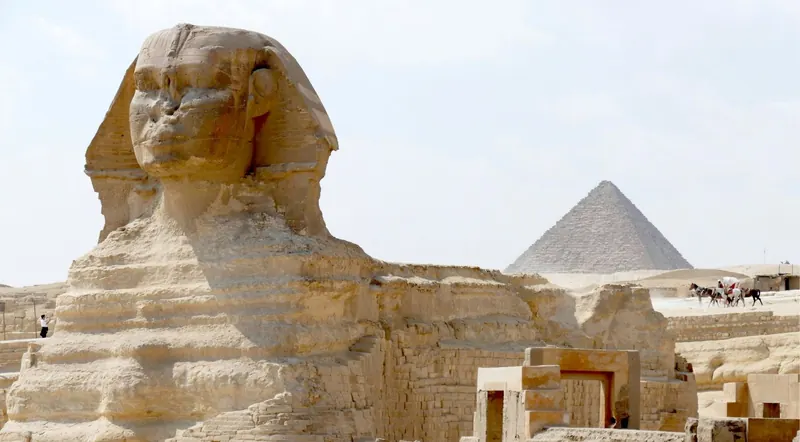
Almost every organised trip to Giza is sold as a “pyramids and Sphinx tour,” yet most visitors spend hours among the pyramids and barely twenty minutes with the Sphinx — usually at the end, from a fenced terrace, unable to get close or touch it. Understanding that reality in advance is the difference between a small disappointment and a genuinely moving encounter with one of the oldest monumental sculptures on Earth. This guide is the definitive resource on the Great Sphinx itself — its history, geology and mysteries — and on exactly how it is folded into a combined Giza tour, with specific advice for travellers coming on a long day trip from Hurghada.
If you are still planning the wider logistics of getting to Giza and back, start with our Cairo day trip from Hurghada overview and our Hurghada to the Pyramids of Giza day trip guide. This article focuses squarely on the Sphinx. Tour prices and departure times shift constantly, so check live availability before you build a day around one.
The Great Sphinx at a Glance
| Feature | Detail |
|---|---|
| Form | Recumbent (reclining) sphinx — lion’s body, human (royal) head |
| Length | About 73 metres (240 ft) from paw to tail |
| Height | About 20 metres (66 ft) from base to top of head |
| Width | About 19 metres across the haunches |
| Material | Single mass of natural bedrock limestone (Mokattam Formation) |
| Date | Old Kingdom, c. 2500 BCE (Fourth Dynasty) |
| Mainstream attribution | Pharaoh Khafre (Chephren) |
| Alternative attributions | Khufu (Stadelmann); Djedefre (Dobrev) |
| Faces | Due east, towards the rising sun |
| Arabic name | Abu al-Hol (“Father of Dread/Terror”) |
| Notable losses | Nose (missing before 1798); ceremonial beard (fragments in museums); royal cobra (uraeus) |
| Condition | Partially restored; carved from soft, layered limestone |
These headline figures derive from the detailed field survey by Egyptologist Mark Lehner, published in The Archaeology of an Image: The Great Sphinx of Giza (1991), still the standard reference. Verify any measurement quoted elsewhere against Lehner’s survey; popular sources vary between 73 and 73.5 m for length.
Other Experiences You Might Enjoy
The Sphinx is one stop on a plateau that sits inside a very full day. Around it are the Pyramids of Giza themselves, Khafre’s Valley Temple, the Grand Egyptian Museum just over a mile away, the Egyptian Museum in Tahrir Square, Old Cairo and the Khan el-Khalili bazaar, felucca sailing on the Nile, and day trips further afield to Luxor and the Valley of the Kings. Back on the coast, Hurghada fills the days either side with snorkelling, diving and desert safaris.
The Sphinx as a Monument: Origins, Geology and Attribution
The other articles in this series cover the plateau, the pyramids and the tour products. None of them cover the Sphinx as an object of history — so here is the depth that makes standing at that railing worthwhile.
Carved from living rock
The Sphinx is not built; it is carved. Ancient masons cut it in place from a single knoll of limestone left standing in a quarry depression, so it sits in an enclosure — a pit — below the general level of the plateau. This is why, from the viewing terrace, you look slightly down at it. The stone is the Mokattam Formation, laid down by an Eocene sea around 50 million years ago, and it is not uniform. Geologists (following the work of K. Lal Gauri) divide the Sphinx into three horizontal bands. Member I, the hard brittle rock of an ancient reef, forms the base and paws. Member II — the soft, flaky, alternating hard-and-soft layers of the body — is notoriously poor stone that erodes quickly. Member III, harder again, forms the neck and head. That geological accident explains the monument’s single most striking feature: the face has survived reasonably well while the body has been “ravaged by weathering,” in Lehner’s phrase, and has needed repeated patching for 3,400 years.
Who built it, and when
The mainstream Egyptological consensus is clear and well supported: the Sphinx belongs to the funerary complex of the Fourth Dynasty pharaoh Khafre (Chephren), around 2500 BCE. The evidence is contextual rather than a signed inscription — the Old Kingdom builders left no builder’s label — but it is strong. The Sphinx, the adjacent Sphinx Temple and Khafre’s Valley Temple share an alignment; the causeway of Khafre’s pyramid runs to the same complex; the core blocks of the temples appear to have been quarried from the very depression the Sphinx sits in; and Auguste Mariette’s discovery of superbly carved statues of Khafre in the Valley Temple in the 1850s tied the king to the site. Lehner and Zahi Hawass, the two archaeologists most associated with the Sphinx, both read it as Khafre’s.
Two serious minority views exist within Egyptology and deserve fair mention. Rainer Stadelmann, former director of the German Archaeological Institute in Cairo, argued on iconographic grounds — the style of the nemes headdress, the face — that the Sphinx depicts Khafre’s father Khufu, builder of the Great Pyramid. And in 2004 the French Egyptologist Vassil Dobrev proposed that Khafre’s half-brother Djedefre built it in the image of their father Khufu, to burnish the dynasty’s prestige. These are genuine, live debates about which Old Kingdom king — not about the era. Lehner himself allows a nuance: he concluded Khafre was responsible for most of the Sphinx while conceding “Khufu might have started it.”
Then there is the far more radical water-erosion hypothesis, associated with the independent researcher John Anthony West and the Boston University geologist Robert Schoch. They read the rounded, vertical weathering on the Sphinx enclosure walls as rainfall damage, requiring a monument many thousands of years older than the Old Kingdom — carved in a wetter climate around 7000–5000 BCE by an otherwise unattested civilisation. Egyptologists and most geologists reject this. The rounded profile is fully explained by the soft Member II limestone, salt crystallisation (haloclasty) drawing moisture through porous stone, and wind-and-sand abrasion over 4,500 years; geologists such as James Harrell attribute the patterns to the stone’s own layering. Crucially, no material culture — no tools, pottery or settlement — supports a lost pre-dynastic civilisation at Giza. The water-erosion theory is best described as a fringe hypothesis that has not been accepted by the scholarly mainstream. Present it to your fellow travellers as an interesting controversy, not as fact.
The 2023 “natural landform” experiment
A more recent and more respectable line of research asks a narrower question: did nature give the ancient sculptors a head start? In 2023, a team at New York University’s Applied Mathematics Laboratory led by Leif Ristroph published “Sculpting the Sphinx” in Physical Review Fluids (vol. 8, 110503, published 16 November 2023). Using a water tunnel to speed up erosion, they showed that a mound of soft clay with a harder core embedded in it, subjected to a steady flow, spontaneously develops a startlingly sphinx-like shape — a raised “head,” an undercut “neck,” an arched “back” and “paws” laid out in the flow’s wake. Their conclusion is modest and worth quoting accurately. As Ristroph, the study’s senior author, puts it: “Our findings offer a possible ‘origin story’ for how Sphinx-like formations can come about from erosion… surprisingly Sphinx-like shapes can, in fact, come from materials being eroded by fast flows.” The idea is that the Sphinx may have begun as a yardang — a wind-sculpted desert landform — that the Egyptians then detailed into a statue. This supports a 1981 suggestion by the geologist Farouk El-Baz. Ristroph is careful to add there is “no doubt that the facial features and detail work was done by humans.” It is a hypothesis about a starting point, not a challenge to the Old Kingdom date.
What Happened to the Sphinx: Losses, Restorations and Myths
Origins are only half the story. Almost everything a visitor notices at the railing — the missing nose, the patched body, the stele between the paws — belongs to the 4,500 years after the Sphinx was carved.
The missing nose: not Napoleon
The most persistent myth about the Sphinx is that Napoleon’s troops shot off its nose with a cannon during the 1798 Egyptian campaign. This is false, and the proof is documentary: the Danish naval captain and explorer Frederic Louis Norden sketched the Sphinx already noseless during his travels, in drawings published in his Voyage d’Égypte et de Nubie (1755) — decades before Napoleon set foot in Egypt. The best surviving explanation comes from the 15th-century Egyptian historian al-Maqrizi, who recorded that a Sufi named Muhammad Sa’im al-Dahr deliberately defaced the Sphinx in 1378, enraged that local peasants were making offerings to it for good harvests — an act of iconoclasm for which he was reportedly executed. Examination of the face shows chisel or rod marks consistent with deliberate destruction. Al-Maqrizi wrote decades after the event and no other contemporary record names Sa’im al-Dahr, so historians treat the attribution as probable rather than certain — but the one thing that is certain is that the nose was gone long before Napoleon.
The beard, the cobra and the colour
The Sphinx once had a plaited ceremonial “divine” beard and a royal cobra (uraeus) on its brow; both are gone. A fragment of the beard — about one-thirtieth of the whole — sits in the British Museum, presented by Giovanni Battista Caviglia, who found beard and uraeus fragments during his 1817 excavation; further fragments went to the Egyptian Museum in Cairo after the 1925–26 clearance. Scholars, including the British Museum’s own catalogue, doubt the beard was original: it was probably added during New Kingdom restoration (18th Dynasty) and later fell. Vassil Dobrev has pointed out that a falling original beard would have damaged the chin, and the lack of such damage supports the “later addition” theory. And the Sphinx was not the bare limestone we see today: flecks of pigment show the face was once painted red, with traces of yellow on the headdress and blue on the beard — Lehner describes it as once decked out in “gaudy comic-book colours.”
The Dream Stele between the paws
If you can see it — access to the enclosure floor is restricted — the pink granite slab standing between the Sphinx’s paws is the Dream Stele, erected by Pharaoh Thutmose IV around 1400 BCE. It tells how, as a prince, Thutmose fell asleep in the Sphinx’s shadow and dreamed that the monument — speaking as the god Horemakhet, “Horus in the Horizon” — promised him the throne if he cleared away the sand engulfing it. He did, and the stele records the deed: effectively the first documented monument restoration in history. Line 13 of the badly damaged text preserves a royal cartouche that most Egyptologists read as “Khaf[re],” which is why the stele is cited as evidence the New Kingdom Egyptians themselves associated the Sphinx with Khafre. The slab is itself reused — the lintel of a doorway from Khafre’s mortuary temple.
Buried, dug out, buried again
For most of its life the Sphinx was buried to its shoulders in sand — which, ironically, protected the soft body. Thutmose IV cleared it around 1400 BCE; the Romans cleared it again around 160 CE under Marcus Aurelius. In 1817 Caviglia and 160 workers made the first modern attempt but could not hold back the inflowing sand. Mariette cleared more in the 1850s; the French engineer Émile Baraize undertook major work from 1925 to 1936; and the Egyptian archaeologist Selim Hassan finally freed the whole monument in 1936–38. It has not been reburied since.
Restoration controversies
The Sphinx’s modern history is a cautionary tale about well-meaning conservation. Cement patching in the 1920s, and heavier cement-and-cladding campaigns in the 1970s and 1980s, did real harm: the hard modern cement was chemically incompatible with the soft ancient limestone and, worse, trapped and wicked salts that accelerated decay of the core. Hawass has called the 1980s work “the worst thing they could have done.” Matters came to a head in February 1988: as NOVA/PBS’s Saving the Sphinx records, “A 700-pound chunk of the right shoulder had fallen off in front of a startled German newspaper reporter,” witnessed by the then-Giza monuments inspector, Zahi Hawass. The fallout was severe — per Associated Press reporting, the fall cost “the country’s chief of antiquities his job,” and the Christian Science Monitor noted it “led to an international outcry, 10 months of debate, and the resignation of the Egyptian antiquities chairman.” The response was a decade-long, carefully documented restoration through the 1990s, guided by 1850s photographs and a stone-by-stone survey, using compatible limestone and lime mortar rather than cement, with the sculptor Adam Henein among the team. A rising water table — fed by sewage in a nearby canal — later emerged as a serious threat, addressed by a groundwater-lowering pumping system (built with USAID support, using around 18 wells) that Hawass credited with keeping “the Sphinx from getting its paws wet.”
The “Hall of Records” and hidden chambers
No account of the Sphinx is complete without the persistent legend of a hidden chamber beneath it. The idea traces largely to the American psychic Edgar Cayce, who in the 1930s claimed a “Hall of Records” containing the archives of Atlantis lay beneath the Sphinx’s paws, to be discovered in the late 1990s. Real science has poked around the question: seismic and ground-penetrating-radar surveys in the late 1970s and 1990s (including work by Thomas Dobecki) detected sub-surface anomalies near the paws. But subsequent narrow core-drilling around those anomalies found only natural voids and fissures — no chambers, no walls, no archive. There are three known tunnels associated with the Sphinx, all attributed to treasure-hunters or ancient quarrying rather than to a secret library. Hawass’s position is blunt: nothing resembling a Hall of Records has ever been found in or near the Sphinx.
In March 2025 a team of Italian and Scottish researchers (Corrado Malanga of the University of Pisa, Filippo Biondi of the University of Strathclyde, and Armando Mei) reignited the story with claims, based on Synthetic Aperture Radar (SAR), of a vast subterranean complex beneath the Khafre pyramid — shafts descending hundreds of metres — and, by March 2026, of a “second Sphinx” buried nearby. These claims are firmly rejected by mainstream science and should be treated as unverified. The physics is the core problem: radar waves attenuate rapidly in dense rock. The ground-penetrating-radar specialist Lawrence Conyers of the University of Denver told The Washington Times (27 March 2025) that in his extensive fieldwork he has “only been able to penetrate about 30 feet,” because “radar waves attenuate… there is going to be a limit to how deeply we can get these to penetrate,” dismissing the underground-city claim as “a huge exaggeration.” Hawass told The National the researchers were “completely wrong” and their claim “lacks any scientific basis,” while the former antiquities minister Mamdouh al-Damaty called it “utterly baseless.” The claims were made via press conference and podcast, not peer-reviewed publication — and the team’s earlier foundational 2022 SAR paper was formally retracted by the journal Remote Sensing on 10 August 2026 (Remote Sens. 2026, 18(16), 2679), after MDPI’s investigation cited “serious methodological flaws and statistical errors” undermining its conclusions. In short: there is no credible evidence of a second Sphinx or an underground city, and no legitimate newly opened “hidden” area at the Sphinx as of 2026.
Visiting the Sphinx in Practice
Where it sits
The Sphinx crouches at the eastern edge of the Giza Plateau, below the general plateau level, directly beside Khafre’s Valley Temple and the Sphinx Temple, and roughly in line with (but well downhill from) Khafre’s pyramid. It faces due east. On a standard plateau circuit that starts high up by the Great Pyramid, the Sphinx is the lowest and most easterly monument — which is exactly why it usually comes last (more on that below).
How close can you actually get?
This is the single most important expectation to set. You view the Sphinx from a raised viewing terrace on its northern and eastern side; you do not walk up to it, into the enclosure, or touch it. The enclosure is fenced. At the closest point of the terrace you are perhaps 30–40 metres back and slightly above it. Standing between the paws — the photograph everyone imagines — is not part of a normal visit; it requires special, pre-arranged permits that a handful of specialist operators secure at premium cost, and it is not something a Hurghada day-tripper will get. Make peace with the railing before you arrive and the encounter is far more rewarding.
The Sphinx Gate and 2026 ticketing
The plateau was overhauled in 2025 under a new operator, Orascom Pyramids Entertainment, working with the Supreme Council of Antiquities. The main entrance moved to a new visitor centre on the Fayoum (Al-Faiyoum) Road; private cars and tour buses are no longer allowed inside; and visitors move between monuments on electric hop-on, hop-off shuttle buses serving stops that include the Sphinx. Tickets are sold online. The historic Sphinx Gate on the east side still functions as a pedestrian entrance/exit in 2026, but it has no ticket office — you can only pass through it with a ticket already bought online, and in practice it is often used as an exit. Access to the Sphinx viewing terrace is included in the general plateau admission ticket; there is no separate “Sphinx ticket.” Verify current pricing and gate arrangements before booking, as the plateau’s management is still bedding in.
The two temples nobody looks at
Immediately beside the Sphinx stand two Old Kingdom temples included in your general admission and consistently ignored. Khafre’s Valley Temple is one of the best-preserved buildings of the Old Kingdom: massive limestone core blocks sheathed in polished pink Aswan granite, alabaster floors, and a T-shaped hall of monolithic granite pillars where 23 statues of Khafre once stood (Mariette found them here; the finest, Khafre with the falcon-god Horus, is a highlight of the Egyptian Museum). The granite joints are cut so precisely a knife blade barely enters. Right in front of the Sphinx sits the ruined Sphinx Temple, similar in plan, with a colonnaded court — probably dedicated to the sun. Give the Valley Temple ten minutes; it is the route by which many tours approach the Sphinx anyway, and it is genuinely extraordinary. Not every listing bothers to name it — the Cairo & Giza Highlights day tour from Hurghada is one that does, calling out the Great Sphinx and the Valley Temple together in its own highlights.
Photography: light, angles and the “kiss”
The Sphinx faces due east, so its face catches the best light in the morning; by mid-to-late afternoon the face falls into flatter light and you are shooting more into the sky. The classic composition is the Sphinx in profile with Khafre’s pyramid rising behind it — best from the terrace’s northern end. The forced-perspective “kissing the Sphinx” or “holding it up” photo is taken from the terrace: line yourself up side-on with your guide directing, and the distance does the trick. For a different angle entirely, the upper terraces of the fast-food outlets (the famous KFC/Pizza Hut building) and small hotels directly across from the Sphinx Gate on Abu al-Hol (“Sphinx”) Street in Nazlet el-Semman give an elevated Sphinx-and-pyramids panorama.
The Sound and Light Show
Each evening the plateau hosts a Sound and Light Show, staged facing the Sphinx: the monuments are floodlit in shifting colours while a narration — voiced in part by “the Sphinx” — tells the story of the pharaohs, over roughly 45–55 minutes, in a rotating schedule of languages. Reviews are consistent: the setting is spectacular, the script dated and theatrical. It is worth doing for first-time visitors with an evening in Cairo — but it runs after dark, and it is not feasible on a Hurghada day trip, which must be back on the road long before showtime. Skip it unless you are overnighting.
How Tours Combine Pyramids and Sphinx
The standard sequence — and why the Sphinx comes last
A typical guided Giza tour starts high on the plateau: the Great Pyramid of Khufu, then the panorama point for the classic three-pyramids shot (and camel or horse photos), past Khafre’s and Menkaure’s pyramids, and finally down to the Sphinx and Valley Temple at the eastern, lowest, most-easterly corner — from which many tours then exit via the Sphinx Gate. The Sphinx comes last for simple geography: it is downhill and at the edge, so it is the natural end of a descending loop. The practical consequence is that by the time you reach the Sphinx you may be tired, hot and running short of time — which is a big reason the Sphinx so often gets only 20–30 minutes.
What the shuttle system changes
Since 2025 the electric shuttles make hopping from the pyramids down to the Sphinx effortless compared with the old walk across open sand, and they include a Sphinx stop. That is good news for comfort. It does not change the sequencing logic, and on a guided tour your guide still controls the pace.
What a “pyramids and Sphinx tour” includes — and doesn’t
Typically included: hotel or ship pickup, transport, an Egyptologist guide, general plateau admission (which covers the Sphinx terrace, the Valley Temple and the Sphinx Temple), and time at the main pyramids. Typically extra and not included by default: entry inside any pyramid (a separate ticket — see our Inside the Great Pyramid guide), camel or horse rides, and lunch. Crucially, “visit the Sphinx” almost always means the viewing terrace, not enclosure access — read the fine print, because some listings blur this. For how to read tour listings and spot red flags, see our guide to choosing the right Cairo pyramids tour.
The Hurghada tours that actually include the Sphinx
Every Cairo day trip we track from the Red Sea coast puts the Sphinx terrace inside its general-admission entry — but they differ sharply in how much of the day is left by the time you reach it. In descending order of how early they get you onto the plateau:
- Hurghada: Cairo Day Trip by Flight, Pyramids, Sphinx & Museum — from $273, rated 4.9★ by 4,048 travellers. The Sphinx is named in the listing and the entrance fees for “Pyramids of Giza and Sphinx” are explicitly included. Flying replaces the pre-dawn drive, which is the single biggest lever on how much time and light you get at the railing. Details on our tour page.
- Hurghada: Full-Day Trip to Cairo by Plane — from $265, rated 4.8★ by 458 travellers, also flight-based, with Giza and Sphinx entrance fees included and a choice of museum. See our tour page.
- Hurghada to Cairo: Pyramids & Museum for First-Time Visitors — from $86, rated 4.8★ by 1,510 travellers. A small-group overnight coach run that lists “visit the Giza Pyramids and the Great Sphinx” among its highlights. See our tour page.
- From Hurghada: Cairo & Giza Highlights Day Tour — from $76, rated 4.6★ by 7,243 travellers, and the most-booked option on this site. Its highlights name the Great Sphinx and the Valley Temple specifically, which is unusual and worth having — most listings ignore the temple entirely. See our tour page.
Ratings, review counts and prices were checked on 25 August 2026 and move constantly — confirm them on the listing before booking.
Half-day versus full-day, and private versus group
A half-day Giza tour covers the pyramids and the Sphinx terrace and is the realistic option for a Hurghada road day trip once you factor in travel time. A full-day tour adds the Grand Egyptian Museum, Saqqara or Memphis, or a felucca — better if you are staying in Cairo, not day-tripping from the coast. Private tours give you control over pace: a good private guide can be asked to reach the Sphinx earlier or linger longer, whereas a large group runs on a fixed clock and the Sphinx is where the schedule is most often squeezed. At the Sphinx specifically, private makes little difference to access (everyone is on the same terrace) but a real difference to timing and interpretation.
Do Sphinx-only tours exist?
Essentially, no — and now you know why. The Sphinx sits inside the single ticketed Giza Plateau alongside the pyramids and temples, viewing takes well under an hour, and there is no separate Sphinx admission. It makes no commercial or logistical sense to sell a “cairo to Sphinx” trip that ignores the pyramids 500 metres uphill. Every credible product is a combined pyramids-and-Sphinx tour. If you see a “Sphinx-only” listing, it is really a general plateau ticket with a Sphinx-focused name.
Camel routes past the Sphinx
Camel and horse rides on the plateau generally loop across the desert edge for the panorama views rather than delivering you to the Sphinx itself; the Sphinx sits in its fenced enclosure at the built-up eastern edge, so animals don’t approach it closely. Treat a camel ride as a pyramids-and-desert experience, and see the Sphinx on foot from the terrace afterwards. On most Hurghada listings the camel or horse ride is an add-on paid separately rather than an inclusion — check the “what’s not included” list rather than assuming.
Ready to book? A well-run “pyramids and Sphinx” day trip with a licensed Egyptologist takes the guesswork out of the plateau’s new gate-and-shuttle system and makes sure the Sphinx gets more than a rushed photo stop. The fastest way onto the plateau from the coast is the fly-in Cairo day trip; the best value is the by-road Cairo & Giza Highlights tour. Both offer free cancellation, so you can lock in a date and stay flexible.
Common Disappointments — and How to Avoid Them
Forewarned is forearmed. The recurring complaints about the Sphinx are all about mismatched expectations:
- “It’s smaller than I imagined.” Photographs, shot from low angles, inflate it. At 20 m high it is impressive but not colossal beside the pyramids. Reframe: its power is in the face and its age, not its bulk.
- “It’s in a pit.” Correct — it sits in its quarry enclosure below plateau level, so you look down at it. This is a feature of how it was carved, not a letdown.
- “You can’t get close or touch it.” The terrace is as close as you get. Accept this in advance.
- “There’s a city right next to it.” Also true. The plateau borders the dense Cairo suburb of Nazlet el-Semman. Look west and you see desert and pyramids; turn around and you see apartment blocks, the Sphinx Gate street, and the KFC/Pizza Hut. The iconic photos are carefully framed to hide the urban side. This “urban Giza” reality surprises almost everyone — knowing it beforehand removes the sting.
- “We hardly had any time there.” The most fixable one. Because the Sphinx comes last, tired guides and tight schedules cut it short.
Specific Advice for Hurghada Day-Trippers
A Cairo day trip from Hurghada is a long, compressed day — whether you fly or take the road (compare them in our plane vs bus guide). That compression lands hardest on the Sphinx, because it is last on the plateau itinerary.
Two practical realities to plan around. First, road day trips typically reach Giza late morning or around midday, having left the coast before dawn — which is the worst window for the Sphinx: the flattering morning light on the east-facing face is fading, and the terrace is at its most crowded with the mid-day tour crush. If you are flying and can reach the plateau earlier, you get better light and thinner crowds. Second, build realistic expectations: 20–30 minutes at the Sphinx terrace is normal on a day trip, and that is genuinely enough to take it in, photograph it and glance at the Valley Temple — provided you are not expecting to get close.
Three things make the Sphinx portion of a Hurghada day trip work:
- Choose a private or small-group tour and tell the guide in advance that the Sphinx and Valley Temple matter to you, so they don’t compress them to nothing.
- Do your reading before you go (this article) so your limited minutes are spent looking, not being briefed.
- Manage the light — if your schedule allows any flexibility, ask whether the Sphinx can come slightly earlier in the loop for better face-on light.
For the broader mechanics of the plateau — the new Great Gate, the shuttle, touts, accessibility and photography rules — lean on our companion pieces: the Giza Plateau guide, the Hurghada to the Pyramids of Giza day-trip guide, the Cairo day trip from Hurghada pillar guide, our buyer’s guide to choosing a pyramids tour, the Inside the Great Pyramid guide and our best time to visit notes. For the full history of the plateau itself, see our complete Pyramids of Giza visitor guide; for what the Sphinx meant to the ancient Egyptians and what it’s like to actually stand in front of it, see our Great Sphinx of Giza guide.
Plan your Sphinx encounter now. If you’re staying in Hurghada, the easiest way to see the pyramids and the Sphinx without wrangling Cairo’s logistics is a ready-made day trip. Compare the Cairo day trips leaving from Hurghada, filter for a licensed guide and hotel pickup, and lock in a date — then use this guide to make the most of your minutes at the railing.
Frequently Asked Questions
Can you touch the Great Sphinx?
No. The Sphinx is fenced within its enclosure and viewed from a raised terrace roughly 30–40 metres away. Touching it is not permitted on a standard visit.
How close can you get to the Sphinx?
As close as the viewing terrace on its northern/eastern side allows — tens of metres, looking slightly down at it. You cannot enter the enclosure or stand between the paws without special, pre-arranged permits that ordinary tours do not include.
Who broke the Sphinx’s nose?
Not Napoleon — drawings by Frederic Louis Norden show it already noseless in the mid-1700s, before Napoleon’s 1798 campaign. The most reliable account, from the historian al-Maqrizi, blames a Sufi named Muhammad Sa’im al-Dahr, who reportedly defaced it in 1378 as an act of iconoclasm.
How old is the Sphinx?
Mainstream Egyptology dates it to around 2500 BCE (Fourth Dynasty), making it roughly 4,500 years old. Fringe “water-erosion” theories claim it is far older, but these are not accepted by the scholarly consensus.
Who built the Sphinx?
Most Egyptologists attribute it to the pharaoh Khafre. Minority scholarly views favour his father Khufu (Stadelmann) or his half-brother Djedefre (Dobrev). There is no builder’s inscription, so the attribution is contextual.
Is the Sphinx included in the pyramid tour ticket?
Yes. Access to the Sphinx viewing terrace, along with the adjacent Valley Temple and Sphinx Temple, is covered by the general Giza Plateau admission. There is no separate Sphinx ticket. Verify current pricing before booking.
Can you go inside the Sphinx?
No. The Sphinx is solid carved bedrock with no publicly accessible interior. The three known tunnels associated with it are attributed to treasure-hunters or quarrying and are not open to visitors.
Is there a Hall of Records under the Sphinx?
No confirmed chamber, archive or “Hall of Records” has ever been found. Seismic and radar surveys detected natural voids and fissures near the paws; drilling found nothing artificial. The 2025–2026 “underground city” and “second Sphinx” claims are unverified and rejected by mainstream experts.
What’s the best time to photograph the Sphinx?
Morning, when the low sun lights the east-facing face. By afternoon the face falls into flatter light. Early arrival also means thinner crowds on the terrace.
How long do tours spend at the Sphinx?
Often only 20–30 minutes, because the Sphinx is usually the last stop on a descending plateau circuit. That is enough to see and photograph it, but plan for it rather than being surprised.
Do Sphinx-only tours exist?
Not really. The Sphinx shares the single ticketed plateau with the pyramids, and viewing it takes under an hour, so every credible tour is a combined pyramids-and-Sphinx trip.
Why is there a city right next to the Sphinx?
The plateau borders the Cairo suburb of Nazlet el-Semman. One direction is open desert and pyramids; the other is a modern city. The famous photos are framed to show only the desert side.
See the Pyramids of Giza — One Full Day from Hurghada
Join 7,000+ travelers who rated this Cairo day trip 4.6/5. Hotel pickup, air-conditioned transport, an expert Egyptologist guide, and lunch are all included. Free cancellation up to 24 hours before you go.
Check Availability & Book